1894-2025+

History of the Religious Hospitallers of Saint Joseph in the United States

The Religious Hospitallers of Saint Joseph ventured into the United States to respond to requests from bishops who were sensitive to the need for hospital care for their vulnerable populations. The Religious Hospitallers came from Montreal, New Brunswick, and Ontario. They established several hospitals and oversaw the training of nurses. The story began in 1894 in Winooski, Vermont.

There are no longer any communities of Religious Hospitallers of St. Joseph in the United States of America.

VERMONT

WINOOSKI

Fanny Allen Hospital, 1894‑2020

ortrait of Sister Frances Margaret Allen, the first Religious Hospitaller of St. Joseph in the United States. Painting by Madeleine Delfosse, oil on canvas, 1944. Archives Department of the General Administration of the Religious Hospitallers of Saint Joseph.

At the request of Bishop John Michaud, five Religious Hospitallers of Saint Joseph from Montreal, including Mother Bonneau, the first Superior, arrived in Winooski on May 24, 1894, to care for the sick, poor, and most needy in Vermont. They transformed the former Dunbar Hotel into a hospital, which they named Fanny Allen Hospital, in honor of the first American sister of the Congregation.

ortrait of Sister Frances Margaret Allen, the first Religious Hospitaller of St. Joseph in the United States. Painting by Madeleine Delfosse, oil on canvas, 1944. Archives Department of the General Administration of the Religious Hospitallers of Saint Joseph.
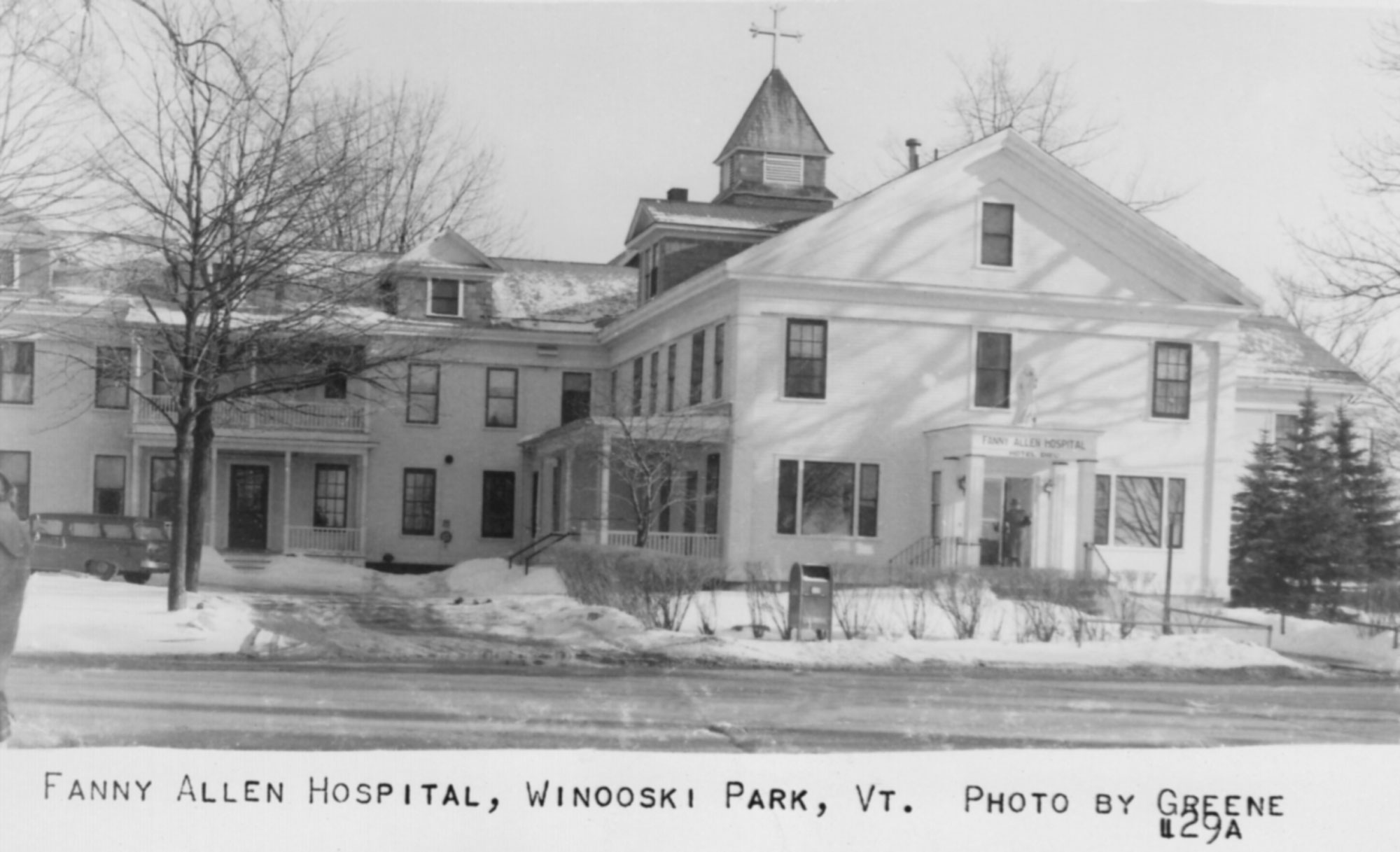
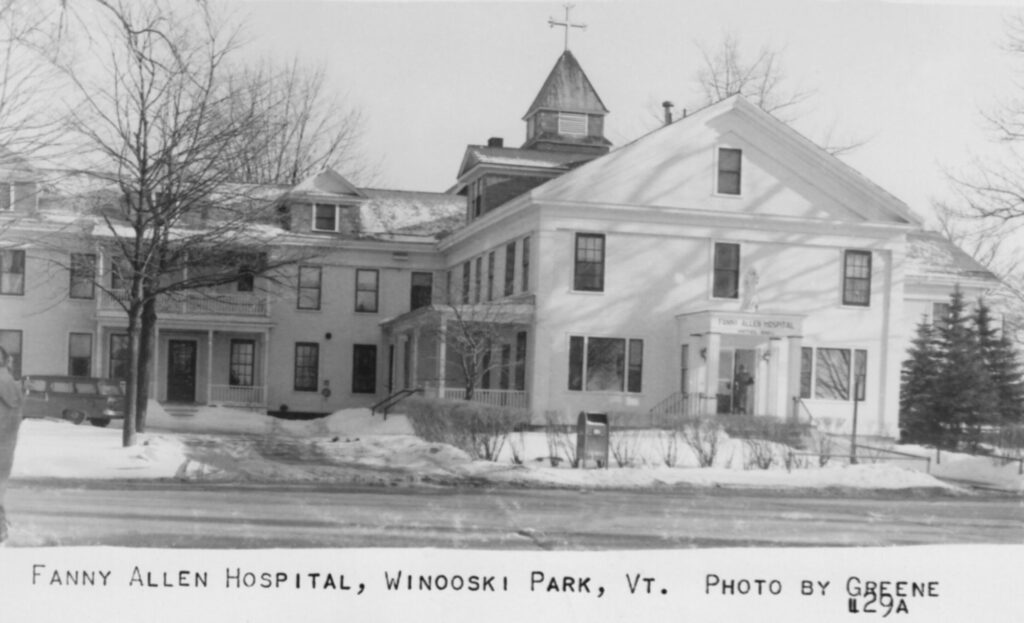
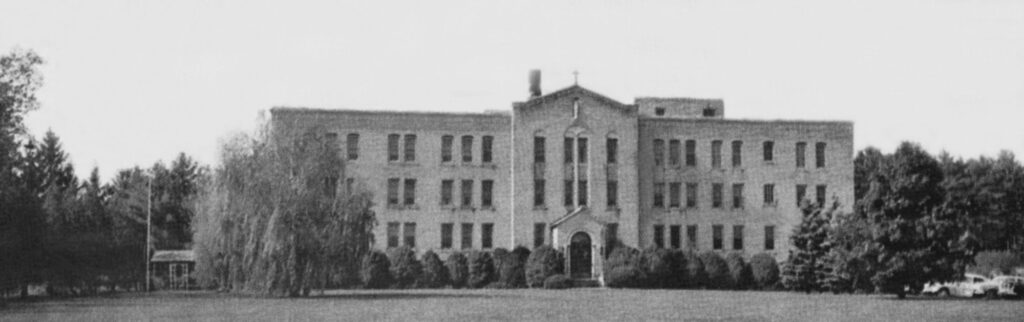
Fanny Allen Hospital in Winooski, Vermont, 1962. Source: The Archives of the Religious Hospitallers of St. Joseph of New Brunswick.

A new hospital was built in 1968, with subsequent expansions and addition of clinical services. In 1995, Fanny Allen Hospital merged with University Health Center, the Vermont Medical Center under the aegis of the University of Vermont, while retaining its Catholic heritage and presence. In 1996, Religious Hospitallers of St. Joseph and Covenant Health Systems became partners in the hospital. In 2008, the Religious Hospitallers transferred their partnership responsibilities to Covenant Health System.

Fanny Allen Hospital in Winooski, Vermont, 1962. Source: The Archives of the Religious Hospitallers of St. Joseph of New Brunswick.
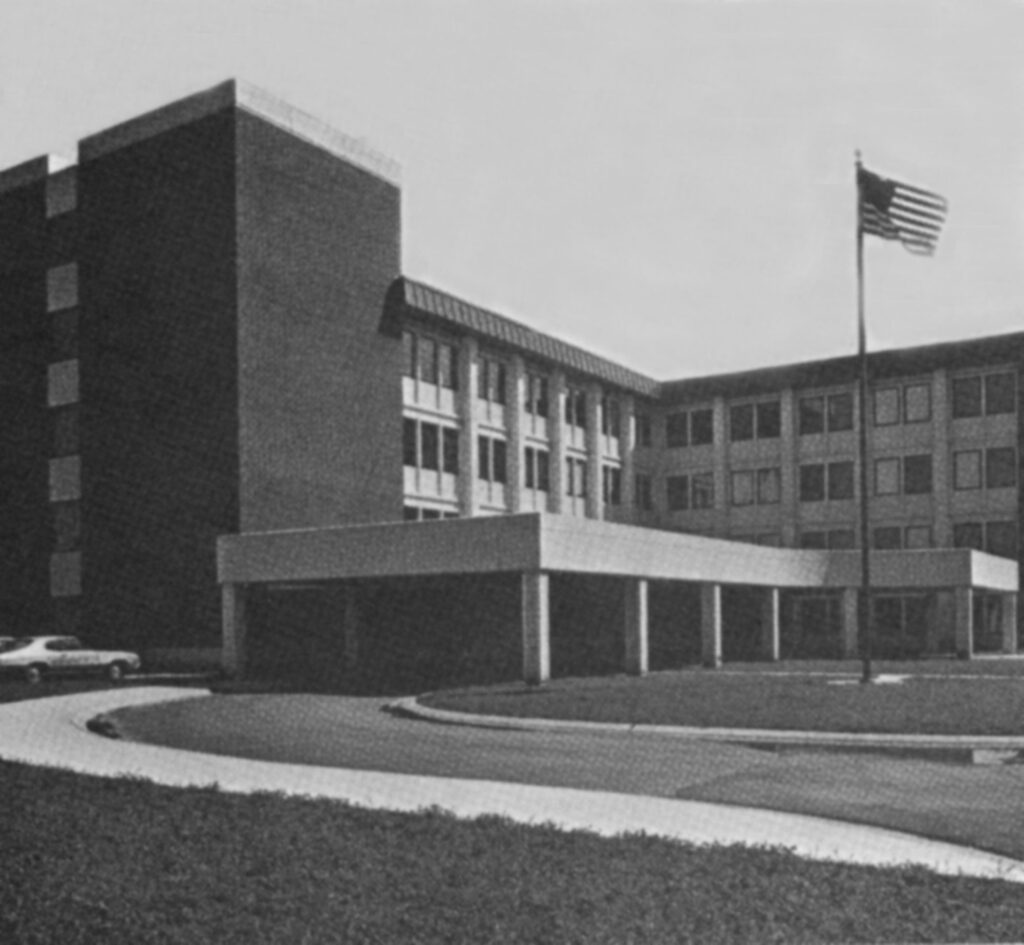
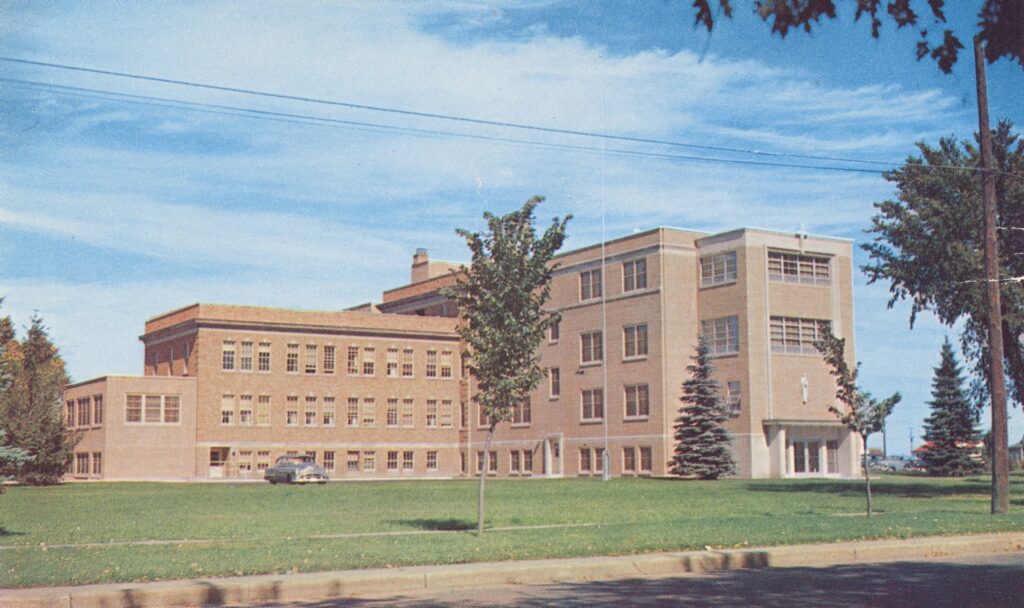
Fanny Allen Hospital in Winooski, Vermont, 1970. Source: The Archives of the Religious Hospitallers of St. Joseph of New Brunswick.

With the creation of the Fanny Allen Corporation Foundation in 1996, the sisters’ mission extends to the sick and the poor in order to improve the quality of life of the most disadvantaged.

In 2004, the sisters left the convent and moved to Our Lady of Providence Residence, an intercommunity residential care facility located in Winooski, Vermont. The last RHSJ to live in Vermont, Sister Irene Duchesneau, died in December 2020.

Fanny Allen Hospital in Winooski, Vermont, 1970. Source: The Archives of the Religious Hospitallers of St. Joseph of New Brunswick.
ortrait of Sister Frances Margaret Allen, the first Religious Hospitaller of St. Joseph in the United States. Painting by Madeleine Delfosse, oil on canvas, 1944. Archives Department of the General Administration of the Religious Hospitallers of Saint Joseph.
Fanny Allen Hospital in Winooski, Vermont, 1962. Source: The Archives of the Religious Hospitallers of St. Joseph of New Brunswick.
Fanny Allen Hospital in Winooski, Vermont, 1970. Source: The Archives of the Religious Hospitallers of St. Joseph of New Brunswick.

BURLINGTON

Bishop DeGoesbriand Hospital, 1925‑1967

Bishop Joseph Rice desired a Catholic hospital in Burlington. He negotiated with the Religious Hospitallers of Fanny Allen Hospital to manage and staff the hospital. The sisters agreed and named the new hospital Bishop DeGoesbriand, in honor of Vermont’s first bishop, Bishop DeGoesbriand.

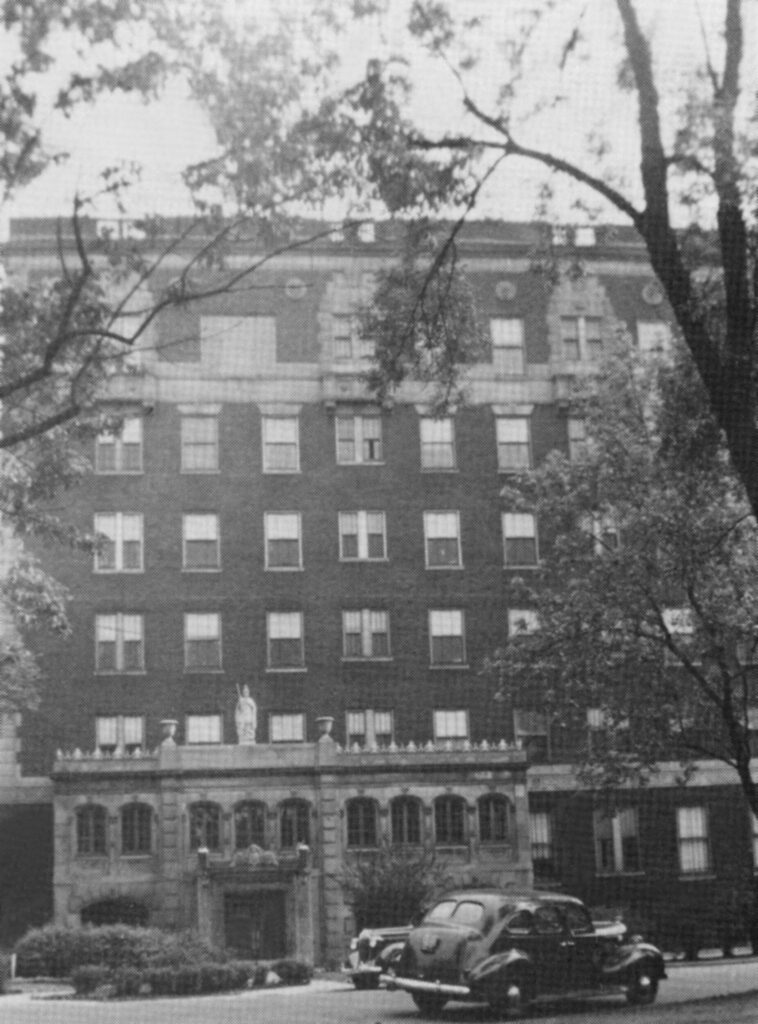
Bishop DeGoesbriand Hospital, Burlington, Vermont. Source: Archives Department of the General Administration of the Religious Hospitallers of Saint Joseph.

In 1922, a fundraising campaign was launched throughout Vermont for this new hospital. By the summer of 1925, the new hospital was ready for occupancy. Sister Monahan, Superior, and seven sisters from the Fanny Allen Hospital community were assigned to this new hospital across the street from the University of Vermont campus. The sisters lived on the fourth floor of the hospital until they moved to a residence a few blocks away. After numerous expansions, including the Vermont Rehabilitation Center, DeGoesbriand Hospital became one of the primary teaching hospitals of the University of Vermont College of Medicine.

In 1953, the Fanny Allen Hospital and DeGoesbriand Hospital nursing schools merged to become the Jeanne Mance School of Nursing in Burlington, establishing a strong nursing education program run by the Religious Hospitallers of St. Joseph. In 1965, students received their basic arts and sciences training at St. Michael’s College in Winooski, Vermont.

In 1967, after two years of extensive study, DeGoesbriand Hospital and Mary Fletcher Hospital merged to become the Medical Center Hospital of Vermont with a total of 585 beds. Some sisters continued to serve at the merged facility, while others were assigned to Fanny Allen Hospital and other nursing training facilities.

This led to an evolution in nursing education that led to the transition from hospital-based nursing programs to university-based programs. On June 6, 1971, thirty-nine women, the 18th and final class of the Jeanne Mance School of Nursing, graduated. A total of 613 professional nurses graduated from the Jeanne Mance School since the first class enrolled in September 1953.

From May 1971, the community was called Holy Family Convent. Due to the dwindling number of sisters, the community was closed on September 1, 1994.

Source: Bishop DeGoesbriand Hospital Archives

Saint Joseph’s Home – Residence for the Elderly, 1943‑1962

In August 1943, Bishop Matthew Brady asked the Fanny Allen Community to accept the management of this institution under the direction of Vermont Catholic Charities, Inc. Five Religious Hospitallers were assigned to this mission, with Sister Loiselle as Superior. Extensive renovations were carried out to meet the growing demand for elderly care. In 1962, this mission was transferred to the Daughters of Charity of the Sacred Heart due to the growing need for the sisters to return to the Fanny Allen Hospital.

ILLINOIS

CHICAGO

St. Bernard Hospital, 1905‑2015

The Religious Hospitallers of St. Joseph present at the celebration of the 100th anniversary of St. Bernard, 2005, Source: The Archives of the Religious Hospitallers of St. Joseph Region.

During the summer of 1903, Father Bernard Murray, pastor of St. Bernard Parish in the Englewood area of Chicago, with the permission of Archbishop James Edward Quigley, invited the Religious Hospitallers of St. Joseph of Kingston, Ontario, to open a hospital in his parish. Archbishop Charles Gauthier of Kingston gave his consent for seven sisters to open the hospital. Sisters Anne Hopkins, Mary of the Sacred Heart (Catherine Leahy), Elizabeth Norris, Gertrude Leahy, Helen Jarrell, Mary Anne Blaney, and Sarah Farrell left Kingston on November 21, 1903. Funds were raised and, after setbacks including a fire that destroyed the sisters’ convent, St. Bernard Hospital opened on November 21, 1905.

St. Bernard Hospital, Chicago, Illinois, 1909. Source: The Archives of the Religious Hospitallers of St. Joseph of New Brunswick.

In 1906, St. Bernard School of Nursing was established and with the first class graduating in 1909. The school, which became affiliated with Loyola University in 1913, graduated more than 1,500 nurses in 66 classes up until its closure in 1975.

Over the years, the hospital has continued to expand to meet ever-growing needs. Major expansion and renovation work has been undertaken almost every decade since 1961, with the construction of new wings, units, and departments, as well as the renovation and modernization of existing areas.

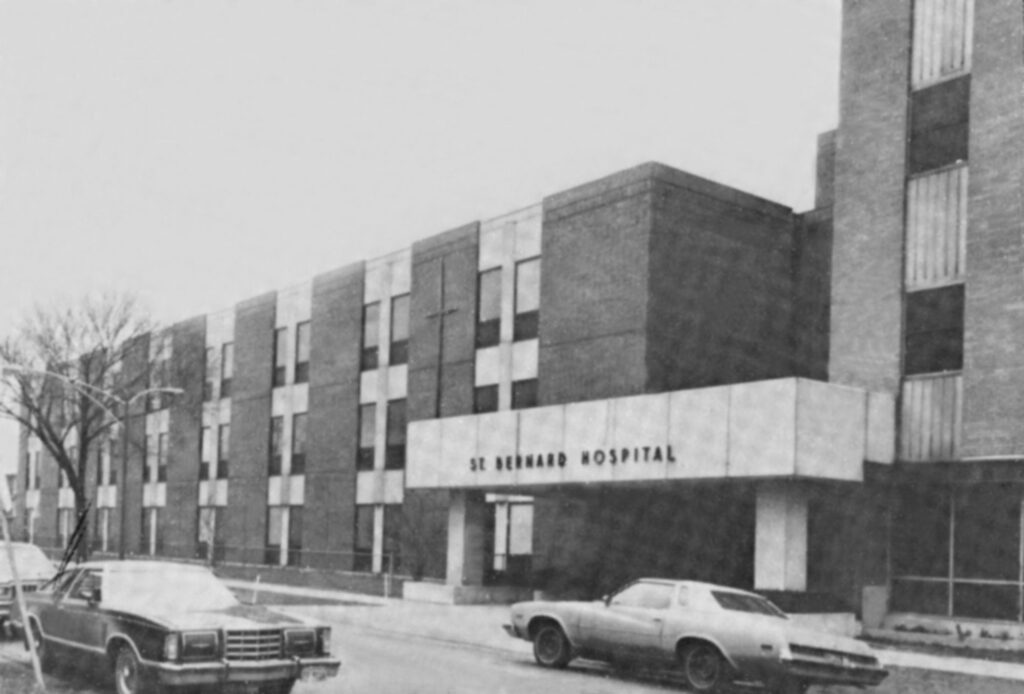
St. Bernard Hospital, Chicago, Illinois, 1976. Source: The Archives of the Religious Hospitallers of St. Joseph of New Brunswick.

Over the years, St. Bernard Hospital has been impacted by the economic and demographic changes in its neighbourhood. The Religious Hospitallers of St. Joseph, however, remained committed to serving the community, living out its mission of compassionate care for those most in need, and the hospital continues to grow to meet the community’s changing needs.

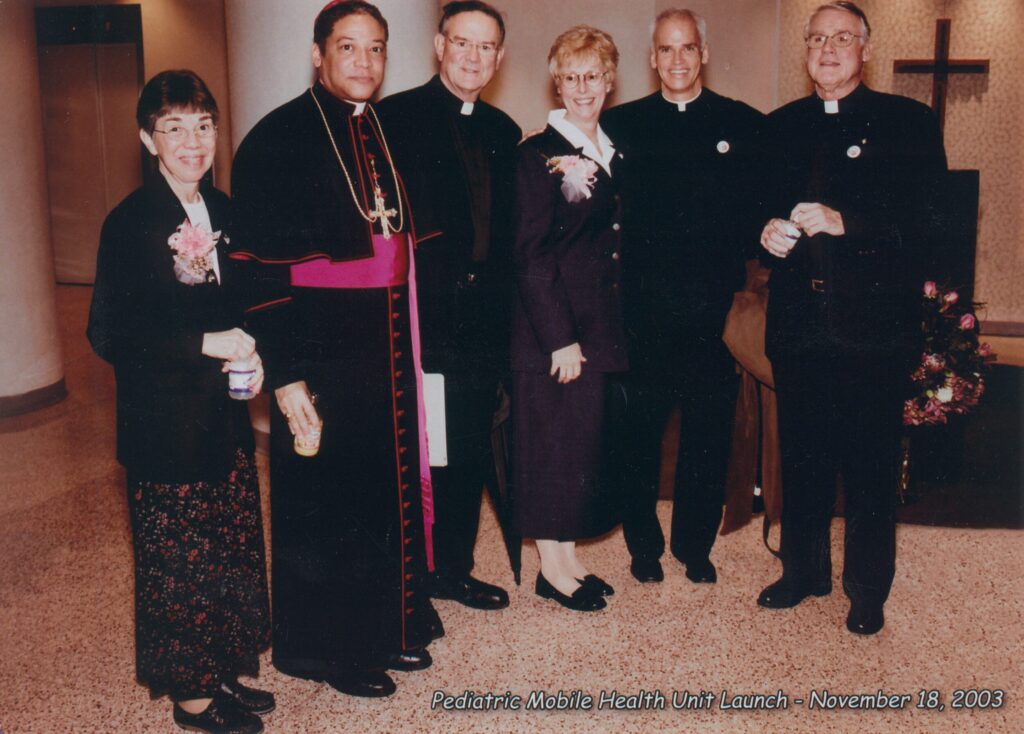
Sister Janet Wahleithner, rhsj, (first from left) and Sister Elizabeth Van Straten, rhsj, (third from right). Launch of the Pediatric Mobile Health Unit, November 18, 2003. Source: RHSJ Archives, Saint Joseph Region.

The Bernard Place development

Seeing the dilapidated homes in the Englewood neighborhood and the many vacant lots surrounding St. Bernard Hospital, the hospital’s executive director envisioned the construction of affordable single-family homes in the area. The St. Bernard Housing Development Corporation was formed in 1999 and, in partnership with civic and private agencies, more than 100 single-family homes were built in a subdivision known as Bernard Place.

St. Bernard Hospital continues to meet the needs of its community. In addition to the hospital’s modern medical facilities, St. Bernard also provides medical care to the community through its Pediatric Mobile Health Unit, established in 2007. This mobile unit provides infant vaccinations, children’s dental care, and free mammograms to uninsured women. It is sponsored by Catholic Health International.

After more than 30 years of service to the community, Sister Elizabeth Van Straten, the last Religious Hospitaller of St. Joseph working at the hospital, retired as CEO of St. Bernard Hospital at the end of 2012. She remained at St. Bernard Convent for several years, continuing to be involved in various volunteer activities until 2015, when she moved to a private residence in Indiana.

PALOS PARK

St. George Hospital, Chicago, Illinois, 1942. Source: The Archives of the Religious Hospitallers of St. Joseph of New Brunswick.

St. George’s Hospital, 1939-1972

In 1938, due to overcrowding at St. Bernard Hospital in Chicago, the Religious Hospitallers of St. Joseph purchased a hospital in the Auburn Park neighbourhood, which they renamed St. George Hospital. The hospital opened in 1939 and was expanded in 1952. Further expansion was necessary but the facilities were unable to meet the accreditation standards of the time. The decision was then made to build a new facility outside the city.

In 1965, Sisters of the St. George Hospital Community acquired 20.8 acres of land in Palos Heights, a Chicago suburb, from the St. Bernard Community. This land had been purchased by the Religious Hospitallers of St. Joseph in 1920 and previously housed Mount St. Joseph, the Religious Hospitallers novitiate, and a farm that supplied food to the hospitals.

Palos Park Hospital, Chicago, Illinois, 1972. Source: The Archives of the Religious Hospitallers of St. Joseph of New Brunswick.

Palos Park Hospital, 1970-2021

Construction of the new facility in Palos Heights began in 1970, and the new hospital, an interfaith facility operated by the St. George Corporation, opened in 1972. St. George Hospital closed at this time. Palos Community Hospital grew rapidly, with expansions beginning in 1975 and additional facilities added between 1979 and 1981.

Sisters Anna Doyle, rhsj, and Margaret Wright, rhsj, Palos Park. Jubilee 2009. Source: RHSJ Archives, St. Joseph Region.

The corporation expanded its healthcare services by developing an outpatient clinic in Orland Park in 1985 and establishing an independent home healthcare agency, Palos Home Health Care, in 1996.

A major expansion was undertaken in the 2010s with the construction of a new wing, known as the Hospitaller Pavilion (opened in 2013) and the complete modernization of the existing building, known as the St. George Pavilion (completed in 2017). In 2021, Palos Health, as it was then known, joined the Northwestern Medicine system.

The Religious Hospitallers of St. Joseph continued to be involved with Palos Community Hospital, serving on the corporation’s board of directors and working at the hospital. Sister Margaret Wright served as President of the board and as Executive Director of the hospital from 1978 until her retirement in 2013. Sister Anna Doyle, the last Religious Hospitaller to live in Palos, served as Vice-President of Nursing from 1986 to 2007 and then as Director of Pastoral Care from 2007 to 2014. Sister Doyle remained in Palos Heights after her retirement until October 2021, when she moved to Kingston, Ontario, and became part of the St. Joseph community.

MONTANA

POLSON, MONTANA

St. Joseph Hospital, 1916-1983

In 1916, the Religious Hospitallers of Kingston, at the invitation of Father William O’Malley of Polson, Montana, and Bishop John Carroll of Helena, Montana, opened a hospital on the shores of Flathead Lake in western Montana. Sisters were needed to provide health care to members of the Blackfeet Nation and other members of the growing community.

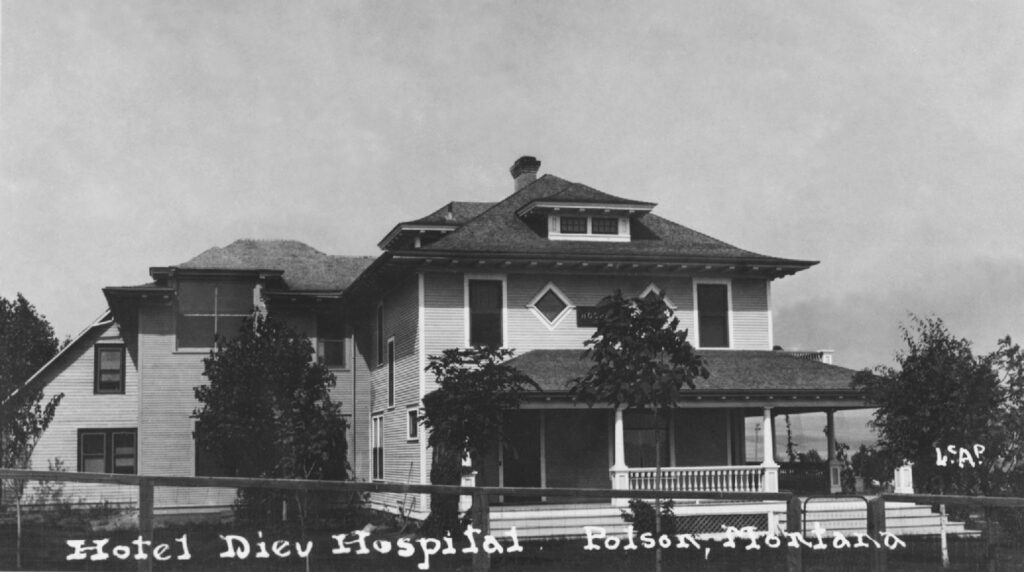
Hotel Dieu of Polson, Montana, 1916. Source: The Archives of the Religious Hospitallers of St. Joseph of New Brunswick.

St. Joseph Hospital is recognized as the first American hospital to offer integrated care to Indigenous and non-Indigenous patients. Three sisters—Sisters St. Joseph (Mary Agnes Leahy), Sister Mary of the Sacred Heart (Catherine Leahy), and Sister Gertrude Leahy—were sent from the Hotel Dieu Hospital in Kingston, Ontario, and arrived in Polson on September 20, 1916, to establish this mission. Upon arrival, they found no hospital building waiting for them. They set about converting a boarding house into a medical facility that could accommodate six patients. In 1918–1919, the building’s capacity increased to 11 patients and was continually in demand during the height of the influenza epidemic.

Hotel Dieu of Polson, Montana, 1930. Source: The Archives of the Religious Hospitallers of St. Joseph of New Brunswick.

New construction project

In 1921, the sisters acquired additional property and the existing building was remodeled and served as a hospital until 1931, when a new building was constructed to accommodate Polson’s growing civic community. By the early 1950s, the 1932 building was found to be inadequate, and discussions began regarding funding for another construction project. The cornerstone of the new building was laid on July 8, 1958, and the 40-bed hospital opened in March 1960.

A lay administrator was appointed in 1974 and, at this time, the sisters withdrew from active participation in the hospital. In March of that year, the community was closed and the five remaining Religious Hospitallers of Saint-Joseph departed the town. Sisters remained on the Board of Directors, however, until 13 March 1984, when the hospital was transferred to the Presentation Sisters of Aberdeen, South Dakota.

WISCONSIN

HARTFORD

St. Joseph’s Hospital, 1926‑1971

In 1926, the Religious Hospitallers of Saint Joseph of Saint Bernard Hospital in Chicago were asked on behalf of the Hartford community to take charge of Hartford General Hospital, which had been founded in 1916. Unable to assign sisters to such an undertaking, the Saint Bernard community contacted the Religious Hospitallers of the Hotel Dieu in Kingston, who expressed an interest in this mission.

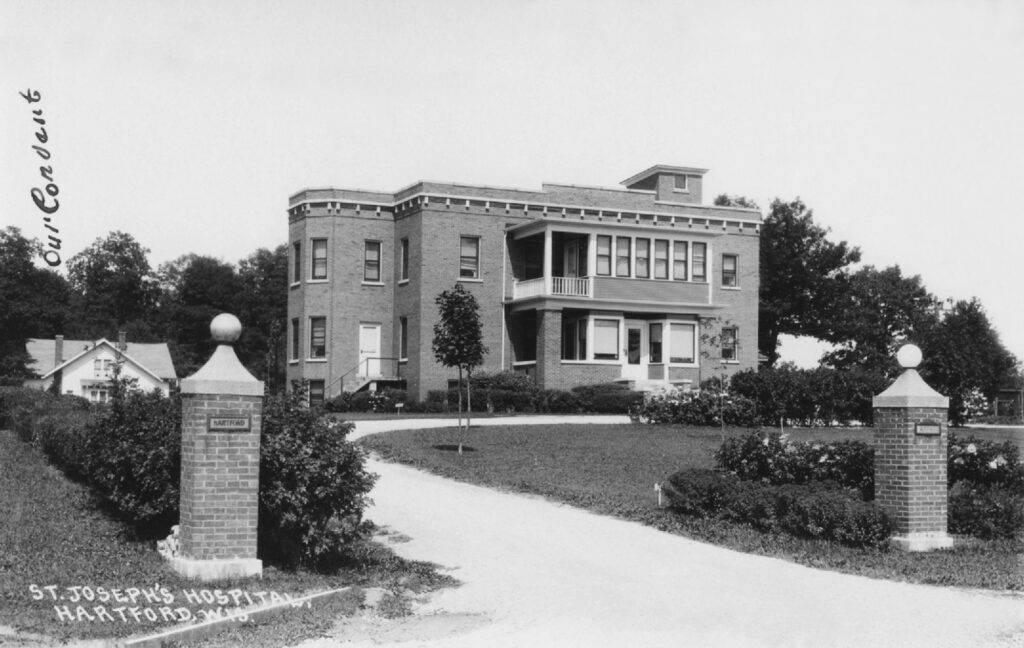
St. Joseph’s Hospital, Hartford, Wisconsin, 1926. Source: The Archives of the Religious Hospitallers of St. Joseph of New Brunswick.

The Religious Hospitallers of St. Joseph purchased the Hartford facility, renaming it St. Joseph’s Hospital and, on April 30, 1926, Mother Margaret Hazelton and Sister St. Oswald (Margaret Mary O’Keefe) arrived from Kingston. Sister Kathleen McCarten and Sister Monica DeMarsh joined them on May 11, 1926. It soon became apparent that the building constructed in 1920 was inadequate for the needs of the growing Hartford community. The sisters therefore embarked on a fundraising campaign to finance the construction of a new 50-bed facility, which was completed in April 1929. The 1920 building was then used as a convent for the sisters.

St. Joseph’s Hospital, Hartford, Wisconsin, 1940. Source: The Archives of the Religious Hospitallers of St. Joseph of New Brunswick.

In 1956, again prompted by the need to modernize and expand the hospital, a public fundraising campaign was launched to raise $350,000 to finance the construction of an addition that would increase the hospital’s capacity to 20 beds. Ground was broken in 1958, and the new annex opened in 1959.

By the late 1960s, the declining number of Religious Hospitallers of Saint Joseph and the cost of operating and modernizing the hospital necessitated a change in governance. Following negotiations with city officials, legal advisors, and the Religious Hospitallers Provincial and General Councils, ownership of the hospital was returned to the civic community through the sale of the property to Hartford Memorial Hospital, a non-profit corporation established in 1970. The official transfer took place on July 20, 1971, when the facility was renamed Hartford Memorial Hospital.

NEW LONDON

1929‑1995

Founders of the RHSJ community of New London: Sisters Bernadette Murdoch, Dwyer (Ellen Walsh), and Anne Hickey. Source: RHSJ Archives, Saint Joseph Region.

New London Community Hospital Foundation

On February 11, 1929, three Religious Hospitallers of St. Joseph—Mother Bernadette Murdoch, Sister Dwyer (Ellen Walsh), and Sister Ann Hickey—left Chatham, New Brunswick, to establish a foundation in New London, Wisconsin. For several months, a local New London priest, Father Otto Kolbe, had been corresponding with Chatham Superior Mother Elizabeth O’Keeffe on behalf of the city about New London’s need for sisters to take over the operation of the small existing hospital. On February 20, 1929, the three Religious Hospitallers arrived in New London and formal possession of the 13-bed hospital and its equipment was transferred from the hospital board to the sisters five days later.

New London Community Hospital, New London, Wisconsin, 1950. Source: The Archives of the Religious Hospitallers of St. Joseph of New Brunswick

New London Community Hospital, 1931–1962

The sisters, with the help of local benefactors, began searching for a suitable site for a new hospital and found one near a stand of trees known locally as “The Pines.” They purchased it and proceeded to build a new 50-bed hospital, which officially opened on March 22, 1931. In 1952 and 1962, new wings were added to the hospital.

St. Joseph Residence

In 1967, the RHSJ took over responsibility for the Clara Nee Retirement Home and renamed it St. Joseph Residence, Inc.

Transfer of the hospital to the civil authorities

A sister held the position of superior/administrator until July 27, 1970, when the position was split in two and the hospital’s first lay administrator was appointed. In 1974, the community moved out of the hospital to a separate residence. That same year, faced with the need for extensive renovations, the General Council and Provincial Council of the Congregation decided to transfer responsibility for the ownership and management of the hospital to the Board of Trustees. In 1975, the Religious Hospitallers of St. Joseph transferred the New London Community Hospital to civil authorities.

Marian Heights Apartments, Trinity Terrace, and Chatham Apartments, Washington Center, 1995–2003

The Religious Hospitallers continued to work in New London, at the hospital and on the Corporation’s Board of Trustees until 1995. They maintained their presence in New London by continuing to manage St. Joseph Residence and serving on the Board of Trustees. This site, managed by Catholic Health International, now includes the Marian Heights Apartments for independent living (opened in 1988) and Trinity Terrace for assisted living (opened in 1995). In 2003, the Chatham Apartments at Washington Center, a completely renovated high school, opened to offer assisted living apartments.

ANTIGO

1933‑2025+

Langlade Memorial Hospital, 1942. Source: RHSJ Archives, St. Joseph Region.

When doctors and businessmen from Antigo, some 75 miles north of New London, Wisconsin, heard about the quality of care provided to New London residents, they invited the Religious Hospitallers of Chatham, New Brunswick, to come and administer their hospital. Three Religious Hospitallers of St. Joseph – Sisters MacIntosh, Malvina Martin, and Gladys Rideout – with permission from Bishop Paul Rhode of Green Bay, began their apostolate in Antigo at the Langlade County Memorial Hospital in March 1933.

Langlade Memorial Hospital, after 1954. Source: RHSJ Archives, Saint-Joseph Region.

Langlade Memorial Hospital Expansion

To meet the continuing health needs of the community and surrounding areas, a new addition hospital was completed in 1954. Additional facilities were added in 1978 to include surgery, radiology, and outpatient departments. In February 1993, a new medical clinic was built adjacent to the hospital.

Aerial view of Langlade Memorial Hospital, 1990. Source: RHSJ Archives, Saint-Joseph Region.

In 2003, Langlade Memorial Hospital completed a $12.4 million renovation and expansion project, the largest ever completed in the hospital’s history. The project included the construction of a 30,000-square-foot physician office building called the St. Joseph’s Outpatient Center, a surgery center, a skywalk, and renovations to several hospital departments.

In June 2007, ground was broken for the construction of an oncology clinic on the campus of St. Joseph’s Outpatient Center. In July 2008, Langlade Memorial Hospital was renamed Langlade Hospital following Vatican approval of its formal affiliation with the community-led, non-profit Aspirus Health System. The hospital is a member of Catholic Health International.

Expanded Mission

In addition to caring for the sick, the Religious Hospitallers of Saint Joseph extended their apostolate to care for the dying at the Le Royer Hospice, which opened in 1991. In 1993, they opened an assisted living facility for 40 people called Pine Meadow. The 18-bed nursing home, Rosalia Gardens Retirement Centre, was added in 1999.

From left to right, Sisters Adele Demulling and Jean Bricco, jubilee of religious profession, 2006. Source: RHSJ St. Joseph Region Archives.

Currently, Sister Adele Demulling, who was missioned to Antigo in 1992, resides at the Langlade Memorial Hospital convent.

MAINE

Hôtel-Dieu de Van Buren, Maine, 1940. Source: Archives of the Religious Hospitallers of St. Joseph of New Brunswick.

VAN BUREN

Hôtel-Dieu St-Joseph, 1938‑1954

In 1938, the Religious Hospitallers of Saint-Basile embarked on their first experiment in creating a foundation, responding to a call from the people of Van Buren, a small American town on the St. John River some 40 kilometers from the Hôtel-Dieu de Saint-Basile. On December 16, the first five pioneer sisters—Sisters Brissette (Nadeau), Maria Albert, Emma Plourde, Brigitte Légère, and Beatrice Kearney—opened a small 30-bed hospital in Van Buren, Maine. These very modest facilities could only be operated temporary and, in July 1954, the Religious Hospitallers of St. Joseph permanently closed the small Hôtel-Dieu in Van Buren.

BIDDEFORD

Notre-Dame Hospital, 1948-1982

The parish priest of Biddeford asked the Religious Hospitallers of St. Joseph of Montreal to found a hospital for the French-American Catholic population of his parish. On September 17, 1948, three sisters left for Biddeford. They were Sister Juliette Barcelo, Superior, Sister Helena Massie, Assistant, and Sister Marguerite Bilodeau, Treasurer.

Notre Dame Hospital of Biddeford Site Unknown photographer. - 1947. Source: Archives Department of the General Administration of the Religious Hospitallers of Saint Joseph.

Since the region already had two English-speaking hospitals, it was necessary to settle for a small French-speaking hospital with 50 beds where all written communications were in English. The blessing of the cornerstone of the future Notre Dame Hospital of Biddeford took place on August 13, 1950. The official opening took place in 1951.

Given the region’s difficult economic climate, the Catholic hospital experienced serious financial problems. It was sold to the Webber Hospital Association in May 1969 and it subsequently became a rehabilitation center. While some sisters continued to work in various capacities in existing healthcare facilities, others chosed to engage with the poor in the Saco area.

SACO

Food Bank and other works, 1982-1999

In 1982, Webber Hospital in Biddeford sold its healthcare facility to a private company. The sisters decided to settle in Saco. Working with neighboring parishes, they organized a sacristy and a food bank for the poor in the convent basement, where furniture and household goods could also be donated. In collaboration with the laity, the Religious Hospitallers organized a hot meal service. The sisters remained active in this ministry until their departure in 1999.