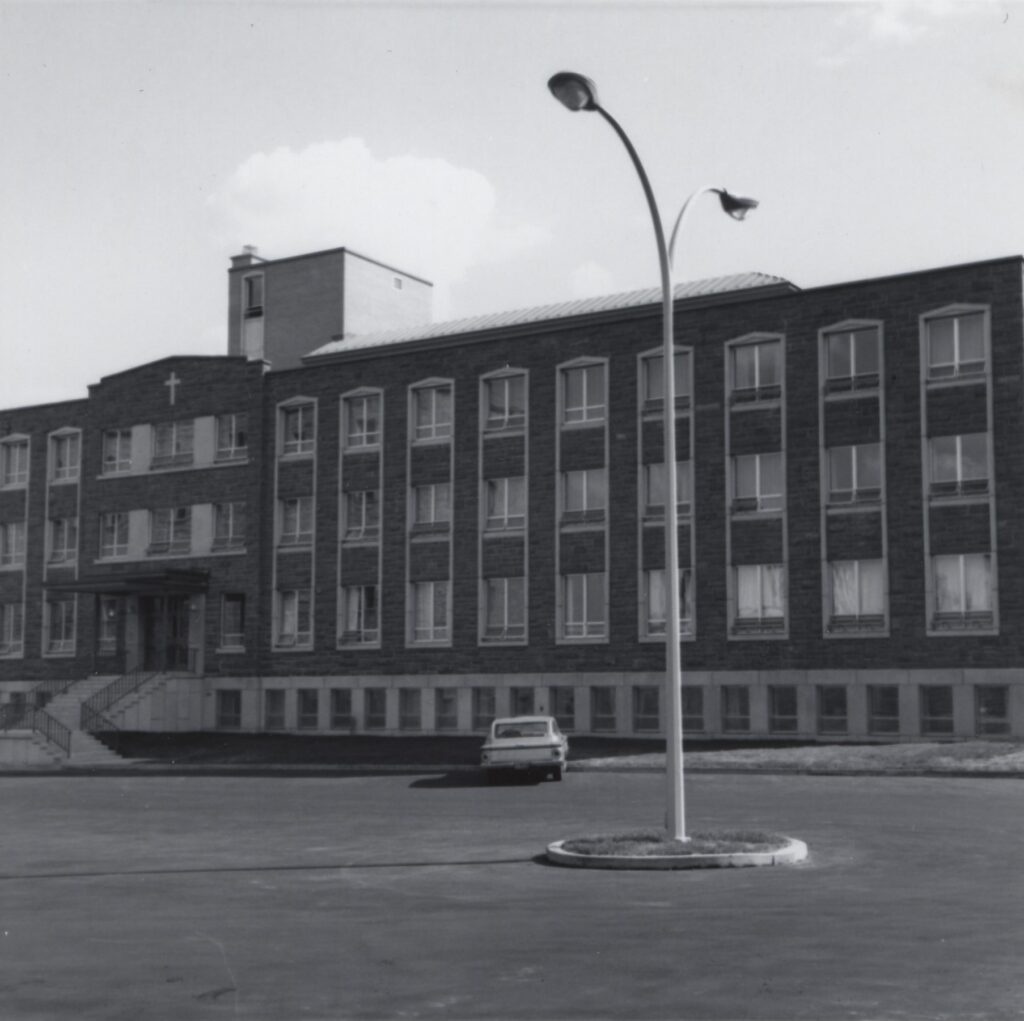
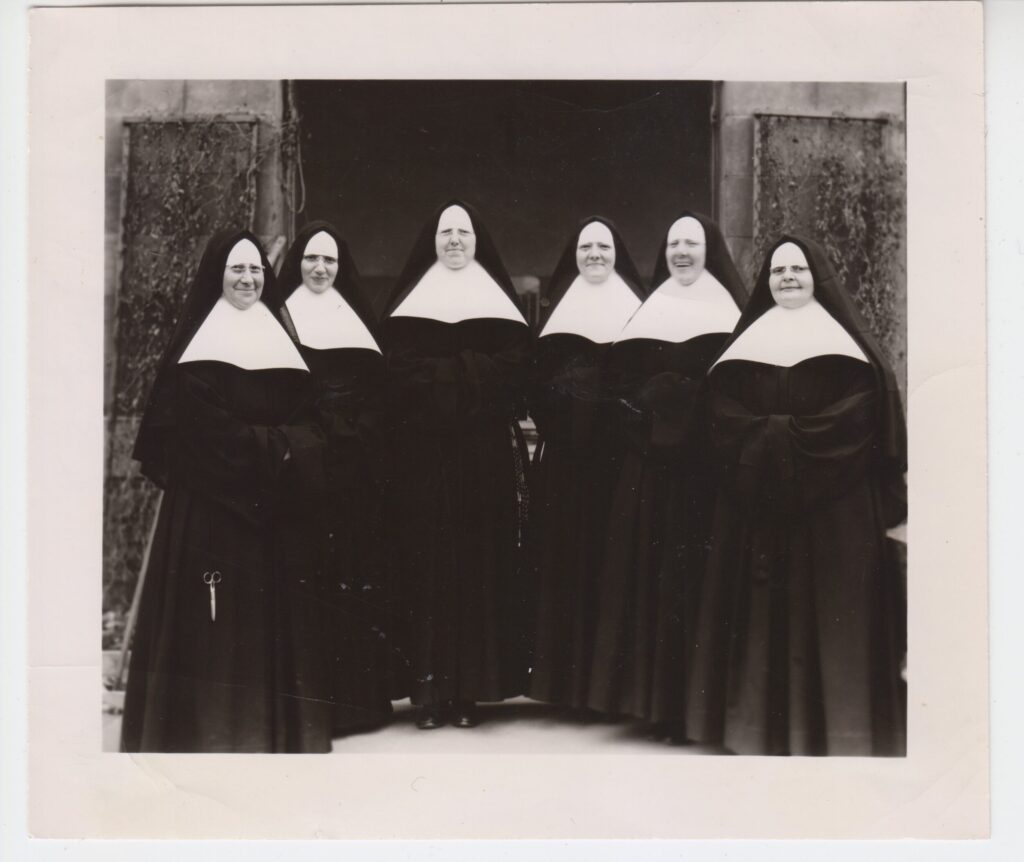
1659-2025+

History of the Religious Hospitallers of Saint Joseph in Canada

QUEBEC

MONTREAL

The three crossings of the Religious Hospitallers of Saint Joseph
From France to Ville-Marie

First crossing, 1659‑1861

On October 20, 1659, three Daughters Hospitallers joined Jeanne Mance in Ville-Marie to collaborate in her mission to found a hospital. This is what we call the first crossing for the Daughters Hospitallers of Saint Joseph, who came from La Flèche after receiving the blessing of their founder, Jérôme Le Royer de la Dauversière, the instigator of the missionary project on the Island of Montreal.

Saint Joseph Chapel located in the inner courtyard of the RHSJ Monastery. Photo: Gilbert Langlois, 2020 - Archives Department of the Mother House.

Second crossing, 1861-2019

The move of the Hôtel-Dieu and the monastery to Mount Ste-Famille at the foot of Mount Royal. The first hospital was becoming too small and did not meet the requirements for advancements in medical science. The move took place in 1861. The 69 sisters left their monastery, taking with them the venerated remains of Jeanne Mance along with those of the Basset brothers and the 178 sisters who had died at the Hôtel-Dieu on St. Paul Street. In recognition of their origins, stones from the original chapel and the monastery were used to build the small Saint Joseph Chapel in an interior courtyard.

Third crossing, 2019

The time has come to cast off and drop anchor in a new location: The House of the Hospitallers of Saint Joseph. The house is adapted and better meets the needs of elderly sisters. This important change in no way diminishes our commitment as the Religious Hospitallers of Saint Joseph.

Today our mission is as follows:

« We, Religious Hospitallers of Saint Joseph, are called to be present to the many faces of our world, at the heart of the Cité-des-Hospitalières, as women of faith, free to love and serve. »

L’Hôtel-Dieu de Montréal
1642-1996

In 1640-1641 in France, Jérôme Le Royer prepared to establish a colony and an evangelization project on the Island of Montreal. He chose Paul de Chomedey, Sieur de Maisonneuve, as governor of the future Ville-Marie and Jeanne Mance as intendant. In accordance with the wishes of Madame de Bullion, her benefactress, she founded a hospital: the Hôtel-Dieu.

Partial plan of the enclosure of the Hôtel-Dieu de Montréal, 1645-1695. Lead on paper. Aristide Beaugrand-Champagne, architect. 1942. Photo credit: Gilbert Langlois. Source: Religious Hospitallers of Saint Joseph of Montreal – Mother House Archives (CH2/B.1-9003).

Hôtel-Dieu de Saint-Joseph, Montreal’s first hospital ‑ 1644

Arrival of the first three Religious Hospitallers of Saint Joseph in Ville-Marie in 1659. Illustration by Francis Back produced in 2009.

On October 20, 1659, the Daughters Hospitallers of Saint Joseph – Judith Moreau de Brésoles, Catherine Macé, and Marie Maillet – arrived in Ville-Marie. There, they founded the first female religious community in Montreal. With Jeanne Mance, they began a long tradition of lay-religious collaboration.

Upon the death of Jeanne Mance on June 18, 1673, the hospital was entrusted to the Sulpicians, Seigneurs of the Island of Montreal, and then transferred to the Hospitallers in 1676. The Hôtel-Dieu, enlarged and rebuilt after three major fires, would remain Montreal’s only hospital until 1822. In 1850, the Hôtel-Dieu welcomed medical students.

Aerial view of the RHSJ convent complex and the Hôtel-Dieu de Montréal. Photo: AIRCAM, May 30, 2011.

In 1861, the hospital on Saint-Paul Street was demolished and a new hospital rises up on Mont Sainte-Famille at the corner of Saint-Urbain Street and Avenue des Pins. With a capacity of 210 beds, it welcomed the sick, the elderly, and orphans. To meet the needs of the sick and the evolution of medical science, additions to the building were built from 1886 to 1926, followed by three pavilions: Le Royer in 1942, Jeanne-Mance in 1950, and de Bullion in 1953.

In 1901, a nursing school was opened within the hospital walls. The Hôtel-Dieu also established specialized training schools for laboratory technicians, medical record librarians, and radiology technicians, as well as a school for nursing assistants and a school for food technicians.

In 1964, at the request of the RHSJ of Montreal, the hospital was incorporated under the name “Hôtel-Dieu de Montréal.” RHSJ members served on the Board of Directors until 1996. In 1973, the last sister to serve as director of the Hôtel-Dieu, Sister Thérèse Trottier, permanently resigned as administrator. A lay director, Mr. Yves André, was appointed.

In 1996, the Hôtel-Dieu became a Pavilion of the CHUM (Montreal University Hospital Center). That same year, the Marie-de-la-Ferre Residence, built in 1964 for the hospital sisters who had lived in the Mother House since 1952, was sold to the Hôtel-Dieu.

Saint Patrick’s Hospital, Montreal, Quebec
1852‑1860

At the request of Monsignor Ignace Bourget, Bishop of Montreal, the Religious Hospitallers decided on April 26, 1852, to purchase the Collège Baptiste building and transform it into a hospital to care for Irish Catholics who suffered from sectarian discrimination.

Located on Rue Guy, in the west of the city, it could accommodate around sixty patients. Sister Catherine Lacroix, Superior, and five companions left the Hôtel-Dieu on June 21, 1852, for this foundation.

Administrative difficulties, the role of the Management Committee made up of Irish priests, and the withdrawal of their financial support prompted the Religious Hospitallers to leave Saint Patrick’s Hospital in 1860 and sell it to the Congrégation de Notre-Dame. The Irish patients occupied the Saint-Patrice and Sainte-Brigitte wards in the new Hôtel-Dieu on Avenue des Pins (1861). As for the sisters, they formed a single community at the Hôtel-Dieu.

St. Mary’s Hospital, Montreal, Quebec
1924‑1930

Since 1908, Sister Helen Morrissey, a pharmacist at the Hôtel-Dieu de Montréal who was from an Irish family, had been thinking about founding a hospital to care for English-speaking patients. In 1924, with the permission of Archbishop Georges Gauthier of Montreal, her Superior, Mother Le Royer, and the support of generous donors, she left the Hôtel-Dieu to found the 50-bed St. Mary’s Hospital in the residence of Sir Thomas Shaughnessy. She called upon the sisters of the Hôtel-Dieu Hospitals of Cornwall, Kingston, and Chicago to assist her in the hospital work. The community welcomed novices. A school for training nurses was opened. Following administrative difficulties, Sister Morrissey returned to the Hôtel-Dieu in 1930. The hospital was entrusted to another community.

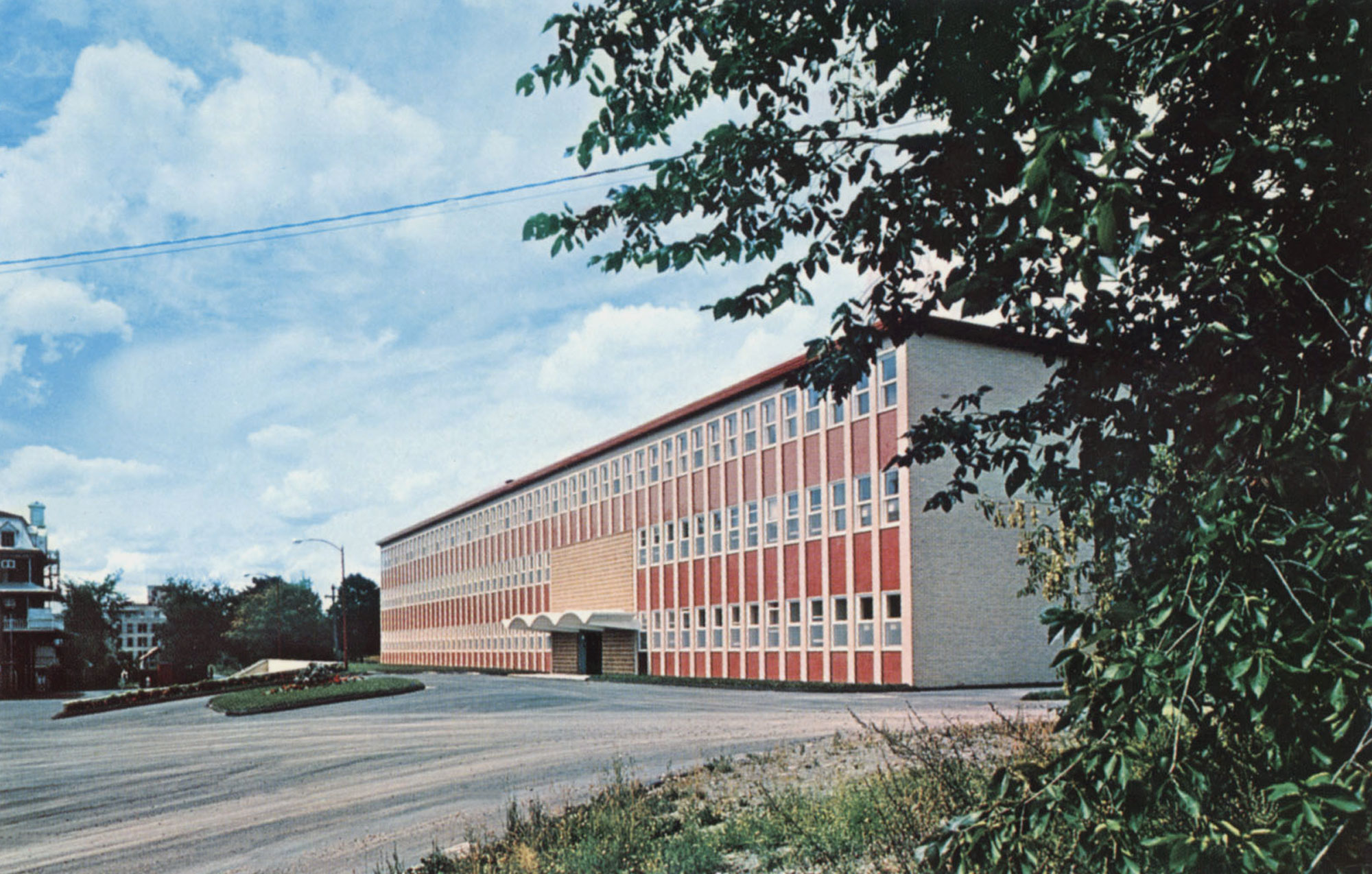
Ville-Marie Provincial House at 2450 ch. de la Côte Sainte-Catherine, Montreal, 1958 (Stirling Avenue side). Unknown photographer, 1958 - Archives Department of the General Administration of the Religious Hospitallers of Saint Joseph.

Ville-Marie Provincial House, Montreal, Quebec 1953-1999

Sister Germaine Lafond, Provincial Superior, who was appointed in 1953, and two councilors left the Mother House in 1956 for a temporary home on Côte Sainte-Catherine. In 1958, the Provincial Council moved into a newly built house on the same street, at number 2450.

The Provincial Superior, a member of her council, or a sister assumed responsibility for the community over the years. In 1970, a subgroup was formed, composed of students and missionaries on leave. Sister Marguerite Mercier led this group until 1974. Sisters from this group would go on to form a community at the Marie-Morin Residence. Since its opening, the Provincial House welcomed student sisters from the congregation and from other congregations. The community defined itself as a community that supported the Provincial Council and as welcoming community.

In 1999, the General Administration moved from Canterbury Avenue to the Provincial House on Côte-Sainte-Catherine Road. As part of the relocation process, the sisters of the Provincial House Community moved to the Canterbury Avenue residence, and the Provincial House became the General House.

In 2007, the General Administration was relocated to the Mother House and the General House was sold to the Notre-Dame-du-Bon-Conseil Institute of Montreal.

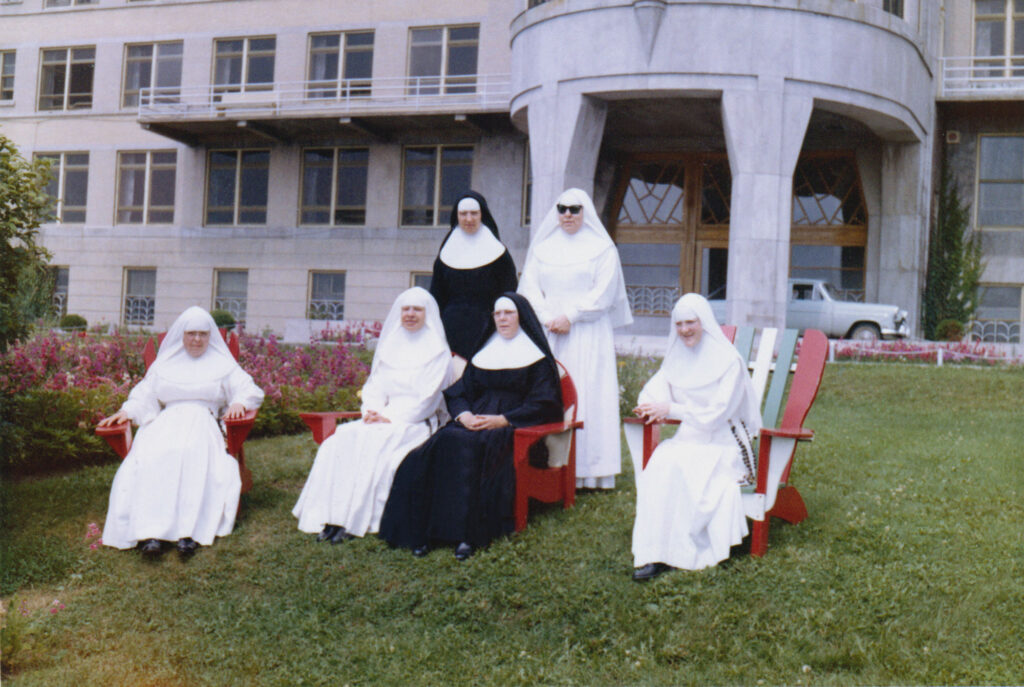
Marie-de-la-Ferre Residence at 3850 Saint-Urbain. Photographer RHSJ, 1964 - Archives Department of the General Administration of the Religious Hospitallers of Saint Joseph

Marie-de-la-Ferre Residence, Montreal, Quebec 1964‑2017

The Marie-de-la-Ferre Residence was built in 1964 in the hospital garden to accommodate the RHSJ of the Hôtel-Dieu. In 1976, the community welcomed women accompanying family members hospitalized at the Hôtel-Dieu.

In 1998, this service moved into a wing of the Mother House. Its mission was to provide a place of peace and welcome for people affected by illness or those accompanying a loved one who was hospitalized. The Marie-de-la-Ferre Residence closed its doors on April 30, 2017.

Marie-Morin Residence, Montreal, Quebec
1974‑2007

Built in 1861, the building located near the Mother House, now called “Résidence Marie-Morin”, served as a staff house until 1962 and was called the “men’s house.” Following renovation, it served as a classroom (an annex to the Lafond School) and as housing for female students for four years, then it was used as accommodation for students and workers until 1974.

In 1974, the house underwent a further transformation to accommodate six Religious Hospitallers from the Ville-Marie Province who experienced a form of community life in fraternity. Other small groups followed with the aim of welcoming young women on Christian and vocational journeys.

In 1990, Sister Cécile Gagné worked as a facilitator at the Centre vocationnel (now the Carrefour intervocationnel). From 1991 to 2008, she served as general manager of this centre, whose goal was to support young people in their search for their vocation. Students living at the Marie-Morin Residence were invited to participate in the centre’s activities. From 2007 to 2009, the residence welcomed sisters visiting Montreal. It was then occupied by students from the IFHIM (Institut de Formation Humaine Intégrale de Montréal). The property was sold in 2017.

Saint-Urbain Residence, Montreal, Quebec
1980‑1993

In the summer of 1978, with a renovation project of the Religious Hospitallers of Saint Joseph’s properties on Saint-Urbain Street underway, the possibility of a community with a concern for a new evangelization was born. Following discussions, a housing cooperative owned by the Religious Hospitallers took shape, and three sisters moved into the home in 1980. Sister Éliane Pépin was superior of this community.

The cooperative’s goal was to promote social justice by fostering mutual aid, care, and solidarity and aimed to provide low-income people with affordable housing. The sisters were part of the cooperative until 1993, when it was sold to its members who shared the same goals.

Sainte-Famille Residence, Montreal, Quebec
1987‑1992

In 1985, Sister Gemma Pednault was the general manager of “La Maison des Amis du Plateau Mont-Royal Inc.”, a place where people in difficulty are welcomed and assisted. This house is an initiative and a work of the Immaculate Conception Parish, of which Pierre Côté, SJ, is the pastor. Six days a week, in the afternoon, the “House” receives sixty, ninety, up to one hundred and twenty men and women, lonely people, roomers, homeless people, welfare recipients, people addicted to drugs, former psychiatric patients. It is a place of belonging for those excluded from society. The “House” is linked to the community services of the neighborhood.

Sister Pednault promoted the training and integration of welfare recipients into the workplace through programs such as kitchen staff, housekeeping, secretarial services, thrift store, general store, and social activities. The thrift store and general store help with the organization’s self-financing. Volunteers and donors, including the congregation, support the “Maison des Amis.”

In 1987, at the request of Sister Pednault, a community of three Religious Hospitallers, with Sister Thérèse Robert as Superior, was established in the neighborhood. This community was dissolved in 1992. At the end of 1999, Sister Pednault passed the torch of service to her assistant, a trained criminologist, but she remained active in the corporation.

Jérôme-Le-Royer Residence, Montreal, Quebec 2010‑2022

On June 19, 1997, the Canterbury Avenue Community was established. On March 23, 2010, the community moved to Fendall Streetand and it took the name Jérôme-Le-Royer Residence Community. The last community meeting took place on February 20, 2022.

The sisters were involved in various sectors: community service, parish, spiritual guidance, pastoral health care at home and at the Centre Pèlerin.

VICTORIAVILLE / ARTHABASKA

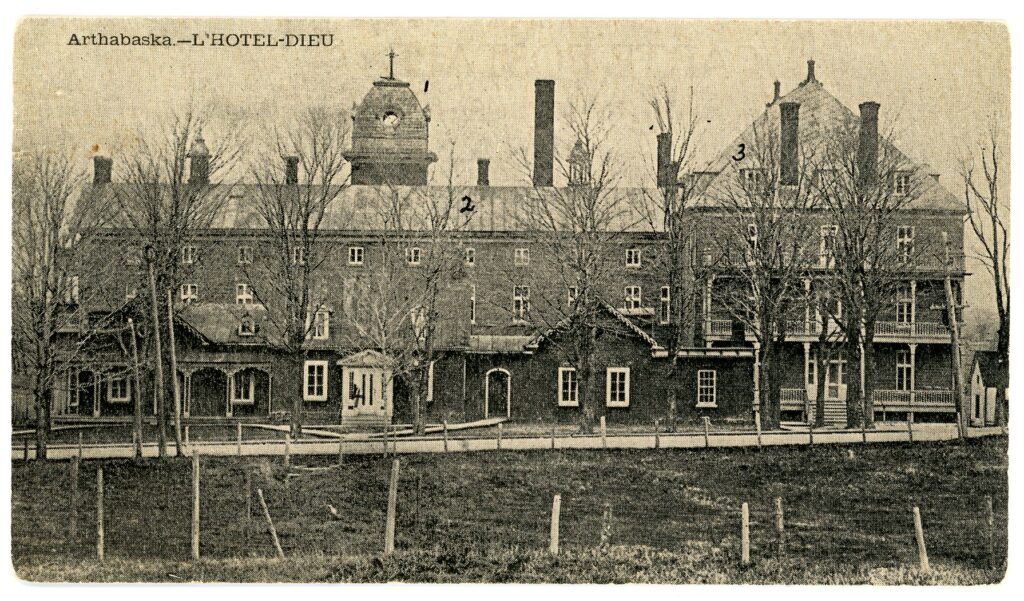
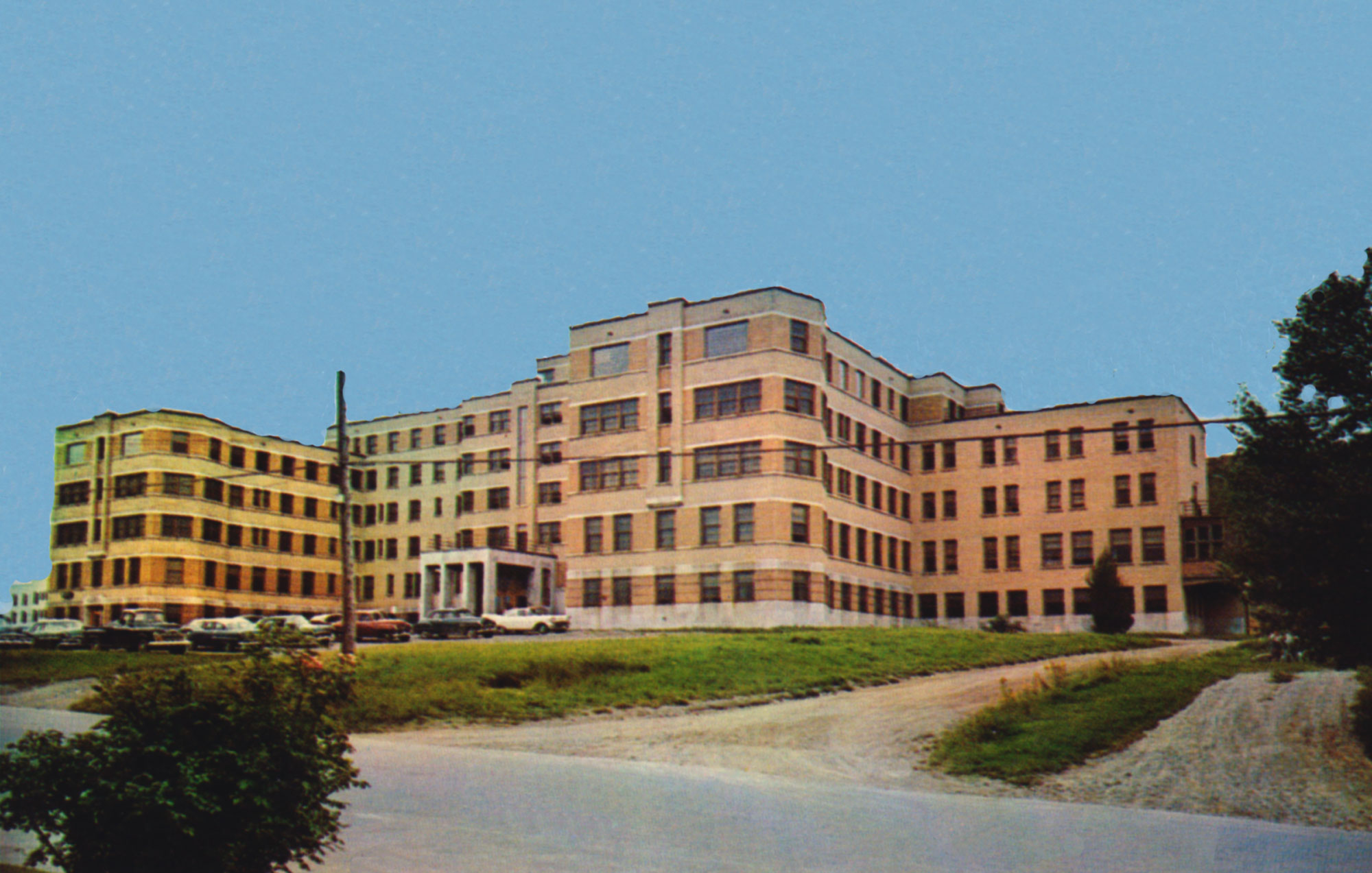
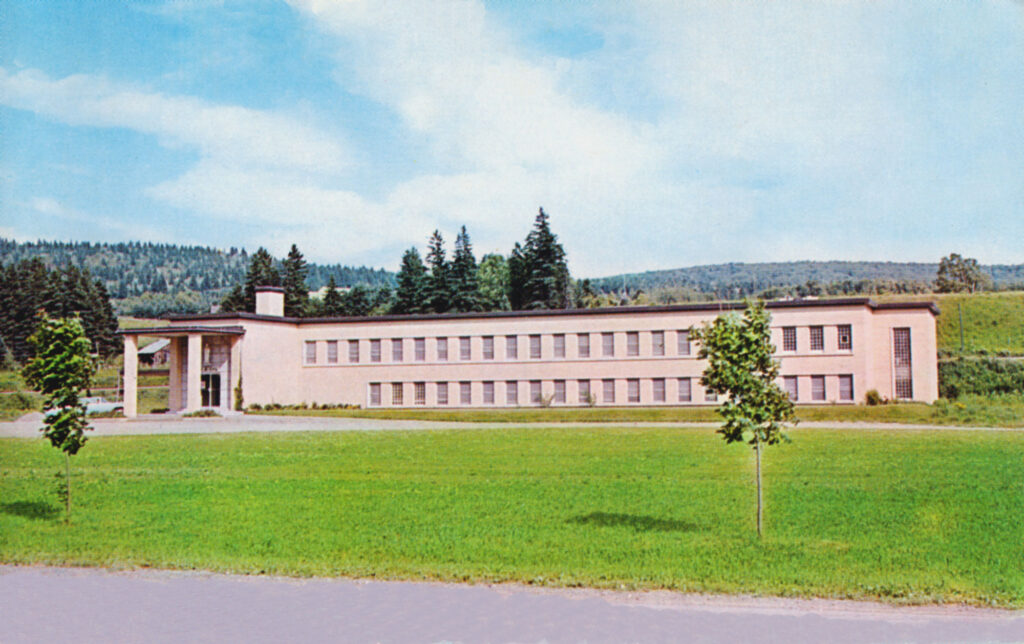
Hôtel-Dieu Saint-Joseph (postcard). Unknown photographer, 1908 - Archives Department of the General Administration of the Religious Hospitallers of Saint-Joseph.

Hôtel-Dieu Saint-Joseph, Arthabaska, Québec 1884‑1998

The incorporation of the Hôtel-Dieu de Saint-Joseph d’Arthabaska was obtained on May 4, 1885, but it was not until 1906 that the construction of the building with hospital status and with a capacity of 120 beds was undertaken. The official opening took place in June 1908.

Successive expansions brought the number of beds to 190 around 1930. A new wing built in 1923 housed around a hundred children until 1943, the year they were transferred to the diocesan orphanage in Nicolet.

In 1953, the RHSJ opened a nursing school where 555 diplomas were awarded up to 1972, year when the school was transferred to the CEGEP (College of General and Professional Education) in Victoriaville.

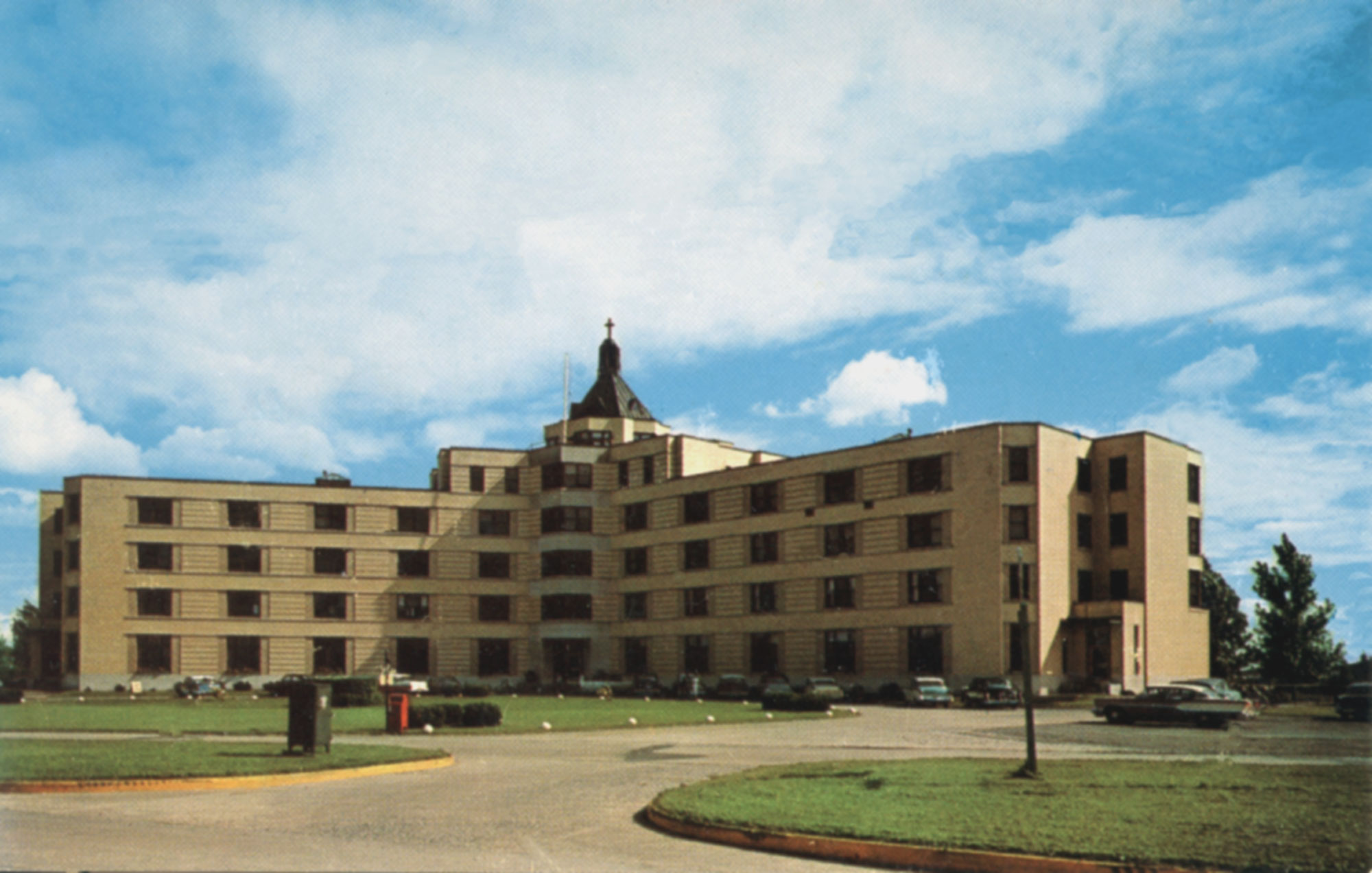
In 1960, the bed capacity of the Hôtel-Dieu was insufficient to meet the growing and increasingly specialized demand for services, so a new 300-bed hospital was built on the site of the old facility. In 1998, the Congregation transferred the Hôtel-Dieu d’Arthabaska to the provincial government.

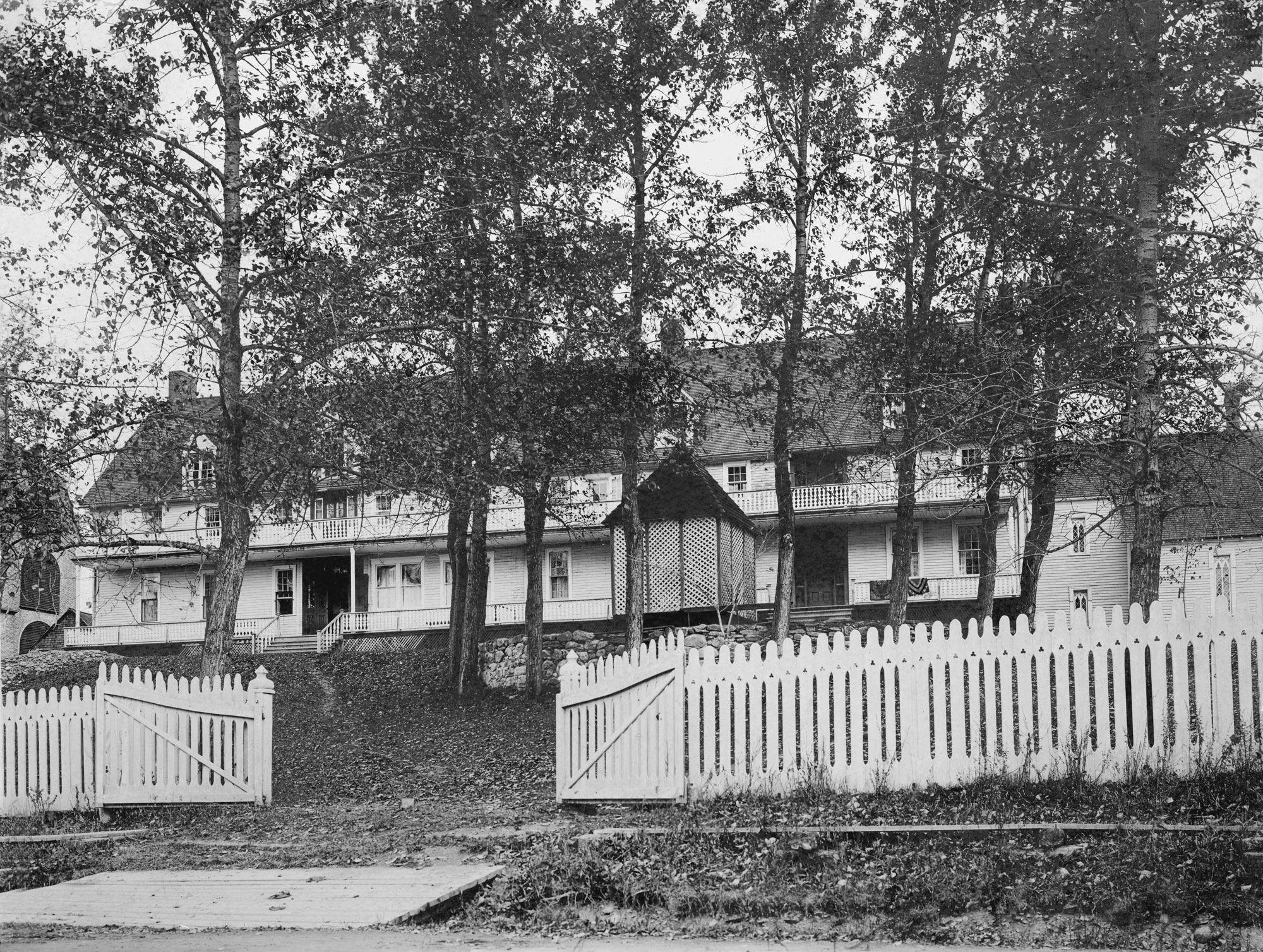
Ermitage Saint-Joseph. Unknown photographer, 1952. Archives Department of the General Administration of the Religious Hospitallers of Saint Joseph.

Ermitage Saint-Joseph, Victoriaville, Québec
1952‑1977

In May 1951, the RHSJs acquired the building of the former college of Frères du Sacré-Cœur in Victoriaville from the provincial government in accordance with a ministerial decree ordering its sale for one dollar. The renovation on the building was completed in early December 1952, and the 85 elderly residents of the Hôtel-Dieu, who had been housed in the former orphanage since 1943, found a permanent home at the Ermitage Saint-Joseph. Twelve sisters from Arthabaska accompanied them there; they managed this work until 1977, when the Ermitage was transferred to the provincial government.

Résidence Arthabaska, Victoriaville, Québec 1993‑2014

Since 1884, the Religious Hospitallers of St. Joseph have served the people of the Bois-Francs region and Résidence d’Arthabaska, founded in 1993, continued the mission of caring for the elderly and the sick. Through an Accès-Logis program they were able to apply the rent supplement offered by the provincial government to a certain number of units which allowed for sharing with less fortunate people. The Résidence d’Arthabaska ceased operations in 2014.

SOREL

Hôtel-Dieu de Sorel, Quebec, 1979. Source: Archives of the Religious Hospitallers of St. Joseph of New Brunswick.

Hotel-Dieu de Sorel, Québec
1944‑1998

Wanting a modern hospital, the people of Sorel made a request to the Grey Nuns, who were unable to accept. Following Bishop Douville’s advice, the Sorel advocates knocked on the doors of the RHSJ in Montreal and Arthabaska, where they received a double refusal. With a mandate from the advocates of the hospital, and on the advice of Bishop LeBlanc, Bishop of Bathurst, Mr. Ludger Simard approached the Hôtel-Dieu in Campbellton.

Interested in this project, after studying the plans, Sisters Berthe Arseneau and Léa Audet agreed to found a hospital in Sorel with Sister Léa Audet serving as its first administrator. The land, a gift from the Franciscan Fathers, was blessed on November 6, 1944, and construction work was completed in 1948.

In 1954, a nursing assistant school was founded at the Hôtel-Dieu de Sorel, a school that was replaced by a nursing school which operated from 1967 to 1972. The last Religious Hospitaller, Sister Simone Cournoyer, left the hospital in June 1998. The Hôtel-Dieu de Sorel was taken over by the government and it became a Health and Social Services Centre in 2008.

SAINT-JEROME

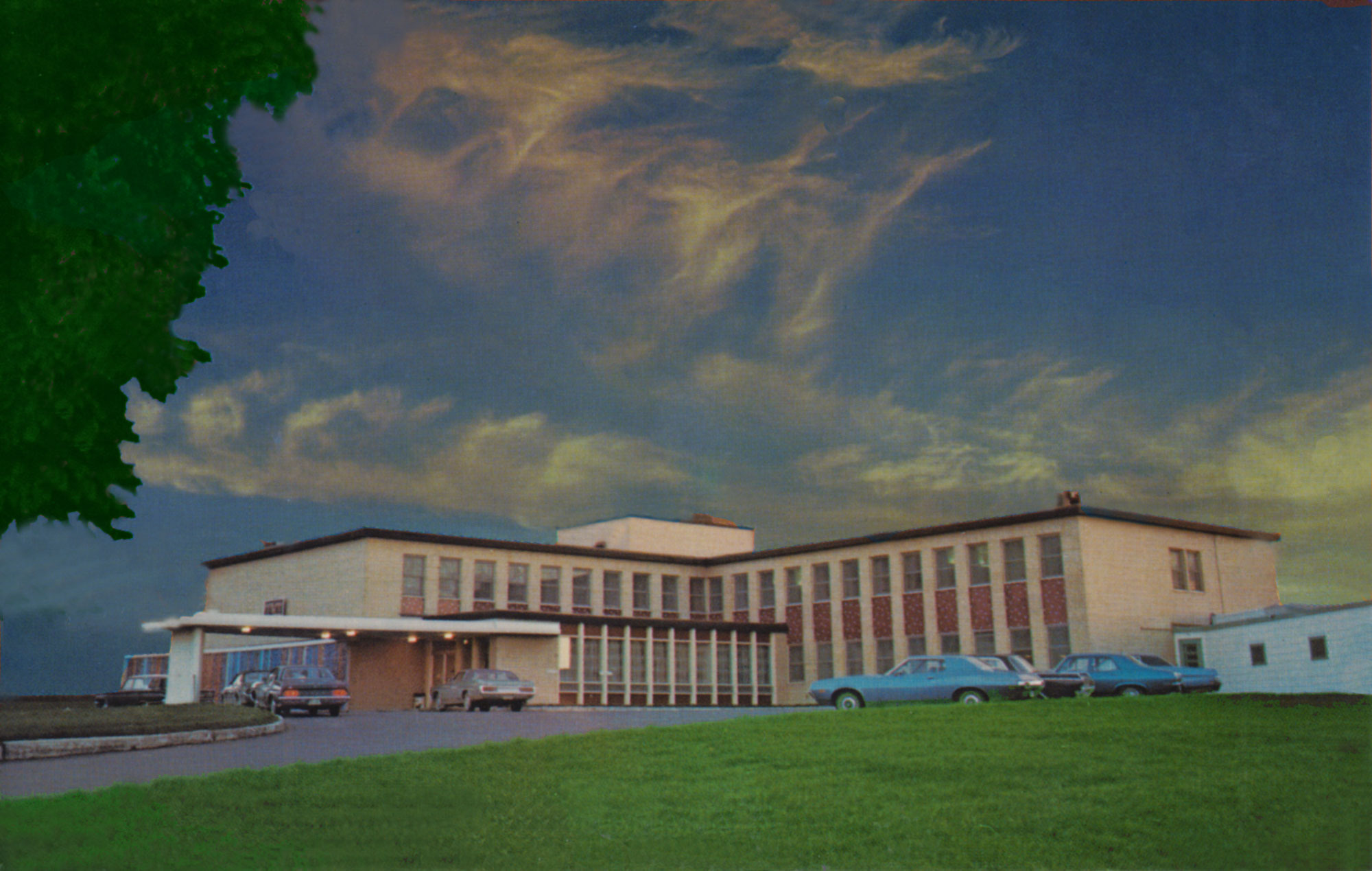
Hôtel-Dieu de Saint-Jérôme. Associated Screen News Ltd. Montreal, 1951. Archives Department of the General Administration of the Religious Hospitallers of Saint Joseph.

Hôtel-Dieu de Saint-Jérôme, Québec
1947‑1976

In 1947, the Religious Hospitallers of the Hôtel-Dieu d’Arthabaska agreed to open a hospital in Saint-Jérôme. The first patients were admitted in 1950. In 1958, a nursing school was established. In January 1969, Mr. Gaétan Bellemare became the first lay general director of the Hôtel-Dieu. In 1976, the Religious Hospitallers od Saint Joseph left Saint-Jérôme. Until 2002, two Religious Hospitallers were members of the board of directors.

BAIE-COMEAU and HAUTERIVE

Founders of the Hôtel-Dieu de Hauterive. Unknown photographer, 1950 - Archives Department of the General Administration of the Religious Hospitallers of Saint Joseph.

Hôtel-Dieu de Hauterive, Québec
1950‑1972

In the spring of 1947, Bishop Napoléon-Alexandre Labrie, Eudist and Bishop of the Gulf of St. Lawrence, went to the Hôtel-Dieu in Montreal to request five or six sisters to run a planned hospital in Baie-Comeau (Côte-Nord).

The official opening of the Hôtel-Dieu (temporarily housed at the bishopric) took place on February 2, 1951. The sisters remained there for more than four years. Construction of the Hôtel-Dieu began in September 1953. On August 26, 1955, the sisters moved into their new hospital. The Practical Nursing School at the Hôtel-Dieu de Hauterive offered classes from March 1959 to June 1972. In 1972, the hospital was transferred to the provincial government. Four years later, there were no more Religious Hospitallers at the hospital, but several would later be hired in new service areas.

Point de Rencontre, Baie-Comeau
1975‑2025+

Point de Rencontre is a residential and rehabilitation centre for people suffering from addiction to alcohol and drugs. This home was born from a call to the heart of Sister Yvonne de la Mirande, who established the helpline SOS Amitié and the Manicouagan Friendship and Assistance Centre. Men in distress, including those who are suicidal and those struggling with drug or alcohol addiction, come to the Centre looking for help. In 1979, it moved into a brand-new house built specifically for these men.

From 2005 to 2017, there were no more Religious Hospitallers on site. Then, after a few years of absence on the Côte-Nord, Sister Claire Gaudreault became involved with the organization again.

Centre de l’Amitié Nazareth, Baie-Comeau, 1983‑2004

In 1983, Sister Françoise Turcotte founded the Centre de l’Amitié Nazareth, a residence that specifically welcomes people with physical or intellectual disabilities. The Centre aims to be a community of faith and hope where the family spirit is lived, as in the Holy Family of Nazareth. The essential characteristic of the Centre is that the poor are at the heart of the community in relationships of love, trust, simplicity, and sharing. Sister Françoise left the Centre in 2004, but not without having taken care to prepare the next generation.

La Vallée des Roseaux, Baie-Comeau, 1988‑1994

The project to open a palliative care home was launched in 1982 by lay people who had graduated from the Approach to the Dying course given by Sister Odette Lavallée, who readily joined the group. A board of directors was formed and, despite ever-constrained financial resources, a 22-room home was purchased and fitted out to accommodate seven patients at a time. The Vallée des Roseaux opened its doors in May 1988.

In 1994, Sister Odette handed over the management of Vallée des Roseaux to another person, in order to devote her time to opening a palliative care training centre. By early 2003, approximately 650 patients had stayed at Vallée des Roseaux where families and friends were accompanied in their grief by caregivers.

Résidence Saint-Joseph, Hauterive/Baie-Comeau 1992‑2003

After 20 years of service at Point de Rencontre, Sister Yvonne de la Mirande noticed that a number of people who were suicidal and/or addicted to drugs or alcohol who had undergone several rehabilitation courses were unable to get back on their feet in life. To help them, Sister Yvonne formed a new corporation that, in January 1992, purchased the land and the former school in Les Buissons, which was renovated, developed, and renamed the Résidence Saint-Joseph. In 2003, Sister de la Mirande’s illness led to the closure of the Résidence Saint-Joseph.

NATASQUAN, North Shore of the St. Lawrence

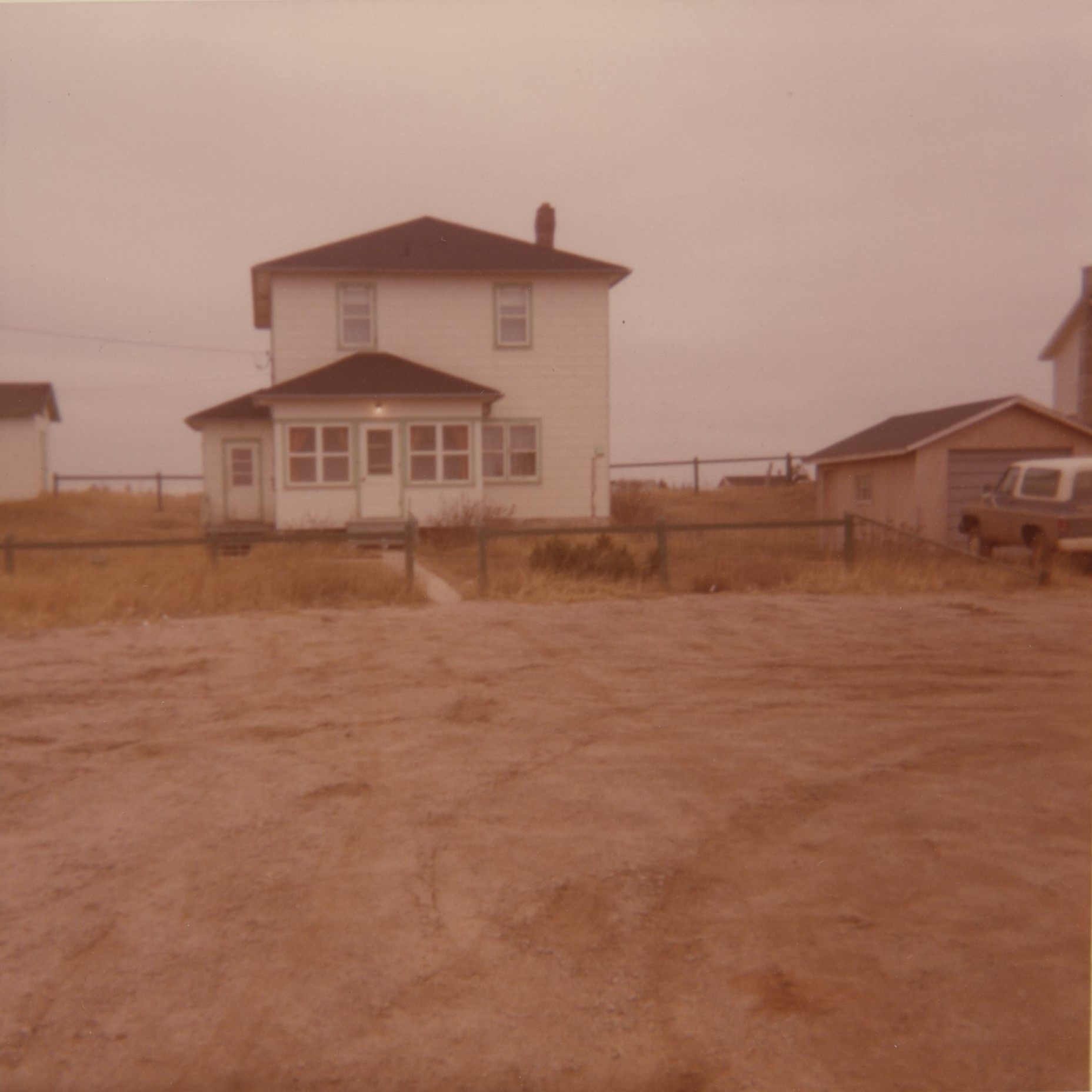
House in Natashquan. Photographer RHSJ. Archives Department of the General Administration of the Religious Hospitallers of Saint Joseph.

Natasquan Dispensary
1974‑1976

The Hôtel-Dieu de Hauterive provided care as far away as Natashquan, nearly 1,600 km to the north. Sister Madeleine St-Michel, then director of nursing at the Hauterive hospital, and Sister Léona Landry took charge of the Natashquan dispensary in September 1974. They served a population of approximately 1,500 people spread across four communities, including an Indigenous reserve. At the time, the road ended in Sept-Îles. The only means of transportation was by plane when the weather was nice and by boat once a week. In the absence of a doctor, the sisters addressed all health problems and provided preventive medicine in villages and schools. They escorted the seriously ill and injured by plane to larger treatment centres. They also took care of liturgical celebrations in the parish. The congregation withdrew from this mission in 1976.

PORT-CARTIER, North Shore of the St. Lawrence

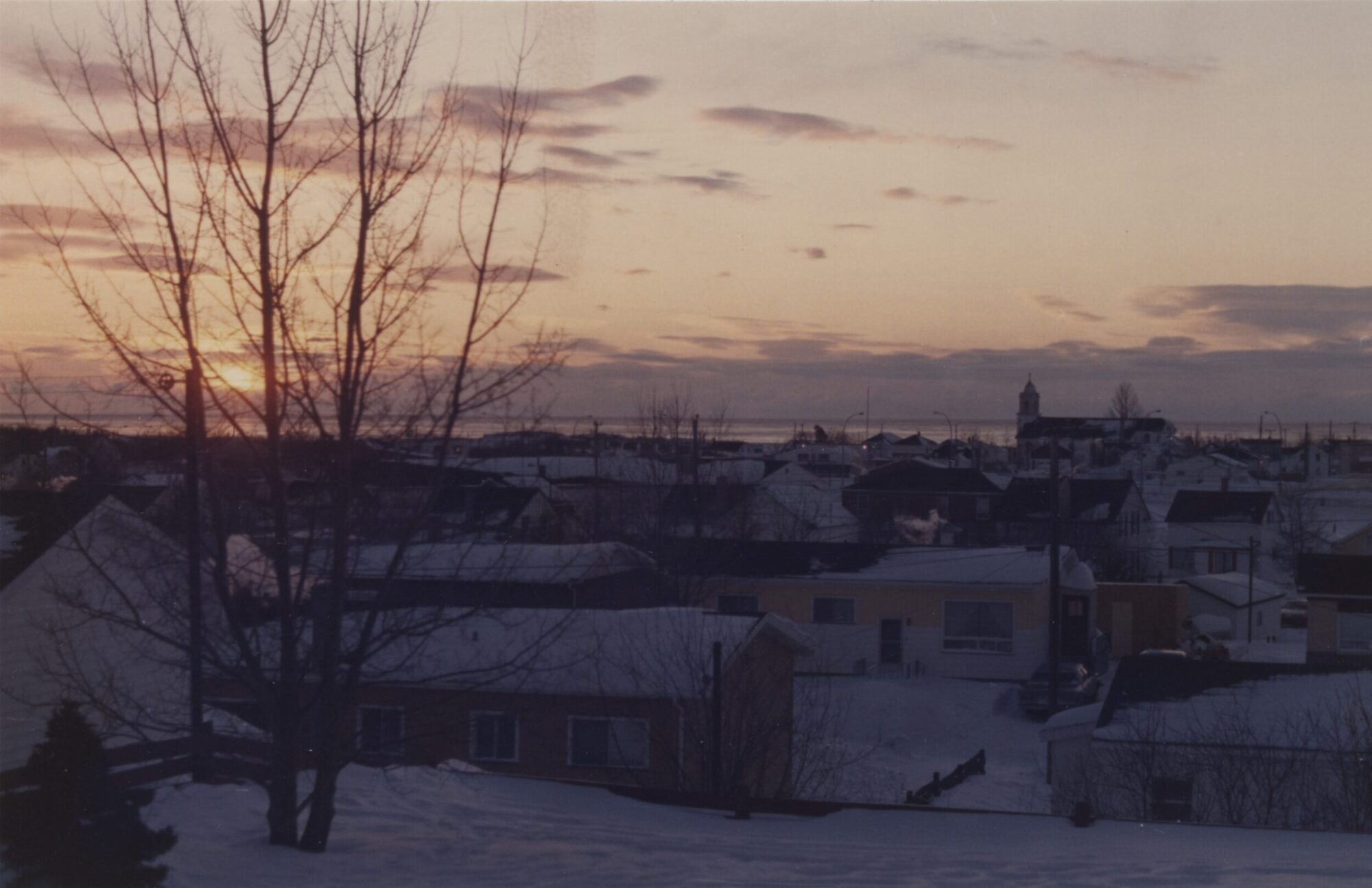
What we see from the kitchen window [Port-Cartier] Photographer RHSJ, 1986 - Archives Department of the General Administration of the Religious Hospitallers of Saint Joseph.

Patient care and social services
1974‑1995

Bishop Gérard Couturier, bishop of the diocese, desired a religious presence in this region where two factories attracted workers from all over. The sisters agreed to go there to care for the sick, provide social services, visit the sick, teach adults, and volunteer with the Sisters of the Good Shepherd. They participated in parish activities including the Welfare and Path of Faith committees, for which Sister Pauline Maillé was responsible.

For several years, the group consisted of four sisters, but their number gradually decreased. With the arrival of the Sisters du Bon-Conseil de Chicoutimi, the presence of the two Religious Hospitallers still in Port-Cartier was less necessary. On November 18, 1995, Sisters Huguette Laramée and Denise Lefebvre closed the house and returned to Montreal.

DEUX-MONTAGNES, Montreal region

Le Manoir Grand-Moulin
1977‑1981

This retirement home consists of forty well-appointed individual rooms and about twenty apartments located a few minutes from the Deux-Montagnes train station. The Religious Hospitallers of Saint Joseph were asked to take over management and in 1977, Sister Thérèse Trottier was appointed executive director, a position with multiple responsibilities: administration, admissions, resident selection, staff, etc. Lay staff eventually took over from her. In 1978, a six-bed infirmary was established, as well as the nursing office. The manor’s site is full of natural beauty and the landscape is splendid. Everything contributes to aging well.

With Sister Trottier, two or three sisters formed a community housed in a facility called “Le Boisé,” a fifteen-minute walk from the manor. The health problems of Sister Trottier and her companions forced them to leave the Manor in 1981.

Notre-Dame-de-la-Merci, Laurentians

Photo of the Dufresne River at Notre-Dame-de-la-Merci in the village near the church. "La Petite Mission" Photographer RHSJ, 1998. - Archives Department of the General Administration of the Religious Hospitallers of Saint Joseph.

Help for the sick and the destitute
1996‑2020

In 1995, a woman brought the poverty and isolation of the people in the parish of Notre-Dame-de-la-Merci to the attention of the Religious Hospitallers of Saint Joseph She hoped that sisters would establish a mission there to help the poor, the sick, and the most destitute. She was assisted by the parish priest, Father Claude Sauvageau. With the authorization of the civil authorities and the approval of the Congregation and Monsignor Gilles Lussier, Bishop of Joliette, two Religious Hospitallers arrived in the parish in September 1996. Another sister joined them in 1997. Members of the community visited people in their homes and the elderly at the Saint-Donat Home, as well as accompanying the sick and lay associates. The sisters also participated in the liturgical life of the parish.

The Community of Notre-Dame-de-la-Merci closed in the fall of 2020, after the last two sisters joined the House of Religious Hospitallers in Montreal.

ONTARIO

In Canada, the Religious Hospitallers of Saint Joseph limited their activities to Montreal for 186 years. In 1841, the Bishop of Kingston, Ontario, invited them to establish their first foundation outside Montréal. The Religious Hospitallers of Montréal founded the Hôtel-Dieu of Windsor in 1888, while the Kingston community set up foundations in Cornwall and St. Catharines. In 2025, the Religious Hospitallers of Saint Joseph are present in two locations in Ontario.

KINGSTON

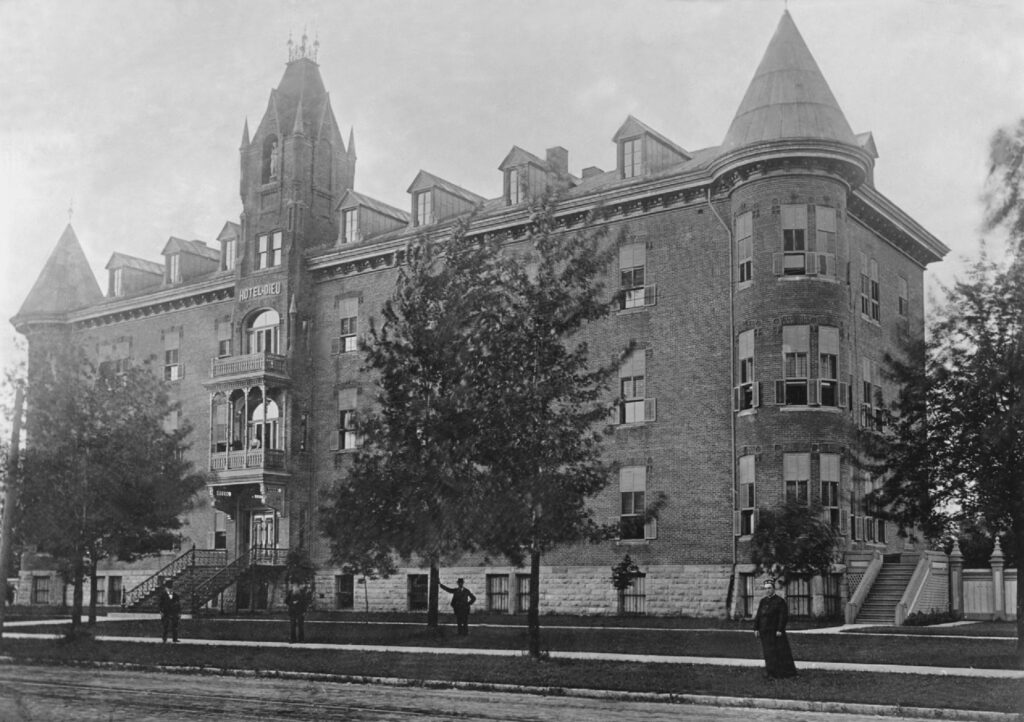
Hotel Dieu of Kingston, 1845‑2017

Hotel Dieu of Kingston, Ontario, 1895. Source: Archives of the Religious Hospitallers of St. Joseph of New Brunswick.

Beginnings of the foundation

In 1841, the Bishop of the Diocese of Kingston, Most Rev. Rémi Gaulin, asked the Religious Hospitallers of Saint Joseph of Montreal to send sisters to care for the sick, the poor, and the most needy of his city. The Religious Hospitallers agreed to found a hospital and orphanage in Kingston, Sister Amable Bourbonnière was chosen as the foundress, with Sisters Huguette Claire Latour, Louise Davignon, and Émilie Barbari appointed to assist her. At that time, housing was scarce in Kingston as it was the capital of the Province of Upper Canada. Buildings were finally obtained in 1845 and the four sisters left Montreal by steamboat on September 1 to begin the new foundation in Kingston.

Kingston RHSJ community in the Hôtel Dieu garden, 1893 (sm) - Archives of the Religious Hospitallers of St. Joseph, St. Joseph Region, Kingston, Ontario.

The Religious Hospitallers began their new ministry in two small houses on Brock Street, one for the Hotel Dieu and the other for their monastery. They expanded their hospital, adding buildings between and beside the original hospital and monastery buildings, but they continually needed more space. In 1892, the Religious Hospitallers moved across Brock Street to the former Regiopolis College on Sydenham Street. Over the years, numerous additions and renovations were made to meet the changing needs of the community. Significant buildings were added each decade of the 20th century, replacing or integrating older buildings. By the early 1980s, Kingston’s Hotel Dieu Hospital covered the entire block.

Hotel Dieu of Kingston, Ontario, 1950. Source: Archives of the Religious Hospitallers of St. Joseph of New Brunswick.

School of Nursing

Over time, it became clear that the sisters themselves could not provide all the nursing care required in their thriving hospital. To ensure the availability of highly qualified nurses, St. Joseph’s School of Nursing was founded in the hospital by Sister St. Charles (Louise O’Connor), and the first classes were held in 1912. The school remained in operation until 1974, with nearly 1,700 nurses graduating from the Hotel Dieu.

Teaching excellence continued at the School of Medical Records (1935), the School of Medical Technology (1949), and the School of Radiology (1957). Through its affiliation with Queen’s University Medical School (est. 1854), the hospital attracted top physicians, who passed on their knowledge to the next generation of residents and interns. The hospital remains a centre of research excellence.

Transition to ambulatory care

Following the restructuring of health care in Ontario in the late 1990s and early 2000s, Hotel Dieu Hospital became an ambulatory care facility. Today, it provides expert care to more than 500,000 people in Kingston and southeastern Ontario through specialized programs including pediatrics, medicine, ophthalmology, cardiology, urology, surgery, mental health, oncology, and urgent care.

On April 1, 2017, the Hotel Dieu officially integrated with Kingston General Hospital on April 1, 2017, forming the Kingston Health Sciences Centre. Within the integrated KHSC, the Hotel Dieu site remains a recognized Catholic healthcare facility. It continues to uphold the mission and values of the Religious Hospitallers of Saint Joseph and is part of Catholic Health International.

Sisters lived at the hospital and, later, across the street as the 202 Johnson Street Community until 2019.

Accommodation

Since September 2012, the Sisters of the Community of Saint Joseph of Kingston have been living with the Sisters of Providence at 1200 Princess Street. Nine sisters reside there, and one sister lives in a private residence.

This community is made up of the sisters who were previously part of the community of the St. Joseph Regional House in Amherstview and the Kingston Community at 202 Johnson Street.

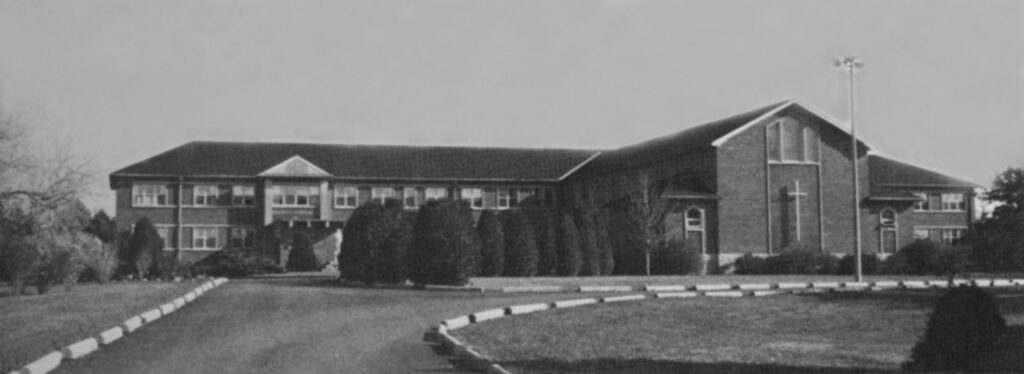
Amherstview, St. Joseph Provincial House, 1957‑2012

In 1952, under the leadership of Mother Cecelia Murray, the offices of the English Generalate and the novitiate moved from the Hotel Dieu of Kingston to a new residence, known as Mount Saint Joseph on Franklin Lake, Perth Road, Ontario.

St. Joseph Provincial House in Amherstview, Ontario, 1971. Source: Archives of the Religious Hospitallers of St. Joseph of New Brunswick.

On March 19, 1953, the English Generalate became the Saint Joseph Province. In order to be closer to Kingston, the Provincial Council, under the leadership of Provincial Superior Mother Gertrude Borden, purchased land in Amherstview and constructed a new building. It was blessed by Archbishop J.A. O’Sullivan in April 1957.

Official opening of the Saint Joseph Provincial House in Amherstview (1957). Archives Department of the Religious Hospitallers of Saint Joseph, St. Joseph Region, Kingston, Ontario.

On May 8, 1957, the sisters, novices and infirmary moved into the new Saint Joseph Provincial House. The novitiate remained in Amherstview until 1961, when the sisters in formation moved to Ottawa. From 1978 to 1987, the young sisters received their formation through the Galilee Intercongregational Program, based in Arnprior, Ontario, where the Religious Hospitallers of St. Joseph had their novitiate.

The Provincial House, which became the Regional House in 2001, served as the administrative centre for the Region until 2012.

Responding to the needs of the community

In 1957, at the request of the local Catholic community, the sisters welcomed the parishioners of Amherstview into the Holy Family Chapel until the construction and opening of the Blessed Sacrament Church in 1981.

The Religious Hospitallers of Saint Joseph responded to the needs of local children by sending teachers to local Separate Schools. On December 8, 1957, Our Lady of Mount Carmel School opened in Amherstview with Sister Gertrude McLauchlan serving as its first principal. The sisters taught at this school until 1969. They also taught at St. Linus Separate School in Bath, Ontario from 1967 to 1973.

Partners in Mission Food Bank, 1984‑2012

True to their mission to serve those most in need, the sisters established the Partners in Mission Food Bank in June 1984. With the help of volunteers, they began collecting and distributing food from their Provincial House until November 1985 when they opened a larger warehouse and distribution center at the Church of the Redeemer in Kingston. A depot was maintained at the Provincial/Regional House to continue serving those in need in Amherstview until its closure in 2012. In addition, the sisters supported the community’s Meals on Wheels program, with hot meals prepared by the kitchen staff at Saint Joseph’s Regional House and delivered to homebound individuals.

Religious Hospitallers of St. Joseph Health System, 1984‑2010

This Catholic health system was the first to be established in Canada. It was inaugurated in 1984 at the Provincial House under the presidency of Sister Rosalia Cobey. In 1988, the Religious Hospitallers of St. Joseph Health System’s headquarters were moved to Kingston and, in 2010, it was integrated into Catholic Health International.

Windsor, Ontario

Hôtel-Dieu of Windsor: hospital, orphanage, school, 1888‑2010

Hôtel-Dieu of Windsor, Ontario, 1890. Source: Archives of the Religious Hospitallers of St. Joseph of New Brunswick.

The beginnings of the foundation

The Hôtel-Dieu of Windsor was founded in 1888 at the request of Dean J.T. Wagner and Bishop John Walsh of London, Ontario. Dean Wagner wanted to establish a school and orphanage to care for Black children emigrating from the southern United States.

Mother Justine Bonneau, Superior of Montreal, offered the assistance of the Religious Hospitallers of St. Joseph. Dean Wagner seized this opportunity and invited them to Windsor to build a hospital as well as to open an orphanage and school. Mother Joséphine Paquette, accompanied by Sisters Joséphine Lamoureux, Philomène Carrière, Joséphine Boucher, and Victoire Caron, left the Motherhouse in Montreal to undertake this new mission, arriving in Windsor on September 14, 1888. The orphanage and school for Black children opened in 1890 and served the region until December 31, 1892. Three children remained under the sisters’ care until March 5, 1893.

Windsor RHSJ Community, 1965. Archives Department of the Religious Hospitallers of St. Joseph, St. Joseph Region, Kingston, Ontario.

In February 1890, the 100-bed Hôtel-Dieu of Windsor Hospital opened after a year and a half of construction. New wings were added and major renovations were undertaken over the years, transforming the hospital into a modern, 450-bed acute care facility capable of accommodating over 130,000 patients annually.

Hôtel-Dieu of Windsor, Ontario, 1928. Source: Archives of the Religious Hospitallers of St. Joseph of New Brunswick.

In 1993, the Windsor Sisters entered into an Alliance Agreement with the Salvation Army, and the hospital was renamed Hôtel-Dieu Grace. In October 2013, Hotel-Dieu Grace and Windsor Regional Hospital reorganized hospital services in the City of Windsor. Hôtel-Dieu Grace assumed operations at Windsor Regional Hospital’s Tayfour Campus on Prince Road and Windsor Regional Hospital assumed operations at Hôtel-Dieu Grace located downtown on Ouellette Avenue. Hôtel-Dieu Grace Hospital, renamed Hôtel-Dieu Grace Healthcare, provides services in mental health and addiction, child and adolescent mental health, rehabilitation, complex medical care, and palliative care.

Villa Maria Home - Unknown photographer, 1986. Archives Department of the General Administration of the Religious Hospitallers of Saint Joseph.

Caring for the elderly

Caring for the elderly had been a concern for the sisters for some time. In 1944, the Religious Hospitallers of St. Joseph purchased the Murphy House on Riverside Drive to house 15 people. Three sisters—Sisters Maria Guévin, Catherine Renaud, and Stella Tremblay—left the hospital community to take charge of the home, known at the time as St. John the Evangelist Home and later as Villa Maria Residence.

As the community’s needs grew, the sisters purchased an adjacent residence that could provide care for more than 27 people. In 1950, supported by a diocesan campaign, the sisters acquired a neighboring house that could accommodate 15 additional residents. Since the three separate houses presented numerous drawbacks, the decision was made to begin construction of a new seniors’ residence, which opened its doors on September 23, 1956. The attractive two-story building, located on the banks of the Detroit River, had a capacity of 120 beds. In 2003, the Ontario government decided to close the Villa Maria residence, and the sisters left to join the Hôtel-Dieu community.

In 2009, the last sisters left Hotel-Dieu of Windsor. They were appointed to the Saint Joseph Regional House in Amherstview and the Mother House in Montreal. Sister Rose-Marie Dufault remained in Windsor to complete the closing transactions and returned to the Mother House in Montreal in April 2010.

Cornwall

Cornwall RHSJ Community, 1903. Archives Department of the Religious Hospitallers of St. Joseph, St. Joseph Region, Kingston, Ontario.

Hotel Dieu of Cornwall, 1897‑1955

At the invitation of Bishop Alexander Macdonnell, the first Bishop of Alexandria, the Religious Hospitallers St. Joseph of Kingston set out to open a hospital in Cornwall. This new mission was entrusted to five sisters: Sisters Mary Ann Donnelly, Ann Hopkins, Janet Macdonell, Margaret Powers, and Katherine McCarthy. The first foundation of the Religious Hospitallers of Saint Joseph Kingston became a reality in Cornwall on February 9, 1897, when the Hotel Dieu opened in the newly renovated home of former Ontario Premier John Sandfield Macdonald. A new hospital was soon built on Water Street.

Hotel Dieu of Cornwall, Ontario, 1938. Source: Archives of the Religious Hospitallers of St. Joseph of New Brunswick.

Macdonell Memorial Hospital, 1955

As the facilities on Water Street were no longer sufficient to meet the growing needs of the community, the sisters planned the construction of a new hospital on property bequeathed to the Religious Hospitallers of St. Joseph by the Allan Macdonell family. In September 1955, the modern Hotel Dieu Hospital was completed and officially opened on McConnell Avenue. The original hospital, located on Water Street, was renovated to accommodate patients with chronic illnesses. It was renamed the Macdonell Memorial Hospital.

In 1989, a new 100-bed addition was built at Hotel Dieu and chronically ill patients were transferred from Macdonell Memorial to the new Janet Macdonell Pavilion. In 1992, the Religious Hospitallers of St. Joseph Housing Corporation converted the Macdonell Memorial Hospital building into the Marie-de-la-Ferre Apartments, a non-profit building for the elderly, comprising 59 apartments, including six for the disabled.

St. Paul’s Home and Saint Joseph’s Villa, 1898-2025+

In 1898, the Religious Hospitallers of St. Joseph opened St. Paul’s Home to care for the elderly. At its maximum capacity, the home accommodated 100 residents in four large dormitories. After more than 65 years of service, St. Paul’s Home was closed and demolished in 1964. A new facility, St. Joseph’s Villa, was built by integrating the nurses’ residence and the former Hotel Dieu Nursing School, opened in 1928 and closed in 1967 with the creation of the Cornwall Regional Nursing School. The Villa, with a capacity of 150 beds, was inaugurated on August 27, 1969.

In 1998, the Villa’s facilities needed modernization but the planned renovations could not meet current standards. It was therefore decided to rebuild on the York Street site. As part of the province’s healthcare restructuring process, the Religious Hospitallers of St. Joseph decided to transfer the Hotel Dieu Hospital site to the city of Cornwall and to assume responsibility for long-term care and complex continuing care in a new facility on the Villa site. With the implementation of these directions in 2004, the name of the facility was changed to St. Joseph’s Continuing Care Centre.

The St. Joseph’s Continuing Care Centre, which includes complex and long-term continuing care facilities, was undertaken in two phases with the opening of the new St. Joseph’s Villa in December 2007. The second phase of 59 complex continuing care beds, replacing the services provided by the Janet Macdonell Pavilion, opened in July 2009.

The Nazareth Orphanage, 1909‑1950

In 1909, two small houses adjacent to St. Paul’s Home were purchased and renovated to accommodate destitute children. The following year, a large house was purchased that could accommodate 24 children. And, in 1919, when Mrs. John McMartin donated her house on Second Street, the Nazareth Orphanage housed up to 100 children at a time. The building burned down in 1950 and, at that time, services were transferred to the Children’s Aid Society.

The presence of the Religious Hospitallers of Saint Joseph continued in Cornwall until the end of August 2006, when Sister Patricia Cuddihy, who was the liaison with the St. Joseph’s Continuing Care Centre, left Cornwall.

ST. CATHARINES

Hotel Dieu of St. Catharines, 1945‑2025+

Hotel Dieu of St. Catharines, Ontario, 1971. Source: The Archives of the Religious Hospitallers of St. Joseph of New Brunswick.

Foundation

Archbishop James C. McGuigan of Toronto, Ontario, encouraged the Religious Hospitallers of St. Joseph of Kingston to accept a new mission and open the only Catholic hospital in the Niagara Peninsula in what is now the Diocese of St. Catharines.

In the fall of 1945, Sisters Mary Immaculate (Sarah Kathleen Kennedy), St. Catherine (Catherine Brennan), and Veronica Callaghan left the Hotel Dieu of Kingston to found this new community. After overcoming many obstacles, the Hotel Dieu of St. Catharines opened in 1948 as a 29-bed maternity hospital in the Woodruff Mansion. In 1953, a new 125-bed Hotel Dieu was built across the street from the maternity hospital. The hospital was expanded in 1962 with the addition of a five-story addition, and its services continued to expand.

The Ontario government’s hospital restructuring, which began in the mid-1990s, led to changes at Hotel Dieu Hospital in St. Catharines. In 2005, the Hotel Dieu changed its mandate from providing acute care to providing complex care and rehabilitation. The Religious Hospitallers of Saint Joseph left Hotel Dieu and assumed governance and management of Shaver Hospital and the Niagara Rehabilitation Centre. The new Hotel Dieu Shaver Health and Rehabilitation Centre provides complex continuing care and rehabilitation services to patients in St. Catharines and the Niagara region, as well as outpatient rehabilitation services, including audiology and speech-language pathology.

Mission

To bear witness to a God who frees and unites, by showing tender compassion to the sick and suffering in the hospital and in our region.

Sister Louise Dillon, rhsj, St. Catharines. - Archives Department of the Religious Hospitallers of St. Joseph, St. Joseph Region, Kingston, Ontario.

In 2025

One Religious Hospitaller of St. Joseph is present in the parish and holds the position of Director of Mission and Pastoral Services at the Hotel Dieu Shaver Health and Rehabilitation Center.

NEW BRUNSWICK

Geographic map. Locations of the Religious Hospitallers of New Brunswick. 1986. Source: Archives of the Religious Hospitallers of St. Joseph of New Brunswick.

« Arriving in New Brunswick in 1868, the Hospitallers of Saint Joseph were pioneers and innovators in hospital care and education. Faithful to the spirit bequeathed by their founder, Jérôme Le Royer de la Dauversière, they sought to respond to the calls of the poor, the sick, and the destitute. » (« Editor’s Note, », in Revue de la société historique du Madawaska, June 1986.)

« Œuvres des Religieuses Hospitalières de Saint-Joseph du Nouveau-Brunswick (1868-1986) », by the sisters Georgette Desjardins and Corinne LaPlante. Revue de la Société historique du Madawaska, vol. XIV, nos 1 et 2, june 1986.

Foundations in New Brunswick by the Religious Hospitallers of Montreal, 1868‑1888

To meet the pressing health and education needs of the people of New Brunswick in the 19th century, the Religious Hospitallers of the Hôtel-Dieu de Montréal generously accepted four foundations between 1868 and 1888: Tracadie, Chatham (now Miramichi), Saint-Basile de Madawaska and Campbellton.

In 1845, the Religious Hospitallers of Montreal had opened a Hotel-Dieu in Kingston, Ontario, in response to the bishop’s request to send Religious Hospitallers to care for the Irish Catholics in the city. In 1868, a new cry for help was heard: leprosy patients were awaiting their aid and relief in Tracadie, a distant Acadian village in eastern Canada.

Sister Marie Pagé, the first Superior of the Lazaretto, deeply touched by the needs of the people, would be present at the beginning of two other foundations in New Brunswick where the sisters would teach and care for the sick: Chatham (now the city of Miramichi) in 1869 and Saint-Basile de Madawaska in 1873. Sisters from Montreal would also respond to the request to send sisters to Campbellton in 1888, for the same reasons.

Other foundations would emerge from these four large establishments run by the Religious Hospitallers of St. Joseph, which provided care for the sick and elderly, as well as education for young people. The Académie Sainte-Famille in Tracadie, St. Michael’s Academy in Chatham, and the Académie de l’Hôtel-Dieu de St. Basile provided education from primary to secondary school and were a source of recruitment for the congregation.

Expansion of the works of the Religious Hospitallers of New Brunswick, 1932 à 2012

A sanatorium for patients with pulmonary tuberculosis was opened in 1932 in Vallée-Lourdes, in the northeast of the province, by the Community of Tracadie and constitutes the first foundation of the Religious Hospitallers of St. Joseph of New Brunswick.

The Dunn House in Vallée-Lourdes, which the Religious Hospitallers took possession of in 1931, served as a common novitiate in 1935 and as a Mother House for the Acadian Generalate from 1946 to 1951.

The Vallée-Lourdes Sanatorium Community in turn founded the Hôtel-Dieu St-Joseph de Bathurst in 1942 and the Foyer St-Camille-de-Lellis in 1943.

Meanwhile, in Madawaska, in 1938, the Hôtel-Dieu St-Joseph de Saint-Basile agreed to open a small hospital in Van Buren, Maine, near the American-Canadian border. The Hôtel-Dieu de Saint-Basile also founded two major health care facilities in Madawaska: the Sanatorium St-Joseph in Saint-Basile and the Hôtel-Dieu St-Joseph d’Edmundston, both of which opened in November 1946.

The New Brunswick sisters also crossed the border into Quebec to found a Hôtel-Dieu in Sorel. Following the refusals of the Religious Hospitallers of Montreal and Arthabaska, Ludger Simard, a wealthy industrialist from Sorel, approached the Religious Hospitallers of the Hôtel-Dieu in Campbellton. The Hôtel-Dieu St-Joseph in Sorel officially opened its doors in June 1948.

The year 1948 also marked the beginning of the missions of the Religious Hospitallers of St. Joseph of New Brunswick in Peru. They founded missions at the leper colony of San Pablo, Amazonia, in 1948; Hogar de la Madre, Lima, in 1951; Indiana, Amazonia, in 1955; Hospital of Huaraz in 1959; Hospital del Empleado in Lima in 1961; Siete de Octubre, in Valdiviezo, Lima, in 1973; Punchana, Iquitos, in 1977; Santa Anita in Lima in 1988; and San Carlos in Lima in 1999.

Several small hospitals were opened in New Brunswick in the mid-20th century. These were the Hôtel-Dieu St-Joseph in Saint-Quentin in 1947; the Hôtel-Dieu St-Joseph in Perth-Andover in 1947; the Pavillon LaDauversière in Bathurst in 1948; and the Hôtel-Dieu St-Joseph in Lamèque in 1949.

For the needs of the Notre-Dame-de-l’Assomption (NDA) Province, the NDA Provincial House was built in Bathurst in 1953, and the Scholasticat Marie-de-la-Ferre and Maillet College in Saint-Basile for the training of young sisters was built in 1963.

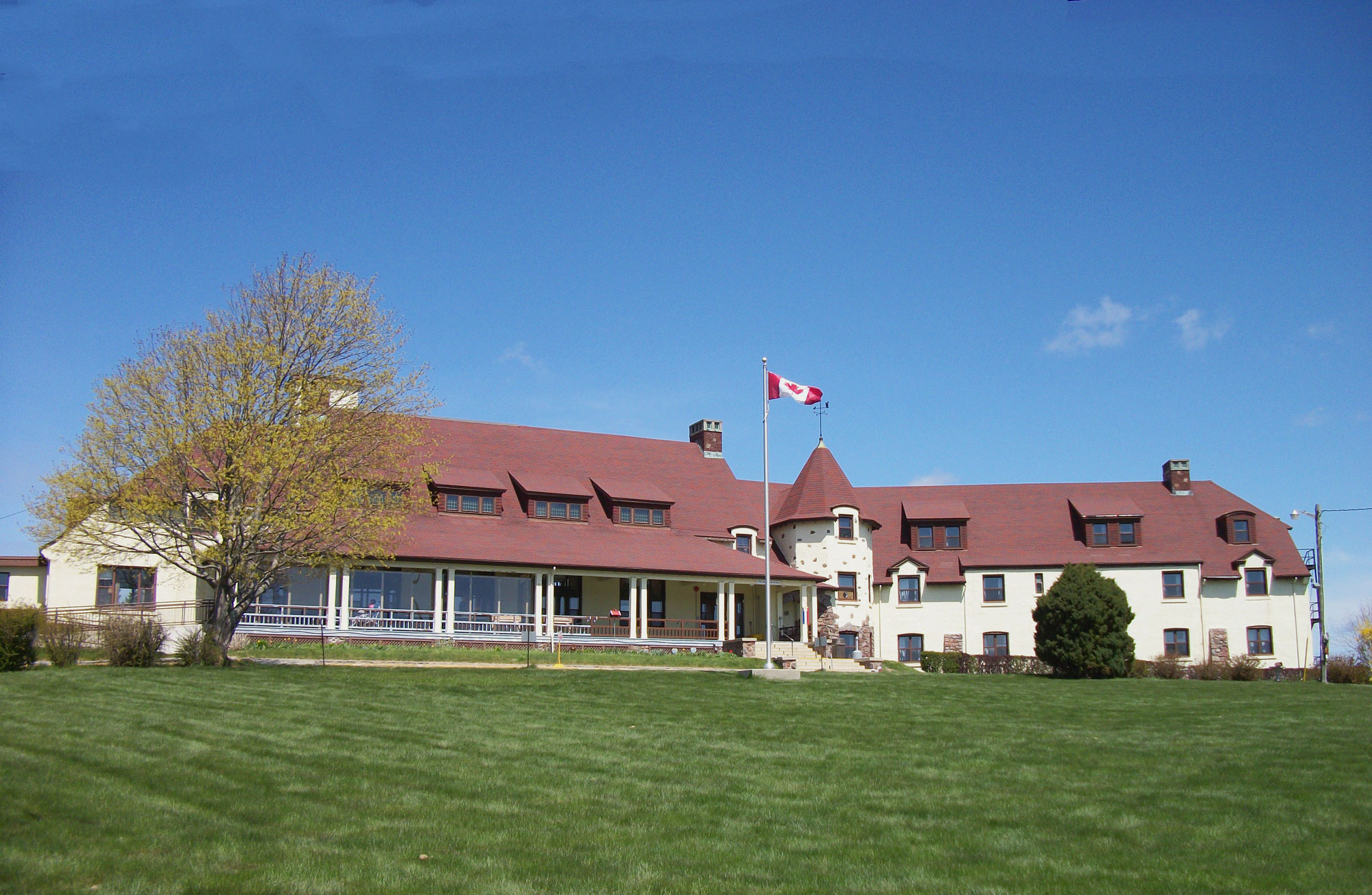
The Religious Hospitallers of New Brunswick agreed to operate a nursing home in Yarmouth, Nova Scotia. St. Joseph’s Home, which opened in 1958, was renamed Villa St. Joseph-du-Lac when it moved to a former CPR summer hotel in Dayton, near Yarmouth.

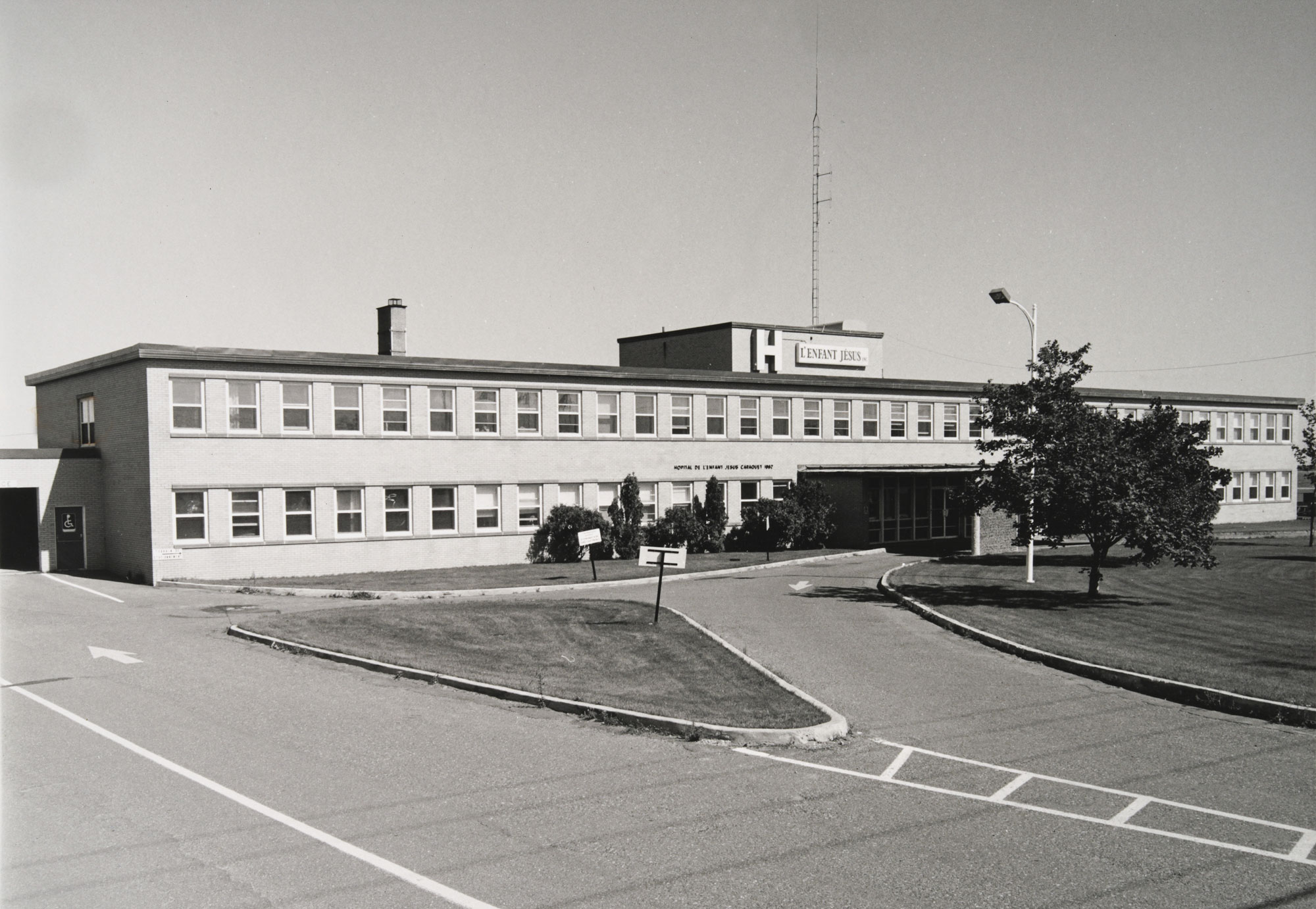
Hospitals for small towns in New Brunswick were then built: the Hôpital de l’Enfant-Jésus in Caraquet in 1963 and the General Hospital in Grand-Sault in 1964. The sanatoriums in Saint-Basile and Bathurst were transformed into nursing homes, becoming the Foyer Notre-Dame-de-Lourdes in Bathurst in 1974 and the Foyer St-Joseph in Saint-Basile in 1976.

Several communities with social and charitable vocations were inaugurated in the 1970s: the Maison de Brantville in 1974; the home at the Maison du 2080, Vallée-Lourdes, in 1978; CentrAide Le Royer in Saint-Basile, 1978; and the Accueil Ste-Famille in Tracadie, in 1979.

The Sisters of New Brunswick also opened houses in Mexico: Maison St-Joseph, in Mexico City in 1992; Communauté Ste-Famille in Chalco, 1993; Hogar San José, Huitzilzingo, Chalco, 1999; and Tenejapa, in Chiapas, in 2012.

All the foundations under the Religious Hospitallers of New Brunswick are divided into several categories according to the works and needs over 150 years (1868-2019). For health care: 11 large and small establishments bearing the name of Hôtel-Dieu, 4 general hospitals, 6 nursing homes for the elderly and the disabled, 2 Lazarettos to treat patients with leprosy, 2 sanatoriums for tuberculosis patients, 1 maternity hospital and 2 nurseries, 2 clinics in rural areas. For social needs: 1 preventorium, 3 residential services homes and 4 residential homes in disadvantaged areas. For education: 4 kindergartens, 2 schools, 5 boarding schools, 3 academies, 1 classical college, 5 nursing schools and 3 nursing auxiliary schools. For large establishments: 5 agricultural and dairy farms and outbuildings, chicken coops, farmyards, gardens, orchards etc. For the congregation: 1 provincial house, 2 regional houses and 4 formation houses.

By 2024, the sisters no longer owned or managed these institutions but, to ensure continuity, some were entrusted to their successor, Catholic Health International, headquartered in Miramichi, New Brunswick.

TRACADIE

The Tracadie Lazaretto was the first in a series of hospital and educational institutions founded by the Religious Hospitallers of St. Joseph in New Brunswick. In addition to caring for people afflicted by leprosy at the Lazaretto, the Religious Hospitallers opened an orphanage and founded the Sainte-Famille Academy for education at all levels, as well as a general hospital, which would become the first Hôtel-Dieu in New Brunswick. The sisters would later open training schools for nurses and auxiliaries, as well as a women’s shelter for victims of violence.

Enlarged wooden Lazaretto: from left to right, visitors' house, sisters' house, chapel, Lazaretto with men's room on the first floor and women's room on the second. Former chapel house at the rear: pharmacy, kitchen, laundry, with orphanage on the second floor in 1888. Around 1895. Source: Archives of the Religious Hospitallers of St. Joseph of New Brunswick.

The Tracadie Lazaretto, 1868‑1965

Leprosy first appeared in northeastern New Brunswick in the early 19th century. In 1844, the provincial Board of Health ordered the confinement of about thirty people afflicted by leprosy on Sheldrake Island in the Miramichi River. They lived miserably there and some fled. Father Lafrance, the parish priest of Tracadie, convinced members of the Gloucester County Board of Health to bring the sick back to the mainland and offered them land near his presbytery. In 1849, a wooden Lazaretto surrounded by a high fence was built in Tracadie. Dr. Labillois was very devoted to the people but his successor neglected them. Disorder set in at the Lazaretto, where filth and misery reigned.

Enlarged wooden Lazaretto: from left to right, visitors' house, sisters' house, chapel, Lazaretto with men's room on the first floor and women's room on the second. Former chapel house at the rear: pharmacy, kitchen, laundry, with orphanage on the second floor in 1888. Around 1895. Source: Archives of the Religious Hospitallers of St. Joseph of New Brunswick.
Lazaretto, a fieldstone building opened in 1896. Source: Archives of the Religious Hospitallers of St. Joseph of New Brunswick.

Father Ferdinand Gauvreau, who became parish priest of Tracadie in 1852, made representations to civil and religious authorities to improve the situation. In 1860, Bishop Rogers of Chatham authorized the arrival of a religious community. It was mainly thanks to Bishop Paquet’s efforts that the Religious Hospitallers of Montreal agreed to send sisters to Tracadie. Thus, Mother Marie Pagé, Superior, and her companions, trained to take charge of caring for the sick, pharmacy, cooking, and domestic tasks, arrived at the Lazaretto on September 29, 1868. An extension to the Lazaretto was built and furnished to accommodate them, and the provincial government granted them a subsidy to care for people afflicted by leprosy.

Under the leadership of the Religious Hospitallers, the Tracadie Lazaretto gradually transformed into a small, well-ordered hospital, promoting the well-being of its patients. In 1880, the Canadian federal government, through the Departments of Agriculture and Public Health, took full responsibility for the Lazaretto and entrusted its administration to the sisters. By 1881, the pharmacy and dispensary had been set up in an annex at the rear of the Lazaretto. Sister St-Jean-de-Goto, who was a pharmacist, collaborated with Dr. J.-C. Taché of the Department of Agriculture in the search for a medication capable of curing leprosy. At the time, treatment relied on chaulmoogra oil.

Lazaretto, a fieldstone building opened in 1896. Source: Archives of the Religious Hospitallers of St. Joseph of New Brunswick.
Enlarged wooden Lazaretto: from left to right, visitors' house, sisters' house, chapel, Lazaretto with men's room on the first floor and women's room on the second. Former chapel house at the rear: pharmacy, kitchen, laundry, with orphanage on the second floor in 1888. Around 1895. Source: Archives of the Religious Hospitallers of St. Joseph of New Brunswick.
Lazaretto, a fieldstone building opened in 1896. Source: Archives of the Religious Hospitallers of St. Joseph of New Brunswick.

As the wooden Lazaretto no longer met the needs of the community, the federal government approved the construction of a new fieldstone building, which opened in 1896. The name Lazaretto is inscribed on the facade above the main entrance. The right wing was reserved for the people afflicted by leprosy, while the left wing served as a monastery for the growing number of sisters. A new building built behind the monastery in 1898 served as a general hospital and orphanage.

After serving for over 45 years as a Lazaretto, monastery, and general hospital, these two buildings burned down in 1943. People afflicted by leprosy were treated in Dr. Ryan’s former home and, as their numbers were dwindling, they were later housed in a smaller wing behind the new Hôtel-Dieu. The federal government provided substantial funding. With the advent of sulfones in the early 1950s, leprosy could be cured. From its beginnings in 1868 to the closure of the Lazaretto in 1965, the Religious Hospitallers of St. Joseph of Tracadie treated 326 people afflicted by leprosy, including about 40 foreign nationals. Some of the sisters who worked there were still alive in 2024.

Hôtel-Dieu de Tracadie: view of the gardens in the foreground, hospital (left) and cloister (right). Fieldstone building built in 1898 behind the Lazaretto to serve as a general hospital and orphanage. Source: Archives of the Religious Hospitallers of St. Joseph of New Brunswick.

Hôtel-Dieu de St-Joseph, Tracadie, 1898‑1988

From the moment they arrived in Tracadie, the Religious Hospitallers were concerned about the fate of the orphans and sick who sought their help. The pharmacist Sister St. Jean-de-Goto (born Amanda Viger) opened a small dispensary for the local population. Due to lack of space in the house, no sick people were hospitalized. Having become Superior in 1875, Sister St. Jean-de-Goto had “fifty cords of stone drawn from the quarry” for the construction of a general hospital and an orphanage. Since the sisters lacked the necessary funds and the bishop forbade them from borrowing, they would have to wait about twenty years for these stones to be used.

The project was completed in 1898 thanks to generous donors. With the support of Father Théberge, former parish priest of Néguac, and Father Babineau, parish priest of Tracadie, the Religious Hospitallers had a fieldstone building constructed on federal government land behind the new Lazaretto which had opened in 1896. On the day of the general hospital’s official opening, six patients were admitted. This marked the beginning of the Hôtel-Dieu de St-Joseph, the second branch of patient care in Tracadie. Its administration was separate from that of the Lazaretto and the New Brunswick government provided small subsidies. The Hôtel-Dieu farm provided food and income for the institution.

In 1922, the new Superior, Sister LaDauversière (born Isabelle Sormany), had the hospital renovated, including the installation of a surgical suite. Some sisters enrolled in the nursing course at the Hôtel-Dieu in Campbellton, while others went on to take the pharmacy course with the Religious Hospitallers of Chatham. Dr. J.E. Paulin became the Hôtel-Dieu’s first resident physician in 1920 and the medical office established in 1925 contributed to the progress of the Hôtel-Dieu. In 1934, Dr. Aldoria Robichaud took over medical services at the Hôtel-Dieu.

Hôtel-Dieu de Tracadie: view of the gardens in the foreground, hospital (left) and cloister (right). Fieldstone building built in 1898 behind the Lazaretto to serve as a general hospital and orphanage. Source: Archives of the Religious Hospitallers of St. Joseph of New Brunswick.
Hôtel-Dieu St-Joseph de Tracadie, 1946-1988. Later demolished. Source: Archives of the Religious Hospitallers of St. Joseph of New Brunswick.

Unfortunately, in January 1943, a fire destroyed everything: the hospital, the Lazaretto, and the monastery. The sick and the sisters found refuge at the nearby Sainte-Famille Academy. Since it was wartime, a special permit was granted for the reconstruction of the hospital. The issuance of $35,000.00 in bonds was approved by the religious authorities. The new Hôtel-Dieu would include a 100-bed hospital, a chapel, and a monastery for the sisters. The federal government granted $30,000.00 for the leprosy wing. The blessing and official opening of the Hôtel-Dieu took place on July 24, 1946.

Since the Hôtel-Dieu’s inception in 1898, the Religious Hospitallers have been responsible for the administration and management of all its services. The sisters did not receive any remuneration, but starting in 1948, following the advice of consultant Mr. Dick, salaries were recorded in the books under accounts receivable. Thus, the per diem, which was very low, was standardized.

The major changes in New Brunswick’s healthcare system that took place in the mid-20th century would impact all of the Religious Hospitallers of St. Joseph hospitals. Starting July 1, 1959, the province’s new Hospital Insurance Plan came into effect. This was a boon for both the population and hospitals. Around 1970, health insurance also covered physician fees.

Since 1968, the Hôtel-Dieu de Tracadie has had by-laws and a Board of Directors that reported to the Board of Governors of the Religious Hospitallers of St. Joseph in Vallée-Lourdes. In 1976, the first lay director general was appointed. In 1988, a modern regional hospital was built in Tracadie to replace the 1946 building, which was later demolished.

Hôtel-Dieu St-Joseph de Tracadie, 1946-1988. Later demolished. Source: Archives of the Religious Hospitallers of St. Joseph of New Brunswick.
Hôtel-Dieu de Tracadie: view of the gardens in the foreground, hospital (left) and cloister (right). Fieldstone building built in 1898 behind the Lazaretto to serve as a general hospital and orphanage. Source: Archives of the Religious Hospitallers of St. Joseph of New Brunswick.
Hôtel-Dieu St-Joseph de Tracadie, 1946-1988. Later demolished. Source: Archives of the Religious Hospitallers of St. Joseph of New Brunswick.

St. Joseph Day School, 1873-1885 and Orphanage, 1889‑1902

The Religious Hospitallers of Montreal, who arrived in Tracadie in 1868 to care for people afflicted by leprosy, also addressed educational needs of the community. At the request of Bishop James Rogers of Chatham, on December 9, 1873, they opened the St. Joseph Day School, which welcomed about fifty Catholic children. The school closed in 1885 due to opposition from some Protestants. However, the sisters did not give up teaching for this reason; in 1888, they welcomed orphans on the second floor of the former chapel, which served as a pharmacy, kitchen, and laundry.

When a large fieldstone building was constructed behind the Lazaretto in 1898, about thirty orphans were transferred there and occupied mainly the top floor, while the general hospital was housed in the same building. Interestingly, and a common practice at the time, bridges on the ground and top floors connected the hospital and the orphanage to the monastery. Later, the orphans were integrated into the classes of the Académie Saint-Famille, which opened in 1912.

Académie Sainte-Famille circa 1950. On the right, a covered bridge leading to the Hôtel-Dieu. In the background, farm buildings. Source: Archives of the Religious Hospitallers of St. Joseph of New Brunswick.

Académie Sainte-Famille, 1912‑1967

Around 1903, Bishop Thomas Barry, the new Bishop of Chatham, expressed the desire for the sisters to open a Catholic school in Tracadie. Plans for the future academy were drawn up by a Mr. Dugas. The sisters received donations, and a four-story, cross-shaped school, built at a cost of $50,000, was soon completed. In September 1912, the Académie Sainte-Famille welcomed 200 boarding and day students. Boys were admitted to elementary school between the ages of six and twelve, while girls could continue their studies until the end of high school. It was a private school, but it taught all the subjects included in the curriculum in New Brunswick schools.

The first principal was Sister LaDauversière (Sormany), followed by Sister Savoie (Georgina Robichaud). Students enrolled in the academic course took the New Brunswick provincial examinations at the end of their secondary studies. Sister Imelda Cyr taught the commercial course to students who had completed grade 9. To complement their intellectual training, students had the opportunity to take courses in domestic science, drawing, and painting. Sister Fauteux taught singing and music. The first graduates to complete grade 11 of the academic course in 1927 were Gertrude LeGresley and Marie-Esther Robichaud.

The number of students in 1936 was 71 boarders and 135 day students. Due to the fire at the Hôtel-Dieu in 1943, some of the academy’s premises were made available to the sick and the sisters. In 1946, the Académie Sainte-Famille resumed its normal routine, but this marked the end of the boys’ boarding school, the domestic arts course, and the commercial course. In addition, from 1947 onward, the teaching sisters, or those who served the students remained at the academy and formed an autonomous community. The Superior, Sister St. Alexander (Mary Branch), would be in charge of the graduating class for about forty years. To accommodate the large number of girls boarding, a new one-story wing was built in 1958, including a large gymnasium and four dormitories, each of which could accommodate 40 students.

The opening of comprehensive schools in New Brunswick marked the end of secondary education in 1967. During its 65 years as a private school, Académie Sainte-Famille welcomed nearly 5,000 boarding and day students. Subsequently, the school board continued to lease most of the elementary and middle school classrooms until the fall of 1976. The academy then permanently closed its doors as a teaching institution and the Knights of Columbus purchased the gymnasium wing and dormitories in 1977.

However, preserving the oldest part of the Académie Sainte-Famille posed a problem, as this heritage building was made of wood. The congregation first appointed an advisory committee and then a board of directors to implement sustainable projects. The Association of Alumni and Friends of the Académie Sainte-Famille obtained letters patent in 1979 and assumed the mission of ensuring the preservation of the building.

Résidence Jeanne-Mance: Nursing School of the Hôtel-Dieu de Tracadie, 1930‑1963

In 1930, the New Brunswick Nurses Association granted permission to the Hôtel-Dieu de Tracadie to open a nursing school for nuns. The school was affiliated with the Université du Sacré-Cœur in Bathurst and offered a three-year theoretical and practical training program. Sister Carroll of Campbellton came to train the nursing sisters, and doctors gave classes. Starting in 1947, young women were admitted to the Nursing School.

In 1956, the Jeanne-Mance Residence was ready to welcome students from the Hôtel-Dieu de Tracadie School of Nursing. Several Religious Hospitallers succeeded one another in directing the School, and three experienced sisters taught classes. Sister Victoria Branch left her mark in surgery. Between 1947 and 1963, 74 nurses graduated in Tracadie, passed the exams, and received the Registered Nurse Diploma from the New Brunswick Nurses Association. In 1963, the three-year nursing training course was abolished in favor of the Bachelor of Science in Nursing offered at the Université de Moncton. The Tracadie School of Nursing then closed its doors.

View of the rear of the Accueil Sainte-Famille (1st floor of the left wing) and the St-Joseph community (right wing) with the Accueil kiosk and the sisters' garden, 1979. Source: Archives of the Religious Hospitallers of St. Joseph of New Brunswick.

School of Auxiliary Nursing 1951‑1973

Sister Dorina Frigault, an expert in nursing techniques, established the Auxiliary School at the Hôtel-Dieu de Tracadie in 1951. This school shared the premises of the Résidence Jeanne-Mance and the Nursing School. The training of auxiliaries, which lasted 12 months, was based on respect for patients. Between 1954 and 1963, the Auxiliary School was managed by the director of the Hôtel-Dieu Nursing School. Sister. Dorina Frigault then took over as director of the Auxiliary School. Representatives of the New Brunswick Nurses Association regularly visited to evaluate the quality of the training and the performance of the auxiliaries. By the time it closed in 1973, the school had graduated 348 students.

Entrance to the St. Joseph Community (left door) and the Accueil Sainte-Famille (right door). Source: Archives of the Religious Hospitallers of St. Joseph of New Brunswick.

Accueil Sainte-Famille de Tracadie, 1974‑2002

In March 1974, the ten hospital sisters living at the Jeanne-Mance Residence focused on addressing social and spiritual needs. Gradually, the residence became a resource center and residential home. Initially, it received women with alcohol problems, then, in collaboration with the Ministries of Social Services and Health, the Accueil Sainte-Famille was inaugurated on September 1, 1979, as a transitional home for women who were victims of domestic violence and their children.

In its early days, the home was administered by the Board of Governors of the Religious Hospitallers of St. Joseph and funded by the New Brunswick government. A team of three sisters and a few other staff members ran the facility with great professionalism and dedication. A Board of Directors, including a few lay members, was formed in October 1987. Two years later, they gained the support of the Department of Health and Community Services.

In 1992, the Religious Hospitallers of St. Joseph Health Network developed the Philosophy and Mission of the Hospital and signed agreements with the New Brunswick Department of Social Services. Accueil Sainte-Famille Inc. received its letters patent and was incorporated in June 1998. Following the transfer of the Board of Governors of the Religious Hospitallers of Bathurst to Montreal and the creation of a “public juridical body of pontifical right” in 1999, full responsibility for Accueil Sainte-Famille was entrusted to the Catholic Health Partners Inc. and is currently part of Catholic Health International, headquartered in Miramichi, New Brunswick.

Communities of the Religious Hospitallers of Tracadie, 1868‑2025

From their beginnings in Tracadie in 1868, the sisters formed a single community under the authority of a superior and a local council. They lived in the wooden Lazaretto until 1896, then in the monastery wing of the large stone Lazaretto. A fire in 1943 forced the sisters and the sick to move to the Académie Sainte-Famille. When the new Hôtel-Dieu opened in 1947, it was decided to form two separate community groups. The teaching sisters and those caring for the students would remain at the academy, while the sisters caring for the sick would move to the new Hôtel-Dieu St-Joseph.

When the girls’ boarding school closed in 1967, the sisters continued to live at the academy, which served as an elementary and middle school until 1976. The sisters then purchased a house on nearby Rue de l’Anse and named it Maison Le Royer. The community moved there in February 1978. In September 1979, the sisters of the St. Joseph Community left their premises at the Hôtel-Dieu and moved into the former Résidence Jeanne-Mance, which had been vacant since the closure of the Auxiliary School in 1973. Over time, as the number of sisters decreased, Maison Le Royer had to close its doors in 2002. The sisters joined the St. Joseph Community, which shared part of the former Résidence Jeanne-Mance with the Accueil Sainte-Famille located on the first floor on the Rue Principale side. The remainder of the building serves the St. Joseph Community, the last remaining community group of the Sisters of Tracadie. The Sisters will leave Tracadie for good on September 29, 2025, anniversary of the arrival of the founders in 1868.They will join the Notre-Dame-de-l’Assomption Community at the Résidence Le Royal in Bathurst.

Parish Sainte-Rose

At the request of Father Edmond Richard, parish priest of Pont-Landry and Sainte-Rose, the Religious Hospitallers of St. Joseph agreed to send sisters to temporarily take charge of the parish of Sainte-Rose, where there was no longer a resident priest. Three sisters attached to the Tracadie community arrived at the Sainte-Rose presbytery on August 15, 1999. Their main objective was to prepare lay people to take charge of their own affairs, which is why they were primarily involved in strengthening the management, pastoral, and catechetical committees. Their mission accomplished, they left Sainte-Rose permanently in 2000.

MIRAMICHI / CHATHAM

In 1868, Bishop Rogers of Chatham approved the sending of the Religious Hospitallers of St. Joseph of Montreal at the Lazaretto in Tracadie on the condition that they also send sisters to his episcopal city. Their arrival in Chatham in 1869 marked the beginning of important works in health care and education. The Hotel Dieu, St. Michael’s Academy for girls, St. Joseph’s School for boys, and Mount St. Joseph would leave their mark and their values on the Miramichi region. The community was autonomous upon its founding but the Chatham sisters joined the Religious Hospitallers of Saint Joseph Generalate of Kingston in 1949, which would become part of the North American Generalate under the name of St. Joseph Province in 1953. The cities of Chatham and Newcastle were merged in 1995 to form the new city of Miramichi

Former bishop's residence ceded to the sisters in 1869. Historical museum, since 1969. Source: Archives of the Religious Hospitallers of St. Joseph of New Brunswick.

Hotel-Dieu of Chatham, in Miramichi, 1869‑1992

In 1869, the Religious Hospitallers of the Hôtel-Dieu de Montréal agreed to send sisters to Chatham, a small settlement in New Brunswick where the inhabitants were mostly of Irish origin. The sisters accepted a dual mission: to care for the sick and to educate the children. When Sisters Louise Virginie Davignon, Superior, Beauchamp (known as Sister St-Louis), Helen McGurty, and Vitaline Leveillé finally docked at the port of Chatham after a three-day voyage aboard the ship Le Secret, they were warmly received.

Bishop Rogers signed a decree establishing them in Chatham, and on July 25, 1869, they took possession of the bishop’s former residence, a small house measuring 36 x 25 feet, which historians call the “first” Hotel-Dieu in Chatham. A small orphan was immediately admitted there, and a sick person was hospitalized. This house still exists near St. Michael’s Basilica and, renovated in 1962, it houses a Historical Museum and Genealogy Centre.

Former bishop's residence ceded to the sisters in 1869. Historical museum, since 1969. Source: Archives of the Religious Hospitallers of St. Joseph of New Brunswick.
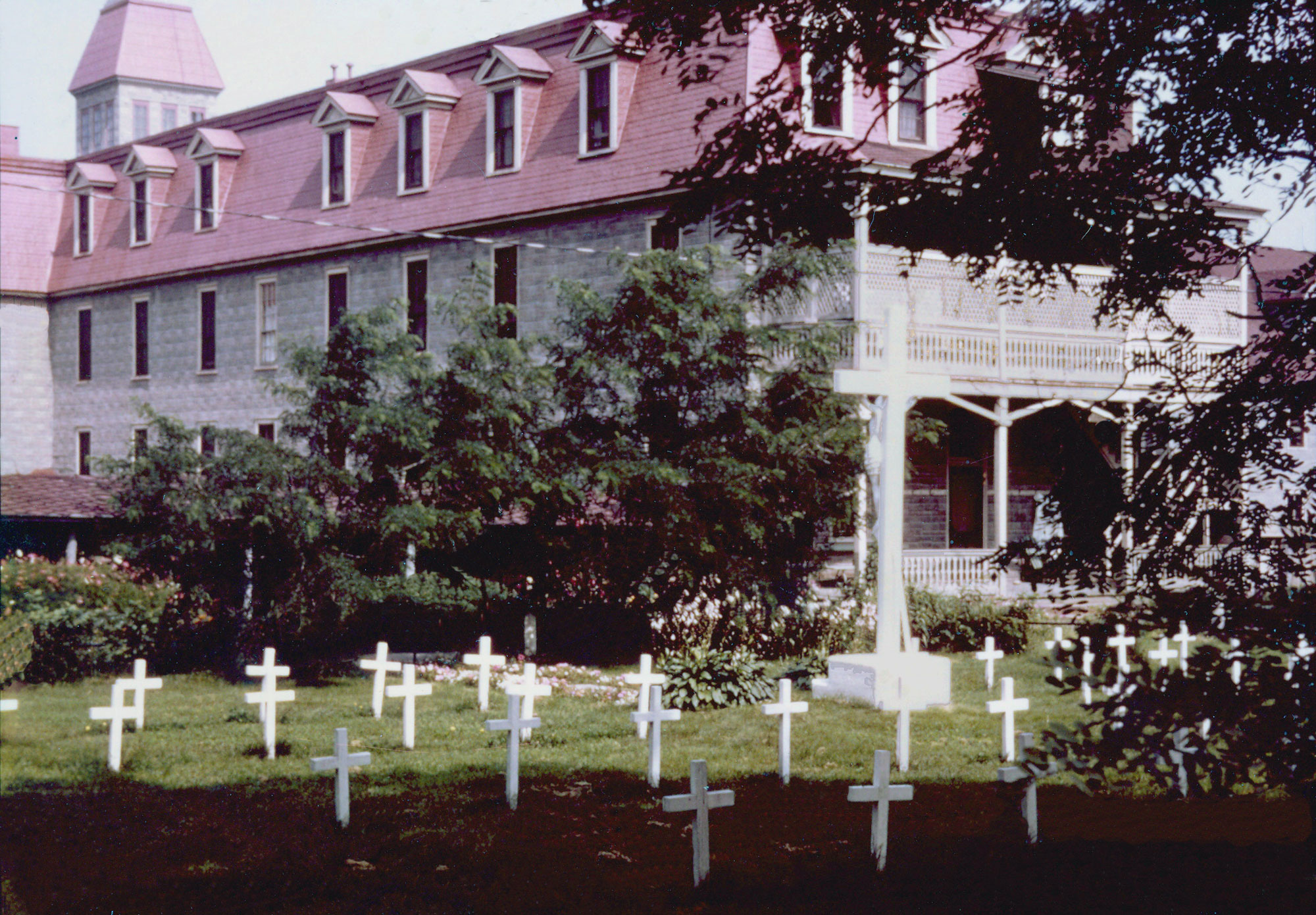
Third Hotel Dieu of Chatham: view of the convent and the sisters' cemetery, 1960s. Source: Archives of the Religious Hospitallers of St. Joseph of New Brunswick.

Second and Third Hotels Dieu of Chatham, 1870‑1963

In 1870, the sisters, students, and the sick moved to a larger building attached to a church. This “second” Hotel Dieu was destroyed by fire in 1878. Fortunately, the sisters and their work left this house in 1876 and were relocated to a wooden “third” Hotel Dieu, which was used until 1963. This rather large, T-shaped building included a chapel and separate wings for the hospital, school, and boarding school, as well as the monastery or convent for the cloistered sisters. In fact, the third Hotel Dieu was a self-contained unit with basement facilities for the kitchen and laundry, as well as large areas at the rear for gardens, orchards, and the sisters’ cemetery.

Part of this third Hotel Dieu would serve as a hospital until 1913 and as a residence for nurses from 1917 to 1937. Over time, this building, which would not be demolished until 1963, would meet a variety of other needs, particularly housing for employees, Academy residents, nursing assistants, as well as the elderly. The community of teaching sisters would live there until 1963.

Third Hotel Dieu of Chatham: view of the convent and the sisters' cemetery, 1960s. Source: Archives of the Religious Hospitallers of St. Joseph of New Brunswick.
Facade of the Hotel Dieu of Chatham, built in 1913 on Lobban Avenue. On the left, the nurses' residence. On the right, the new wing dating from 1958. Source: Archives of the Religious Hospitallers of St. Joseph of New Brunswick.

Fourth Hotel Dieu: Care of the sick and Nursing School, 1913‑1992

In 1913, the “fourth” Hotel-Dieu, a hospital with a capacity of 70 beds, opened its doors on Lobban Avenue. The sisters were responsible for administration, but to help them, an advisory council made up of local people was established in 1949. Construction of an extension, named Lourdes, began in May 1956, and it opened in 1958. The main building was also renovated, giving it a capacity of 127 beds. With the help of a Board of Directors and the Religious Hospitallers of St. Joseph Health System of Amherstview in Ontario, the Hotel Dieu served the population until its closure in 1992. The Miramichi Regional Hospital, established by the New Brunswick government, was the result of the merger of the Hotel Dieu of Chatham and the Newcastle Regional Hospital. This marked the end of the Relihious Hospitallers’ presence in the Miramichi hospital environment but, they continued to provide care for the elderly.

The Chatham School of Nursing began in 1917, and nurses lived at the Hotel Dieu until 1937. In February 1938, construction of the Student Nursing Residence was completed, which served nursing students until the school’s final graduation in 1973. This residence was demolished in 1974 to make way for the new Mount St. Joseph. The Hotel Dieu of Chatham also had a School for Nursing Assistants. Founded in 1948, it operated until 1964.

Facade of the Hotel Dieu of Chatham, built in 1913 on Lobban Avenue. On the left, the nurses' residence. On the right, the new wing dating from 1958. Source: Archives of the Religious Hospitallers of St. Joseph of New Brunswick.
Former bishop's residence ceded to the sisters in 1869. Historical museum, since 1969. Source: Archives of the Religious Hospitallers of St. Joseph of New Brunswick.
Third Hotel Dieu of Chatham: view of the convent and the sisters' cemetery, 1960s. Source: Archives of the Religious Hospitallers of St. Joseph of New Brunswick.
Facade of the Hotel Dieu of Chatham, built in 1913 on Lobban Avenue. On the left, the nurses' residence. On the right, the new wing dating from 1958. Source: Archives of the Religious Hospitallers of St. Joseph of New Brunswick.
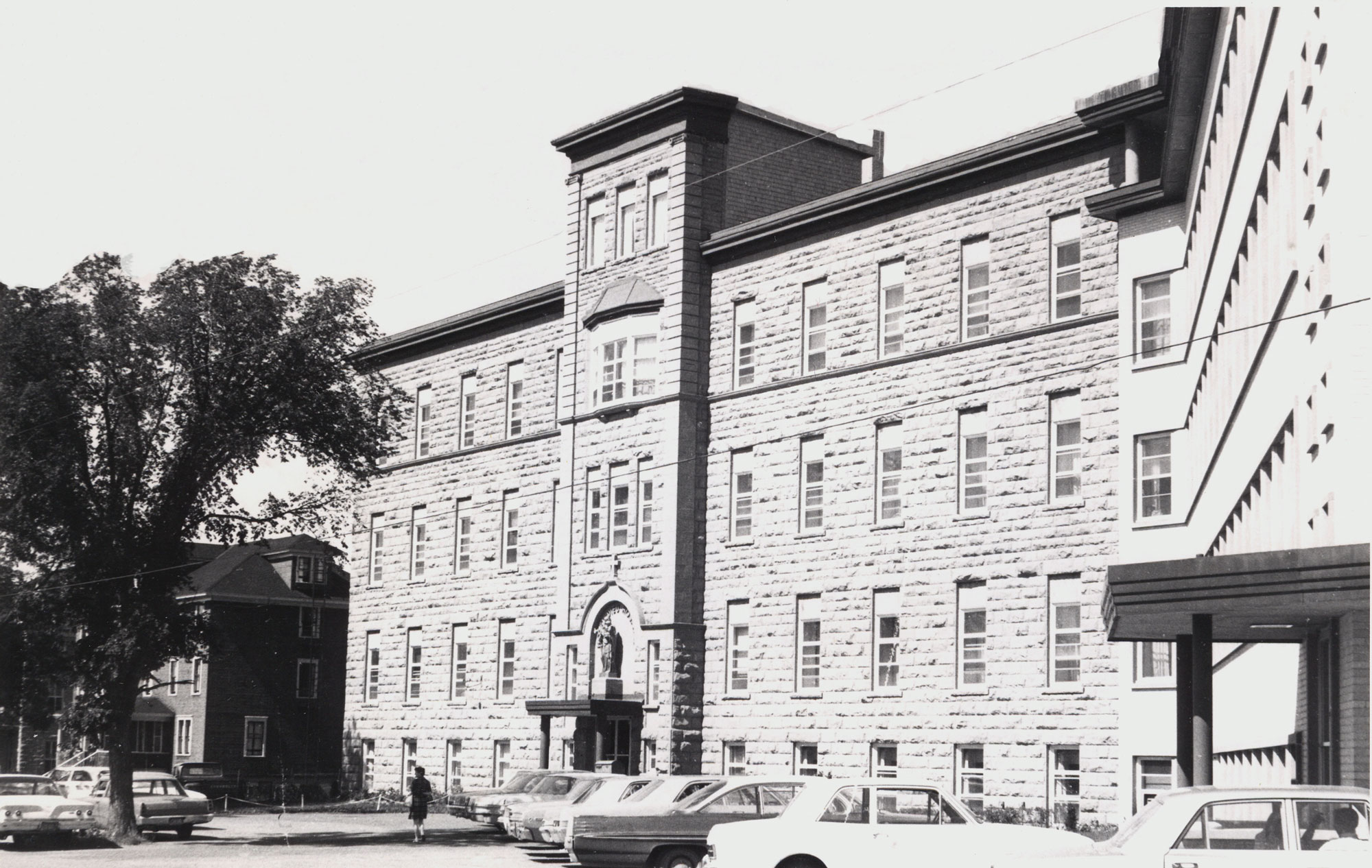
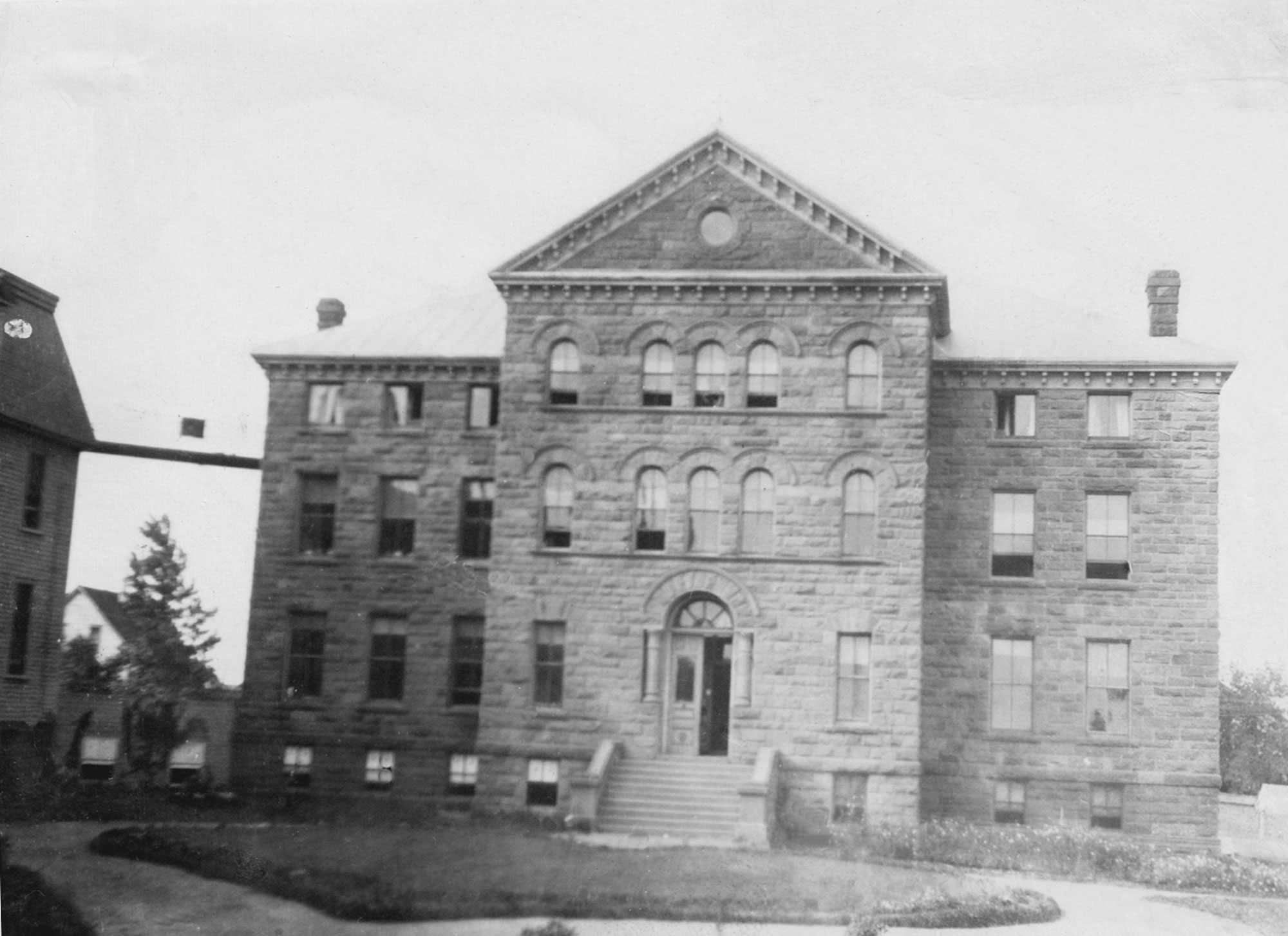
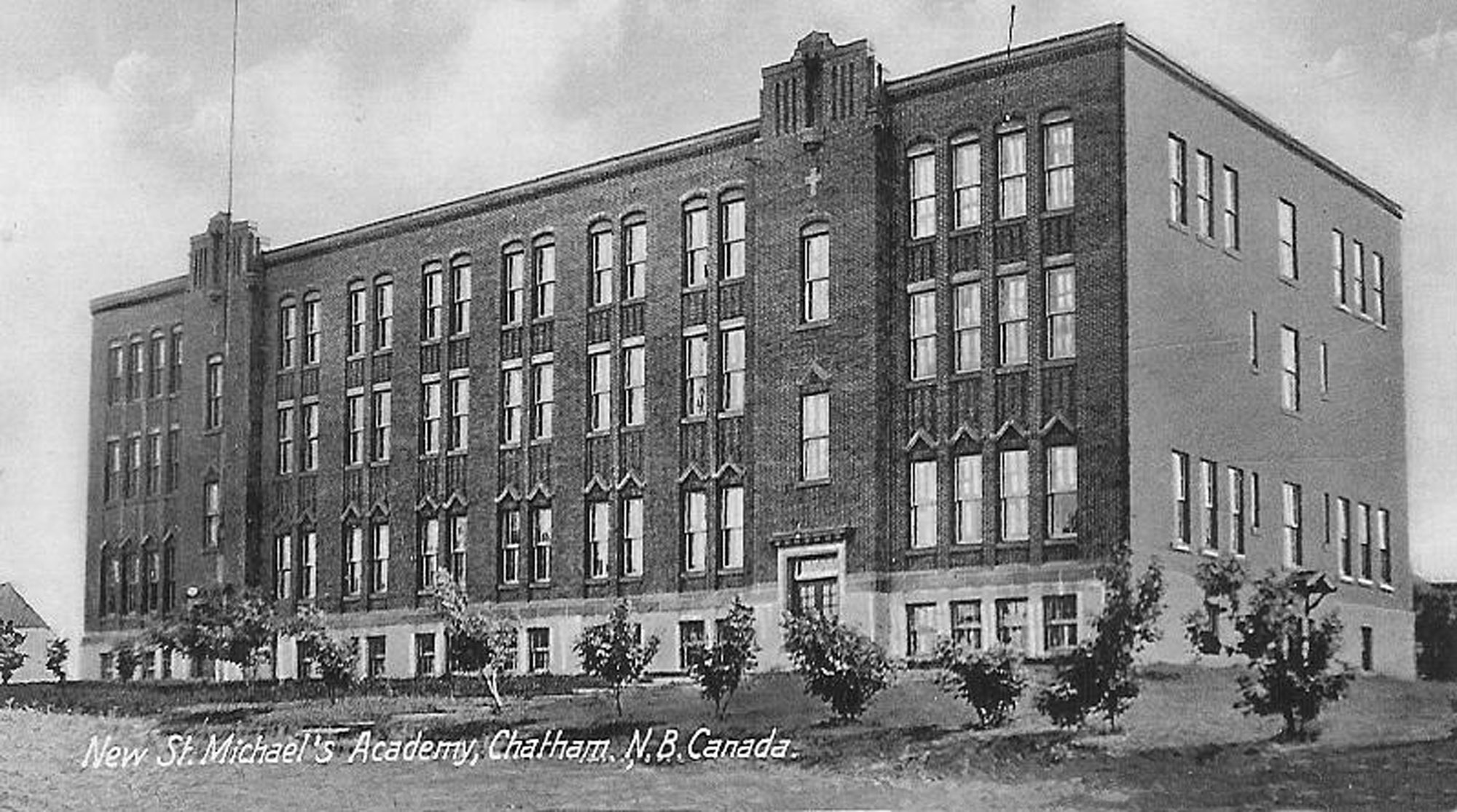
St. Michael's Academy, boarding school and school from 1902 to 1949. Mount St. Joseph Nursing Home, from 1950 to 1975. Source: Archives of the Religious Hospitallers of St. Joseph of New Brunswick.

St. Michael’s Academy, 1871‑1969

The education of Chatham’s children was part of the mission the bishop entrusted to the Hospitallers who came from Montreal in 1869. Bishop Rogers asked the sisters to open a boarding school for girls and an orphanage. The second Hotel Dieu, which the sisters moved into 1870, was large enough to hold classes. Miss Ann Quinlan, a teacher from Chatham, was hired and would teach for ten years with the sisters. When the school began on October 1, 1871, there were 30 day students and two boarders. Instruction was in English. Thus began the educational work in Chatham, which would be placed under the protection of St. Michael for the Academy and St. Joseph for the Boys’ School.

In 1876, the sisters’ school and convent, along with the hospital, occupied part of the premises of the third Hotel Dieu. The number of students attending classes increased so rapidly during the 1890s that construction of a new building became necessary. St. Michael’s Academy, the first stone building built by the Chatham sisters, was completed in 1902. In addition to teaching all grade levels, the Academy served as a boarding school for girls until 1948. Between 80 and 100 boarding students were admitted each year. In addition to academic studies, it offered commercial studies, domestic science, music, and drawing.

St. Michael's Academy, boarding school and school from 1902 to 1949. Mount St. Joseph Nursing Home, from 1950 to 1975. Source: Archives of the Religious Hospitallers of St. Joseph of New Brunswick.
St. Michael's Academy, built in 1931 and run by the Sisters of Chatham. All grade levels were offered there from 1948 to 1970. Source: Archives of the Religious Hospitallers of St. Joseph of New Brunswick.

St. Michael’s Academy enjoyed an excellent reputation due to the quality of the education offered to girls. The education of boys aged 6 to 12 also held an important place for the Sisters of Chatham. From 1913 to 1917, St. Joseph’s School for boarding and day boys in the primary classes was located in the third Hotel Dieu, but it had to give way to the expanding commercial course. In 1919, St. Joseph’s School, which also prepared boys for college studies, moved into the small house in the first Hotel Dieu. At the time, St. Thomas College was run by the Basilian Fathers, who were in Chatham from 1910 to 1923.

The need for a larger school arose and the Sisters built a new St. Michael’s Academy on University Street. Beginning in 1931, it offered grades 1 through 12. In 1969, the middle and high school students were transferred to a new school in the school district, and the Religious Hospitallers, who had always been its principals, sold St. Michael’s Academy to the government in 1970.

St. Michael's Academy, built in 1931 and run by the Sisters of Chatham. All grade levels were offered there from 1948 to 1970. Source: Archives of the Religious Hospitallers of St. Joseph of New Brunswick.
St. Michael's Academy, boarding school and school from 1902 to 1949. Mount St. Joseph Nursing Home, from 1950 to 1975. Source: Archives of the Religious Hospitallers of St. Joseph of New Brunswick.
St. Michael's Academy, built in 1931 and run by the Sisters of Chatham. All grade levels were offered there from 1948 to 1970. Source: Archives of the Religious Hospitallers of St. Joseph of New Brunswick.

Mount Saint Joseph, 1950‑2025+

In 1948, the sisters decided to use the former St. Michael’s Academy as an annex to the Hotel Dieu for the care of convalescents and the chronically ill. Mount Saint Joseph was accredited as a Long-Term Care Center and had 79 beds by 1971. In 1975, the residents of Mount St. Joseph moved to a modern building near the Hotel Dieu Hospital. Although it shared some services, Mount St. Joseph retained its own identity, had its own Bylaws and Regulations, and had a separate Board of Directors. Major renovations were carried out, continuing until 2017. Mount St. Joseph is a nursing home for the elderly funded by the New Brunswick government and sponsored by Catholic Health International

Hotel Dieu Place, Miramichi, 2006‑2025+

Hotel Dieu Place in Miramichi is a residential facility for seniors that was founded by the Religious Hospitallers of St. Joseph in 2006. A few Religious Hospitallers lived there until 2009. The building includes thirteen subsidized apartments and space leased to Chatham Daycare Inc., which provides childcare services. Hotel Dieu Place is a member of Catholic Health International.

The sisters maintained a presence in Miramichi until September 2013 when the final two Religious Hospitallers of the Miramichi Community were transferred to Kingston, Ontario.

SAINT-BASILE of Madawaska

Madawaska Academy, first Hôtel-Dieu of Saint-Basile, 1874. Source: Archives of the Religious Hospitallers of St. Joseph of New Brunswick.

Hôtel-Dieu St-Joseph, 1873‑2013

In response to the request of Bishop James Rogers of Chatham and thanks to the support of Mother Pagé, one of the founders of Tracadie who had become Superior of the Hôtel-Dieu community in Montreal, seven hospital sisters were appointed to Saint-Basile in the summer of 1873. At the beginning of October, Mother Louise Davignon, who had already lived in Chatham, and her six companions arrived at the Madawaska Academy, to take over from the Sisters of Charity who had returned to Saint John, New Brunswick.
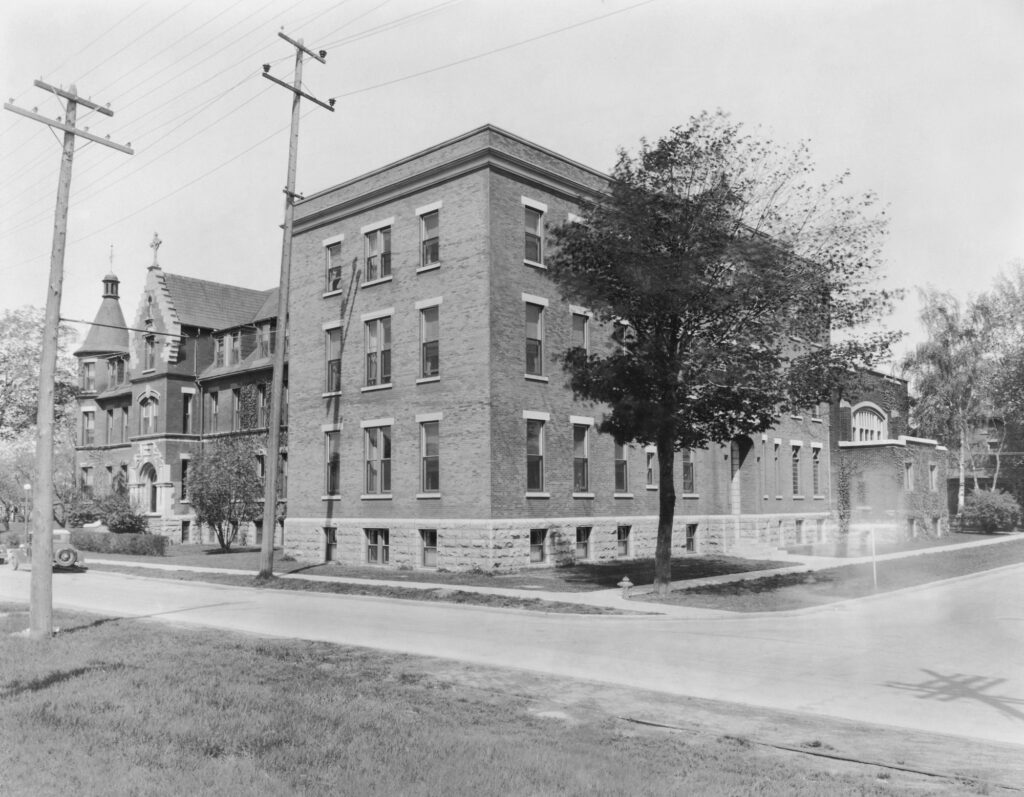
Teaching at the Academy of Saint-Basile, 1873 à 1915

From the very beginning of their foundation, the sisters took charge of a little orphan girl named Lizzie Fournier and announced the reopening of the girls’ boarding school. In January 1874, seven young ladies from the Costigan, Hartt, and Proulx families of Grand Falls and Edmundston presented themselves at the Academy’s boarding school. Two years later, there were twenty-five girls, including orphans. Day students were admitted free of charge. A few houses were built near the Hôtel-Dieu specifically to house day students would later be used by employees. In 1885, the Academy was recognized as a public school and began admitting boys aged six to twelve. Since “the care of the poor and destitute” was part of the mission of the Religious Hospitallers of St. Joseph, they accepted all orphans who came forward.

First hospital in Madawaska, 1881-1915

The educational aspect was well underway, but what about the care of the sick, which is a vital task for the hospital sisters? People had complete trust in the sisters and the sick flocked to consult the pharmacist Sister Maillet (Alphonsine Ranger), who would soon be nicknamed the “sister doctor.” On November 5, 1873, the first patient named Jules Cyr, a farmer from Caribou, Maine, who was suffering from consumption, was hospitalized for eleven days in the small music room.

Encouraged by Mother Pagé of Montreal, Mother Davignon, Superior at Saint-Basile, insisted that a hospital be immediately made available to the people of the region. She met Lévite Thériault, a benefactor who provided the wood needed to build an extension to the Academy’s central building. Construction began in 1877, and a small 14-bed hospital officially opened in 1881. The first hospital in Madawaska would also serve the population of northern Maine and southern Quebec. All patients who presented themselves were admitted without distinction of nationality, language, or religion.

Brick convent constructed in Madawaska, 1889 à 1915

The number of students, sisters, patients, employees, pensioners, and other categories of people living at the Hôtel-Dieu grew rapidly. There was soon a lack of space to adequately house everyone. For the time being, the hospital was sufficient for the care of the sick but a new building was needed to accommodate the students, with classrooms and recreation rooms, dormitories, and refectories. The sisters who were cloistered needed premises that comply with their religious regulations.

Orphanage, boarding school and convent: Hôtel-Dieu, Saint-Basile, NB, ca. 1900. Source: Archives of the Religious Hospitallers of St. Joseph of New Brunswick.
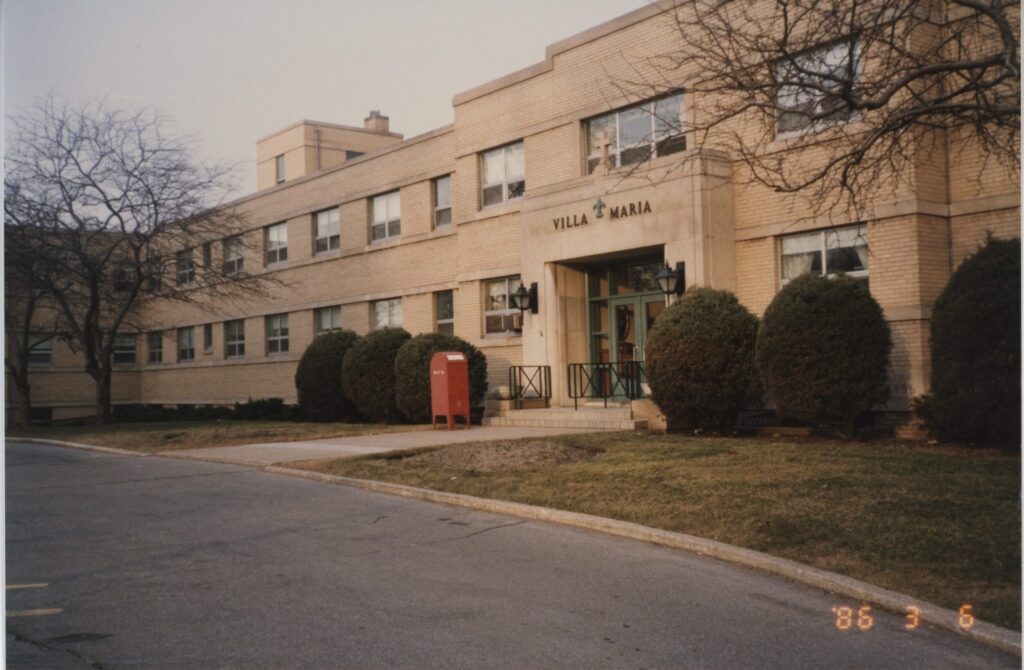
The architect Berlinguet of Quebec, who would draw up plans for a new building designated as the “orphanage” free of charge, suggested that the sisters use brick as a building material, simply because the sisters’ property near the St. John River contained the ideal quality of clay soil and sand for making quality bricks. Sister Maillet, who was then superior, did not hesitate: a brickyard was established and brick production began in 1885. The large, four-story brick building, which opened its doors on September 3, 1889, would serve as a school, an orphanage, and a boarding school for the students, as well as a “convent” for the community of hospital sisters.

At the opening, the orphanage welcomed twenty-one little boys, sixty older and younger girls, and approximately twenty-five sisters who worked at the Academy and the Hôtel-Dieu. The orphaned and boarding girls occupied the Sainte-Catherine boarding school, while the boarding and orphaned boys lived at the Saint-Louis boarding school. As the number of students increased further, the sisters decided in 1902 to build a boarding school for boys in the backyard. On the ground floor, classrooms were set up for boys and younger girls, while upstairs there was a performance hall and the boys’ rooms, which connected to the second floor of the hospital by an overhead bridge.

Monastery of the sisters of the Hôtel-Dieu de Saint-Basile, NB, 2012. Source: Archives of the Religious Hospitallers of St. Joseph of New Brunswick.

Construction of the monastery, boarding school and chapel, 1904‑1915

The period of major construction was not over at the Hôtel-Dieu de Saint-Basile: the community of Religious Hospitallers did not yet have a real monastery that met the requirements of their rule. A good boarding school was also needed, with classes for older girls and a large chapel to serve everyone: sisters, male and female students, the sick, the elderly, the disabled, pensioners, boarders and visitors, employees and families, servants and others. Large-scale projects began. A second brickyard, started around 1904, would provide all the bricks needed for the central part of the Hôtel-Dieu, including the monastery and the sisters’ choir, the chapel, and the section for the girls’ boarding school, built as an extension of the first brick building and adjoining the large chapel on the secular side.

In 1915, fifty-seven sisters entered their new cloister, while the boarding girls moved into their enlarged Sainte-Catherine boarding school. The interior of the chapel was not finished, but it would be in 1931 thanks to funds raised by the Academy’s alumni.

Hôtel-Dieu St-Joseph: Self-sufficiency community or Large Family? 1873 à 1960

At the turn of the century, the Hôtel-Dieu de Saint-Basile became a focal point for the region and a place of healing, intellectual development, and spiritual, cultural, and social renewal. In Madawaska, as in many other foundations, the Religious Hospitallers of St. Joseph devoted considerable time, energy, and resources to establishing and promoting major undertakings in the health care and education of girls and boys.

In addition, the Hôtel-Dieu benefited from skilled administrative staff: a superior, a council of three assistants, and a bursar or treasurer who is knowledgeable about business. Sisters, assisted by a dedicated lay staff, manage the Hôtel-Dieu’s many services: a large kitchen, a bakery, a laundry, a shoe repair shop, and other services. They cultivated large vegetable gardens, an orchard of apples and other small fruits, in addition to decorative trees and flowers.

The community of sisters of Saint-Basile owned a large farm whose produce was an invaluable resource for the Hôtel-Dieu. It could count on the help of a foreman and manual workers for farming and livestock care. The outbuildings were numerous: a large barn with stables for horses and cows, a pigsty, a sheepfold, a chicken coop, a dairy with pasteurization, a blacksmith shop, and woodsheds. There was also a mountain behind the convent with chalets, which were ideal for excursions for students and sisters, a place of relaxation and vacation for all.

Like a very large family headed by a superior and her council, the Hôtel-Dieu is similar to an autarky or an economically self-sufficient system. Taking into account all the works grouped there, the Hôtel-Dieu de Saint-Basile managed to subsist on its own resources, to house, feed, and take care of all those who live there, whose number only increases over time and could easily reach nearly 300 people. This situation will persist until the middle of the 20th century.

Hôtel-Dieu St-Joseph, Saint-Basile, NB, 1940. Source: Archives of the Religious Hospitallers of St. Joseph of New Brunswick.
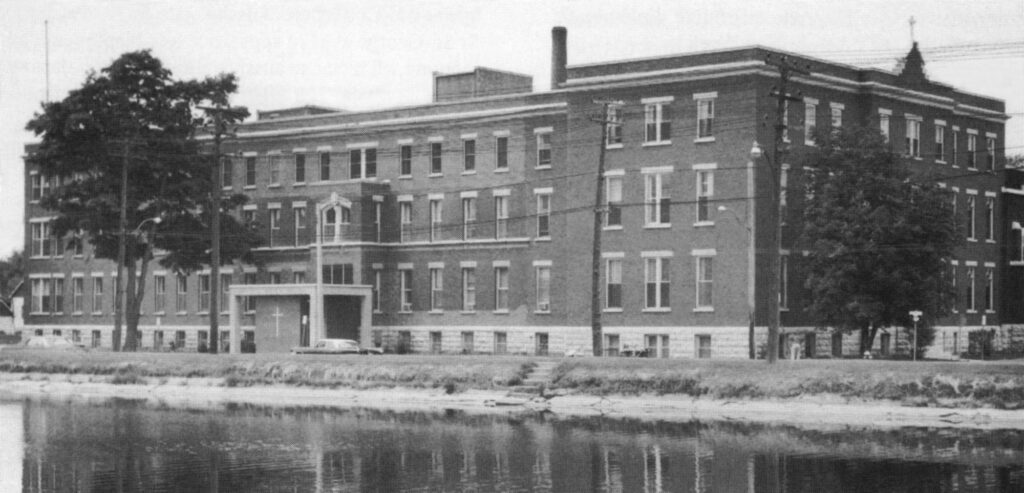
Growth of the works of the Religious Hospitallers of Saint-Basile, 1935‑1983

Following the fire in the old wooden convent in 1935, a new building was necessary. The Hôtel-Dieu Academy, which opened in 1936, included classrooms, dormitories, and rooms for students, a floor for retired ladies, and a floor for the clergy.

The transformation of society in the post-war years, and especially the urgent needs in the health sector, challenged the Religious Hospitallers of Saint-Basile. As the number of sisters increased, the community was able to expand throughout the region. The first foundation took place in 1938 in Van Buren, Maine, near the American-Canadian border, 50 kilometers from Saint-Basile. The small Hôtel-Dieu, with about thirty beds, would be short-lived, as it was forced to close in July 1954.

In the early 1940s, the Superior and the community of the Hôtel-Dieu de Saint-Basile took charge of two major healthcare institutions in Madawaska: the Sanatorium St-Joseph de Saint-Basile and the Hôtel-Dieu St-Joseph d’Edmundston, both of which opened their doors in November 1946. Nineteen sisters were appointed to each location, including a Superior who was also the Executive Director.

The departure of the Saint-Basile hospital and its healthcare staff to Edmundston in 1946 left three floors virtually vacant. This allowed for more seniors and people with disabilities with various needs to be accommodated. This part of the Hôtel-Dieu was renamed Foyer St-Joseph and was accredited by the government. When the former Sanatorium St-Joseph de Saint-Basile closed its doors in 1972, it was renovated and updated to accommodate the residents of the Foyer St-Joseph, who moved there in 1976.

In the field of education, the Sisters of Saint-Basile devoted considerable effort and energy to the development of secondary and post-secondary education at the Academy and Maillet College. The young sisters were grouped together at the Scholasticat Marie-de-la-Ferre, a new building constructed in the backyard in 1963. It also housed Maillet College, which quickly becomes a center of cultural activities and events for the region.

In collaboration with Social Services, a new project called CentrAide LeRoyer was launched at the Hôtel-Dieu in 1978. This shelter, which could accommodate up to fifteen women and young girls in difficulty, had to close its doors in 1982.

Foyer Saint-Joseph, Saint-Basile, NB, 1946‑2015

Since the arrival of the Religious Hospitallers in Madawaska in 1873, caring for pensioners and the elderly has always been a priority. In 1946, with the transfer of the Saint-Basile hospital to the new Hôtel-Dieu d’Edmundston, the nursing home expanded and occupied the three vacant floors. In 1972, the nearby St-Joseph Sanatorium closed its doors, and the Religious Hospitallers decided to convert this building into a nursing home to which the residents of the Hôtel-Dieu would be transferred.

Foyer St-Joseph, Saint-Basile, NB, 1999. Source: Archives of the Religious Hospitallers of St. Joseph of New Brunswick.
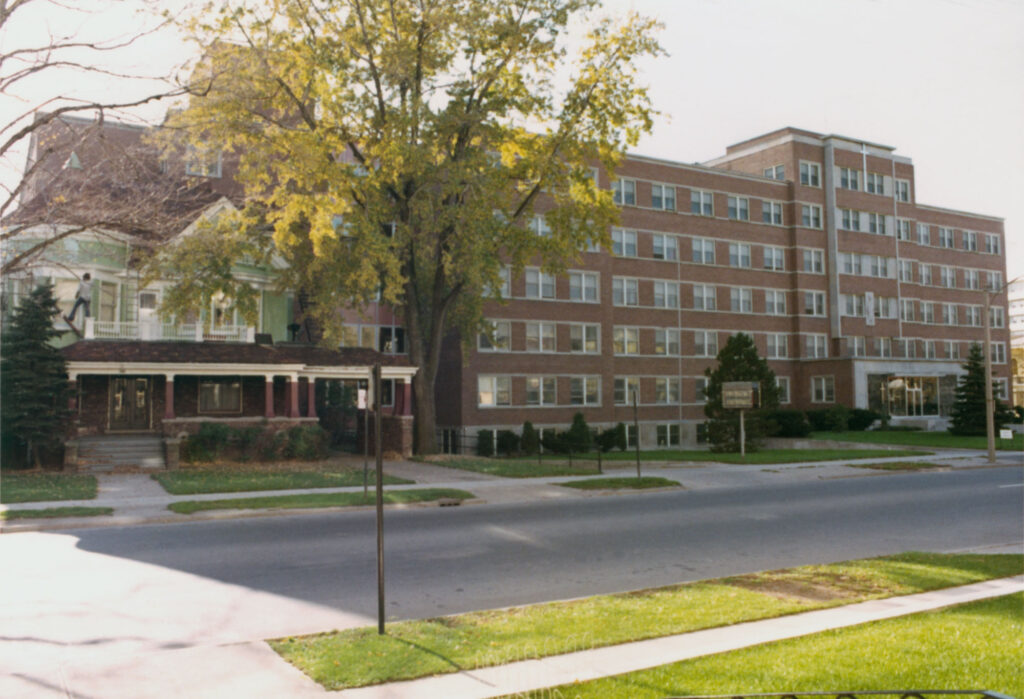
The Religious Hospitallers of St. Joseph, who owned the facility, undertook renovations and brought the old sanatorium up to modern standards. Sister Claudette Ouellet, appointed executive director, oversaw the work. The residents and staff were transferred to the new Foyer St-Joseph on March 26, 1976. There was room for 106 residents requiring long-term care.

The management of the Foyer St-Joseph reported to the Provincial Council of the Religious Hospitallers of St. Joseph and to the New Brunswick Department of Health. A management office was replaced by a lay Board of Directors that was established in 1984. In 1999, the Health Services Accreditation Council renewed the accreditation of the Foyer Saint-Joseph, recognizing the excellence of its care and staff. The Foyer then had 126 beds and employed 150 people.

In the summer of 1968, a group of sisters employed at the Edmundston Sanatorium and Hôtel-Dieu lived in the two houses side-by-side on Principale Street in Saint-Basile, across from the convent. The Résidence Jeanne-Mance, which would later house the sisters employed at the Foyer St-Joseph, closed its doors in 2006.

Foyer St-Joseph, Saint-Basile, NB, 1999. Source: Archives of the Religious Hospitallers of St. Joseph of New Brunswick.
Résidence Jeanne-Mance, Saint-Basile, NB, 1986. Source: Archives of the Religious Hospitallers of St. Joseph of New Brunswick.
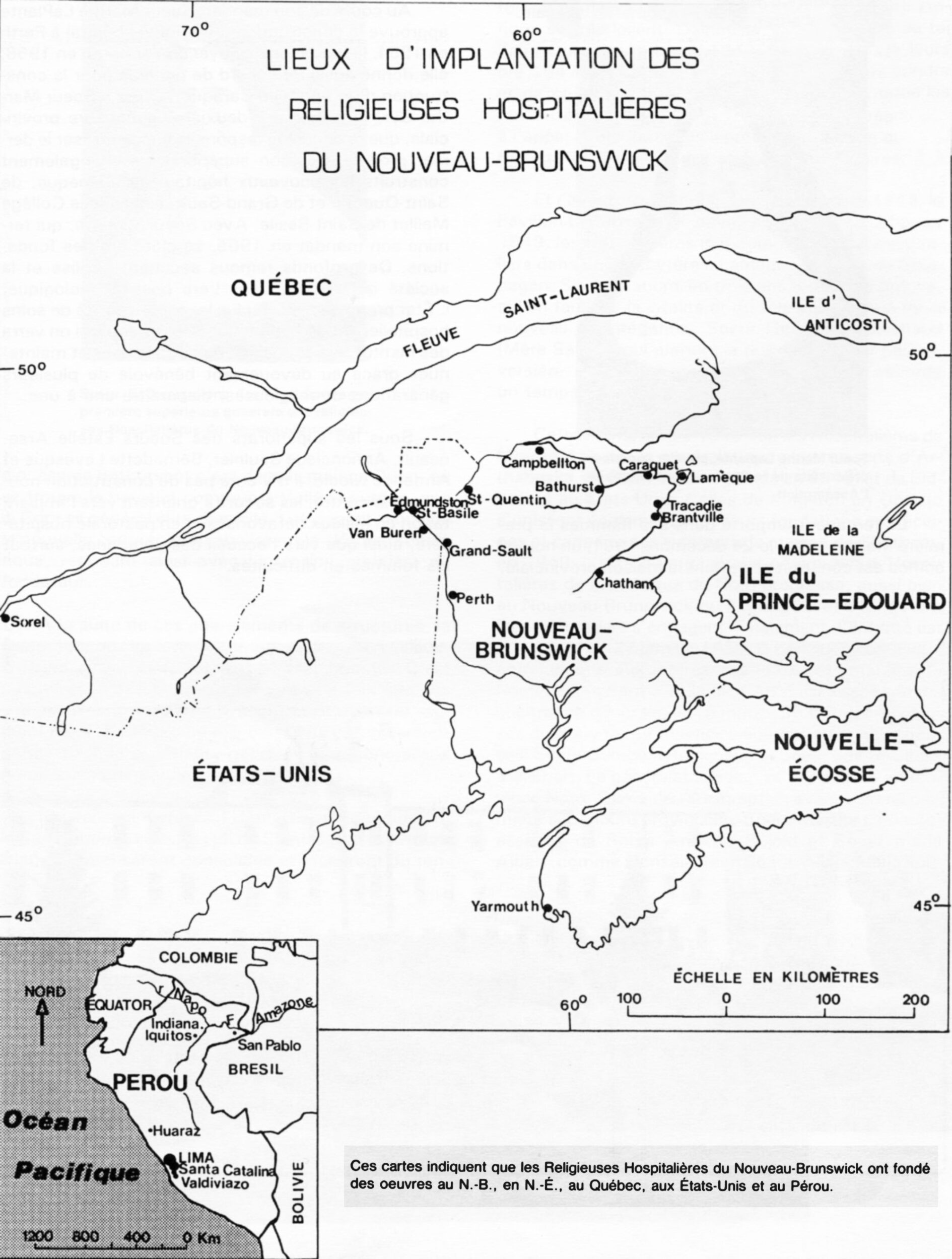
At Foyer Saint-Joseph, the transition to secular administration took place gradually over fifteen years. The first lay director was appointed in 2002. Beginning in November 2001, Foyer Saint-Joseph became part of Catholic Health International. On December 2, 2015, the residents of Foyer de Saint-Basile were transferred to Résidences Jodin Inc. in Edmundston. The Foyer St-Joseph building was sold in 2019.

But this wasn’t the end of services for seniors at Saint-Basile. Quite the contrary: in 2013, the former Hôtel-Dieu, which will become the Résidences Hôtel-Dieu, was completely renovated and the interior of the LeRoyer wing was completely redone at the Religious Hospitallers’ expense to accommodate about thirty residents in need of care. Rooms and apartments were created in the St-Joseph wing for about sixty independent retirees.

Résidence Jeanne-Mance, Saint-Basile, NB, 1986. Source: Archives of the Religious Hospitallers of St. Joseph of New Brunswick.
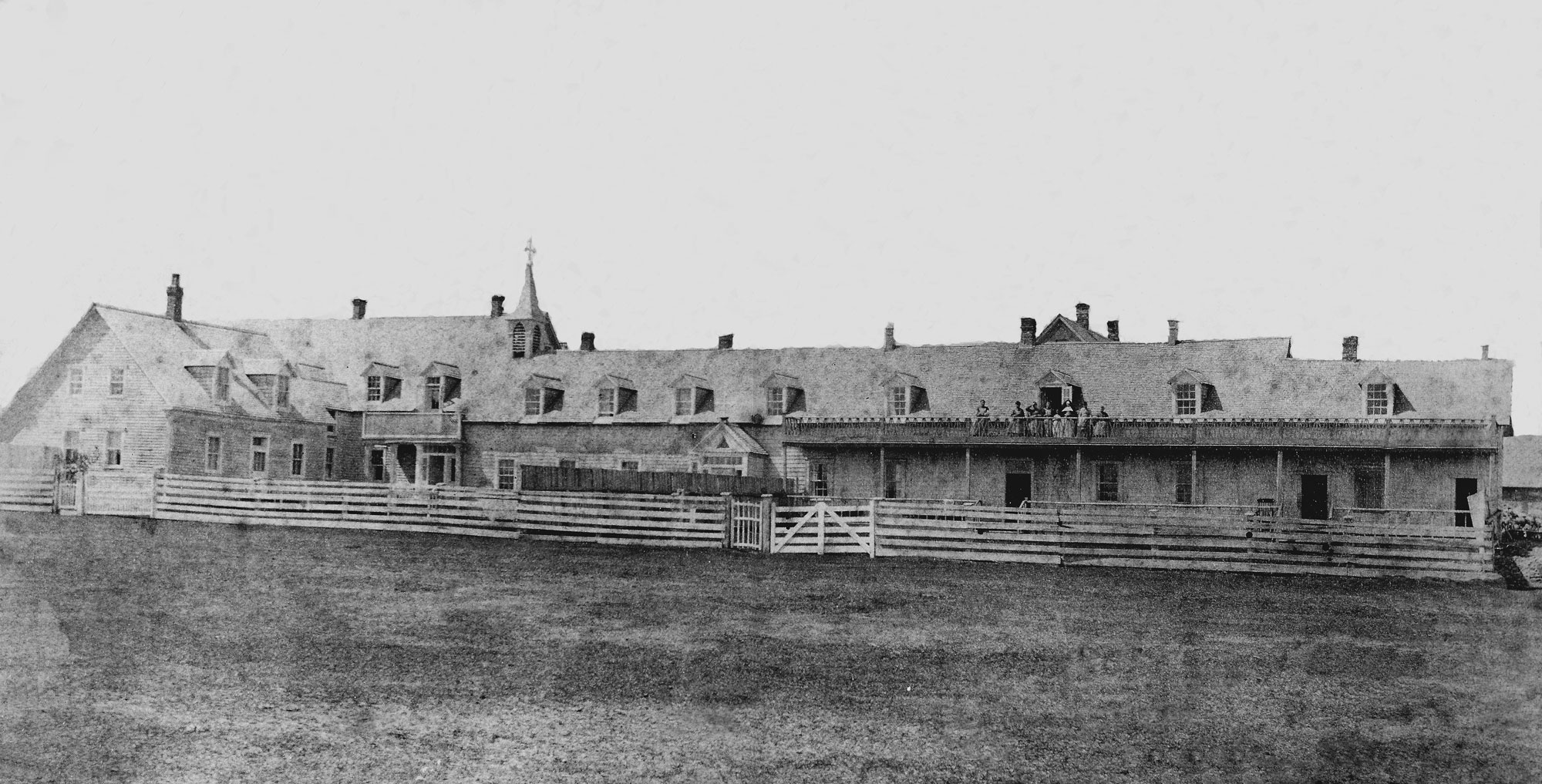
Foyer St-Joseph, Saint-Basile, NB, 1999. Source: Archives of the Religious Hospitallers of St. Joseph of New Brunswick.
Résidence Jeanne-Mance, Saint-Basile, NB, 1986. Source: Archives of the Religious Hospitallers of St. Joseph of New Brunswick.
Tribute to the staff of the Hôtel-Dieu Residence. Banner of Catholic Health International, Miramichi, NB, 2021. Source: Archives of the Religious Hospitallers of St. Joseph of NB.

Les Œuvres de l’Hôtel-Dieu Saint-Joseph Inc., 1998‑2024

Over time, a question arose what was the purpose of this old heritage building, whose magnificent silver bell tower was visible for miles around on both the Canadian and American sides of the border? The congregation decided to preserve the building and turn it into a retirement home. This institution’s reputation for unconditional hospitality has been established for a period of over hundred years. Rooms and apartments were developed in the former academy, known as the St. Joseph wing, to house approximately fifty independent retirees.

The Résidence Hôtel-Dieu, the new name for the renovated building, would be profitable. In 1998, the work was incorporated under the name “Les Œuvres de l’Hôtel-Dieu Saint-Joseph Inc.” The sisters handed over management of the work to a lay employee who received support from a board of directors. A Foundation for the works was established in 1992 to collect donations.

The Hôtel-Dieu Residence can accommodate about a hundred residents in its two wings. Completely renovated and rebuilt from the inside at the expense of the Religious Hospitallers of St. Joseph in 2011, the LeRoyer wing of the old Hôtel-Dieu houses seniors with reduced independence, including 27 residents who require assistance, and nine in type 3b. The top floor of the LeRoyer wing and the central section above the cafeteria are occupied by about ten Religious Hospitallers. Their infirmary at Saint-Basile closed in 2011, and the sisters’ monastery was demolished in 2013. The congregation’s archives and a heritage room of the Religious Hospitallers of Saint-Basile occupy premises on the ground floor of the Hôtel-Dieu.

On March 19, 2013, responsibility for the work was transferred to the Catholic Health Partners Inc. On December 8, 2013, the Congregation transferred the property (land and buildings) to the to Les Œuvres de l’Hôtel-Dieu. On June 28, 2021, Catholic Health International dedicated a large vertical banner to the staff of the Hôtel-Dieu Residence of Saint-Basile.

In 2023, the Hôtel-Dieu celebrated the 150th anniversary of the arrival of the Religious Hospitallers at Saint-Basile and the Revue de la société historique du Madawaska published a special issue of its journal. A unique and interesting fact stands out: one of the Hôtel-Dieu’s main activities, namely the care of the elderly, is still active at Saint-Basile and has continued since its origins in 1873.

Saint-Basile, Secondary and Post-Secondary Education, 1928‑1972

Hôtel-Dieu Academy, 1928‑1972

Teaching boys ages 6 to 12 and girls of all school ages has long been an integral part of the Sisters of Saint-Basile’s work. From the very beginning, the Hôtel-Dieu Academy had elementary and middle school classes. The introduction of secondary education at the Academy dates back to the 1920s. Before enrolling at Fredericton Normal School, Yvonne Lavoie received her Grade 11 diploma in 1928 and a medal attesting that she was the first graduate of the Saint-Basile Academy.

Hôtel-Dieu Academy / Maillet, Saint-Basile, NB, 1967. Source: Archives of the Religious Hospitallers of St. Joseph of New Brunswick.

When the oldest wooden part of the Hôtel-Dieu burned down in 1935, it became urgent to build accommodations for boarding and day students. In 1936, a modern brick building opened its doors: the entire third floor and part of the second were reserved for classes, the fourth floor served as dormitories for boarding students, girls and boys, the ground floor contained a refectory and a large room used for gymnastics, concerts, sessions and plays, and for recreation for the little ones. The first floor of this building called the Academy was reserved for the clergy and the administration, while the second was the floor for retired boarding ladies.

In this large, fireproof concrete and terrazzo building, the Academy developed rapidly. In addition to the provincial curriculum, it offered classes in home economics and countless cultural and extracurricular activities (theatre, singing, drawing, rhythmic gymnastics, sports, folk dancing). The Academy offered the primary school for boys and girls, while grades seven to eleven were reserved for boarding and day girls.

After preparing many young boys for college, the boarding school for young boys, or “Little College of Bishop Dugal,” closed in 1947. Between 1954 and 1963, the first private, free kindergarten welcomed around twenty children at the Hôtel-Dieu. In 1970, a new kindergarten was established for all the children of Saint-Basile, with a sister as teacher. Between 50 and 70 five-year-olds were admitted each year. When kindergartens were integrated into the public school system, a private preschool welcomed four-year-olds was operated until 2007.

The Hôtel-Dieu Academy, which took the name Maillet in 1960, marched in step with secularization and centralization. In 1968, a lay principal was hired and, two years later, high school classes were transferred to the regional school and then to the Edmundston comprehensive school. For a few years, two private high school classes were offered at Maillet College. After almost 100 years of existence, the girls’ boarding school closed its doors in 1972. During its existence, the Academy educated several thousand students and awarded diplomas to 471 graduates of academic and business courses.

Maillet Academy, which now offers only elementary education, was renamed Maillet School and moved in 1983 to the Maillet College building, the property of which was transferred to the school district. Since the Sisters of Saint-Basile were never short of creativity and solutions, the Academy’s classrooms were transformed into spacious apartments for retirees.

Maillet College, 1949‑1972

In 1947, the Eudist Fathers opened a boys’ college in Edmundston. Sister Rhéa Larose, director of classes at the Hôtel-Dieu Academy, obtained permission from Bishop Roméo Gagnon and his superiors to open a classical college for girls. Maillet College, named after Mother Maillet, superior and founder of the Hôtel-Dieu, was affiliated with Saint-Louis College in Edmundston. It officially began in 1949 with a few graduates of the Hôtel-Dieu Academy. The four-year curriculum was essentially the same as for boys: belles-lettres, rhetoric, and philosophy 1 and 2. Languages taught were Latin, French, and English; French, English, and Canadian literature; mathematics, science, history, religion, philosophy, and typing, which was very useful at the time.

Middle school girls share the Academy’s classrooms and had their science labs and home economics classes (cooking, sewing, knitting, embroidery, weaving), which were mandatory. Drawing and painting, piano and choral singing, drama and classical and folk dance, sports, student journalism, and Catholic Action (J.E.C.) were optional but highly valued.

Maillet College, Saint-Basile, NB, 1967. Source: Archives of the Religious Hospitallers of St. Joseph of New Brunswick.

Sister Larose also obtained permission from the New Brunswick government to open a teacher training college for sisters. It closed in 1968, after graduating nearly 80 sisters from various congregations. With the support of her superiors, Sister Larose established complementary study programs at Maillet College: pre-hospital sciences in 1955, medical secretarial studies in 1960, and a bachelor’s degree in nursing in 1962. The legal secretarial course would follow.

The development of programs and the increase in the number of students soon required larger and more functional premises. In the fall of 1963, the middle school girls and their teachers moved into a beautiful building built behind the Hôtel-Dieu. The large gymnasium, which was transformed into a performance hall, promoted not only sports, but also a significant number of cultural activities: a middle school girls’ choir and a mixed choir with St-Louis College, piano recitals, dramatic arts, and folk dance. Maillet College quickly became a renowned cultural center for the entire region, welcoming troupes and international stars.

In 1966, Sister Anne-Marie Savoie became director of Maillet College and received the support of a board of directors. The higher education commissions would disrupt the future of Maillet College, first by removing the bachelor’s degree in nursing. The merger of Maillet and Saint-Louis colleges in Edmundston took place in June 1972, and some sisters teaching or serving at Maillet would follow in Edmundston’s footsteps. Medical and legal secretarial courses continued to be offered at the Maillet Pavilion until 1980. Maillet maintained its vocation as a cultural center for the Madawaska region until 1982.

During its 23 years of existence, Maillet College offered higher education to young women and awarded 211 bachelor’s degrees in arts, 13 bachelor’s degrees in nursing, 11 in pre-science, 269 in medical secretarial studies and 72 in legal secretarial studies.

Maillet Residence, 1967‑2022

At the beginning of the foundation in Saint-Basile, the sisters were all part of the Hôtel-Dieu community. As their numbers grew large, a new grouping became necessary. In 1963, about thirty teaching sisters formed a separate community group with a superior and a local council. In 1967, the community moved to the “white house” at 399 rue Principale, which was completely renovated to accommodate the sisters.

Maillet Residence, Saint-Basile, NB, 2022. Source: Archives of the Religious Hospitallers of St. Joseph of New Brunswick.

The Maillet Residence has quite a history, as the front section dates back to 1879. This small, one-story house, built to house pensioners, had a fieldstone foundation. It also served as a quarantine house for patients at the Hôtel-Dieu. Over time, it was enlarged and raised to accommodate families of employees of the Hôtel-Dieu farm, among others. The large, tall, two-story house on the left was originally detached from the first. It was apparently built by Placide Thériault when he retired to the Hôtel-Dieu with his wife around 1900. A family who came from France to work on the farm lived there for a few years.

The extension between the two houses dates back to the 1940s. This large, long house served for a time as housing for the “maids” or girls employed at the Hôtel-Dieu. The custom of housing employees was to cease in the 1960s, so the white house became available to house the community of the Maillet Academy and College. For 55 years, the Maillet Residence was available to the teaching sisters until the community closed in 2022. The last teaching sisters then joined the community of the sisters of the Hôtel-Dieu, on the fourth floor of the LeRoyer wing. The Maillet Residence, the oldest part of which was 135 years old, was immediately demolished.

Sanatorium Saint-Joseph, Saint-Basile, NB, 1946‑1972

The Sanatorium Saint-Joseph of Saint-Basile was founded by the community of the Religious Hospitallers of St. Joseph of the Hôtel-Dieu de Saint-Basile. The superior, Sister Lucie Morneault, led this major project to build and organize a 140-bed sanatorium to treat patients suffering from pulmonary tuberculosis. Construction work began in the fall of 1944 and the sanatorium officially opened on July 8, 1946.

In the summer of 1946, a group of nine sisters, almost all from the Hôtel-Dieu de Saint-Basile, were appointed to organize and serve this new work. All the sisters had the training required to assume the various responsibilities and services entrusted to them: administration, accounting, personnel management, sick rooms, laboratory, pediatrics, kitchen, laundry, pharmacy, sterilization, and others. The first superior, Sister Brigitte Légère, reported to the authorities of her congregation, the Religious Hospitallers of St. Joseph, who owned the Sanatorium Saint-Joseph. As executive director, she administered the institution in collaboration with the bursar and also reported on its management to the New Brunswick Department of Health, which provided the operating funds for the Sanatorium, at a rate of $2.75 per day per patient.

Sanatorium St-Joseph, Saint-Basile, 1946. Source: Archives of the Religious Hospitallers of St. Joseph of New Brunswick.

The Religious Hospitallers ensured the management and smooth running of the Sanatorium in collaboration with Dr. Gérald E. Gauvin, appointed medical superintendent from the very beginning of the sanatorium’s founding. Dr. Andor Retfalvi joined the medical staff in 1951 and replaced Dr. Gauvin in 1968. There were also several consulting physicians, including: A.H. Sormany, surgeon; J.H. Cyr, anesthesiologist; and D. Albert, radiologist. Fathers Damase Thibodeau and Sylvio Thériault, among others, served as chaplains at the sanatorium.

The Pediatrics Department opened in 1949, and fourteen children and adolescents, almost all from the northern part of the province, were admitted to Saint-Basile. They were provided with care and instruction, according to their abilities. The sanatorium also offered occupational therapy and a rehabilitation program, with workshops in carpentry, knitting, sewing, and other cultural and recreational activities. There were also clinics for out-of-towners which were held every Monday. The Sanatorium Saint-Joseph was fully recognized by the Joint Commission on Hospital Accreditation on August 10, 1954. Between 1946 and 1959, more than 2,723 people were treated at the Saint-Joseph Sanatorium in Saint-Basile.

Sanatorium St-Joseph, Saint-Basile, 1946. Source: Archives of the Religious Hospitallers of St. Joseph of New Brunswick.
Religious Hospitallers serving at the Sanatorium Saint-Joseph, Saint-Basile, 1946. Source: Archives of the Religious Hospitallers of St. Joseph of New Brunswick.
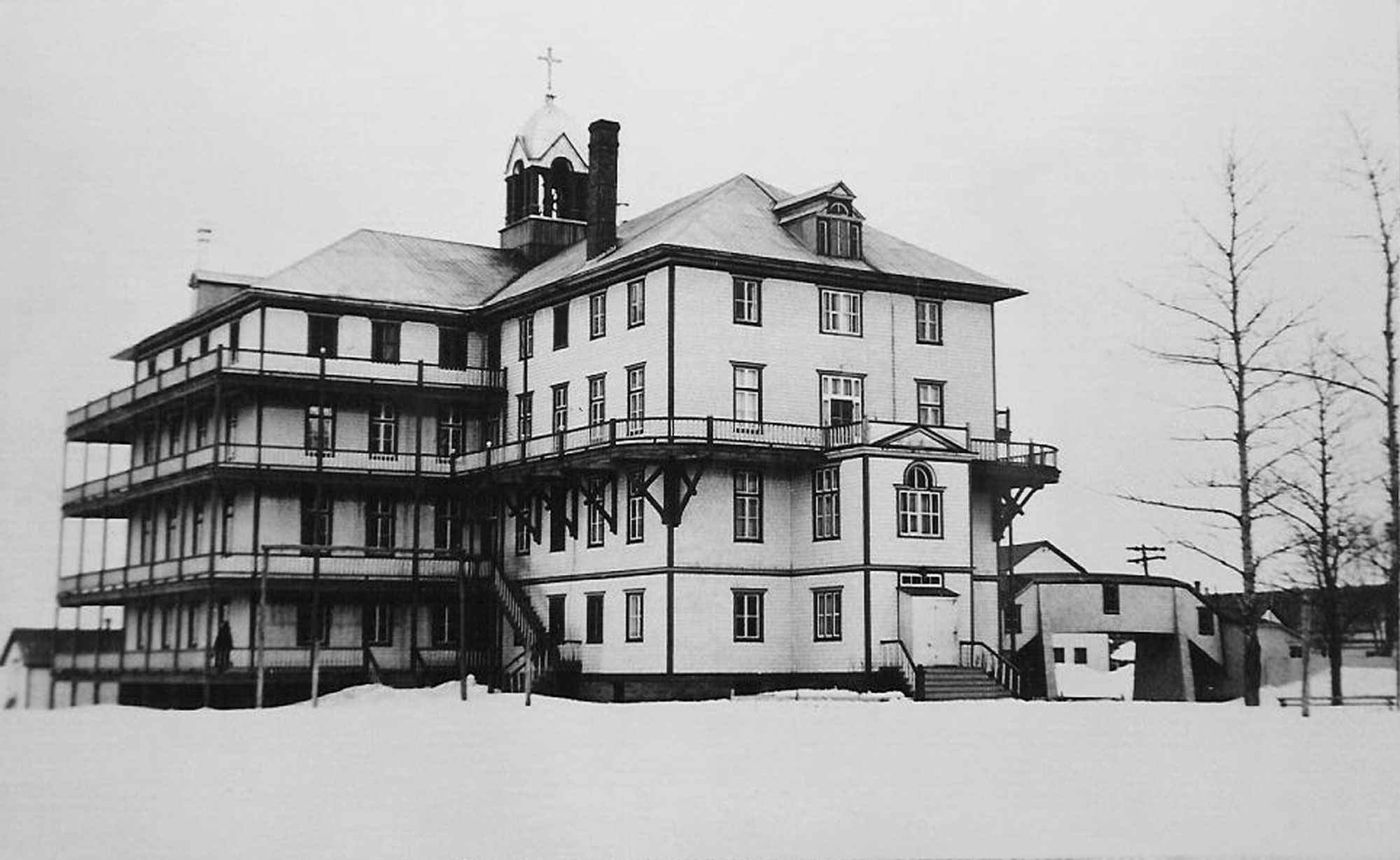
Over time, with advances in medical science and better care, the number of patients decreased significantly. By 1960, there were only about thirty tuberculosis patients left. Around 1967, the Minister of Health requested that the sanatorium serve as an annex to the Hôtel-Dieu d’Edmundston and that elderly people, mostly medical cases, be admitted. The boards of directors merged the following year. A management committee was formed, and the merger with the Edmundston Hospital took place in 1968. The sisters were housed on the top floor of the sanatorium until 1968. Some moved to the Résidence Jeanne-Mance, across from the Hôtel-Dieu de Saint-Basile.

In 1972, the Ministry of Labour reported on the poor condition of the electrical installations at the former Saint-Basile Sanatorium. On May 4, 1972, the Minister of Health announced its closure, and on May 15, the 23 patients were divided between the Hôtel-Dieu d’Edmundston and the Saint-Basile, Baker-Brook, and Saint-Léonard care homes.

The Religious Hospitallers appointed a committee to study the use of the building, which was still in use. During the 1970s, it was renovated and brought up to code to accommodate residents of the nursing home, which occupied a wing of the old Hôtel-Dieu de St-Basile nearby. The move took place on March 26, 1976.

Religious Hospitallers serving at the Sanatorium Saint-Joseph, Saint-Basile, 1946. Source: Archives of the Religious Hospitallers of St. Joseph of New Brunswick.
Sanatorium St-Joseph, Saint-Basile, 1946. Source: Archives of the Religious Hospitallers of St. Joseph of New Brunswick.
Religious Hospitallers serving at the Sanatorium Saint-Joseph, Saint-Basile, 1946. Source: Archives of the Religious Hospitallers of St. Joseph of New Brunswick.
Hôtel-Dieu St-Joseph, first hospital in Madawaska, Saint-Basile, NB, 1881. Source: Archives of the Religious Hospitallers of St. Joseph of New Brunswick.

Hôtel-Dieu St-Joseph, Edmundston, NB, 1946‑1972

The first hospital to open in Madawaska in 1881 was the Hôtel-Dieu St-Joseph de Saint-Basile. Lévite Thériault, Member of Parliament for Fredericton, provided all the lumber needed for the construction. Care for the sick began in 1874 at the Academy and before the construction of the small hospital with about 20 beds that served the population on both the American and Canadian sides from 1881 to 1915. The sick were then transferred to the west wing of the brick Hôtel-Dieu, which had previously served the students and sisters.

Between 1915 and 1946, the Saint-Basile hospital boasted excellent doctors and dedicated hospital sisters. Soon, Hôtel-Dieu’s reputation spread to both sides of the Canada-U.S. border.

The Hôtel-Dieu d’Edmundston was founded by the Religious Hospitallers of Saint-Basile, who were well aware of the demands of hospital services and the needs of the region. Superior Sister Lucie Morneault led this project for a large hospital, which would replace the small 50-bed hospital at the Hôtel-Dieu de Saint-Basile. Construction began in the fall of 1944 and the hospital opened its doors in November 1946.

Hôtel-Dieu St-Joseph, first hospital in Madawaska, Saint-Basile, NB, 1881. Source: Archives of the Religious Hospitallers of St. Joseph of New Brunswick.
Hôtel-Dieu St-Joseph de Saint-Basile, west wing which served as a hospital from 1915 to 1946. Source: Archives of the Religious Hospitallers of St. Joseph of New Brunswick.

In his article “The genius of modern science in the service of suffering” published in the Hôtel-Dieu souvenir album, foreman Alexandre Angers states that if records were established regarding the cost and duration of the work, this was due to “the perfect cooperation between the Religious Hospitallers of St. Joseph of Saint-Basile, the architects and the general contractor.”

In 1946, nineteen Religious Hospitallers went to Edmundston to organize a 200-bed hospital offering virtually every service: surgery, medicine, anesthesia, obstetrics, pediatrics, psychiatry, and more. The community’s local council supported the superior administrator, who assumed full management of the Hôtel-Dieu, but not without great difficulty because, from the beginning, the hospital, owned by the sisters, faced serious financial problems. Many patients did not pay their bills, and the counties of Madawaska and others provided almost nothing for the “poor.” The Hôtel-Dieu doctors’ office collaborated with the Religious Hospitallers, and the Ladies’ Auxiliary organized fundraising activities.

Initially, the Hôtel-Dieu’s governing board consisted of the local council of sisters and the board of physicians. An advisory board was formed on December 15, 1949, comprising thirteen influential community members, including Mr. Chaiker Abbis; Cyrice Godbout, county prefect; Bishop William Conway; Dr. EA Martin, medical director; and Gaspard Boucher, secretary-treasurer of the province. Committees were established for finances and other needs. With such a board, the hospital sisters, who had done their part, could consider handing over to lay leadership.

Hôtel-Dieu St-Joseph de Saint-Basile, west wing which served as a hospital from 1915 to 1946. Source: Archives of the Religious Hospitallers of St. Joseph of New Brunswick.
Hôtel-Dieu St-Joseph in Edmundston, NB 1966. Source: Archives of the Religious Hospitallers of St. Joseph of New Brunswick.
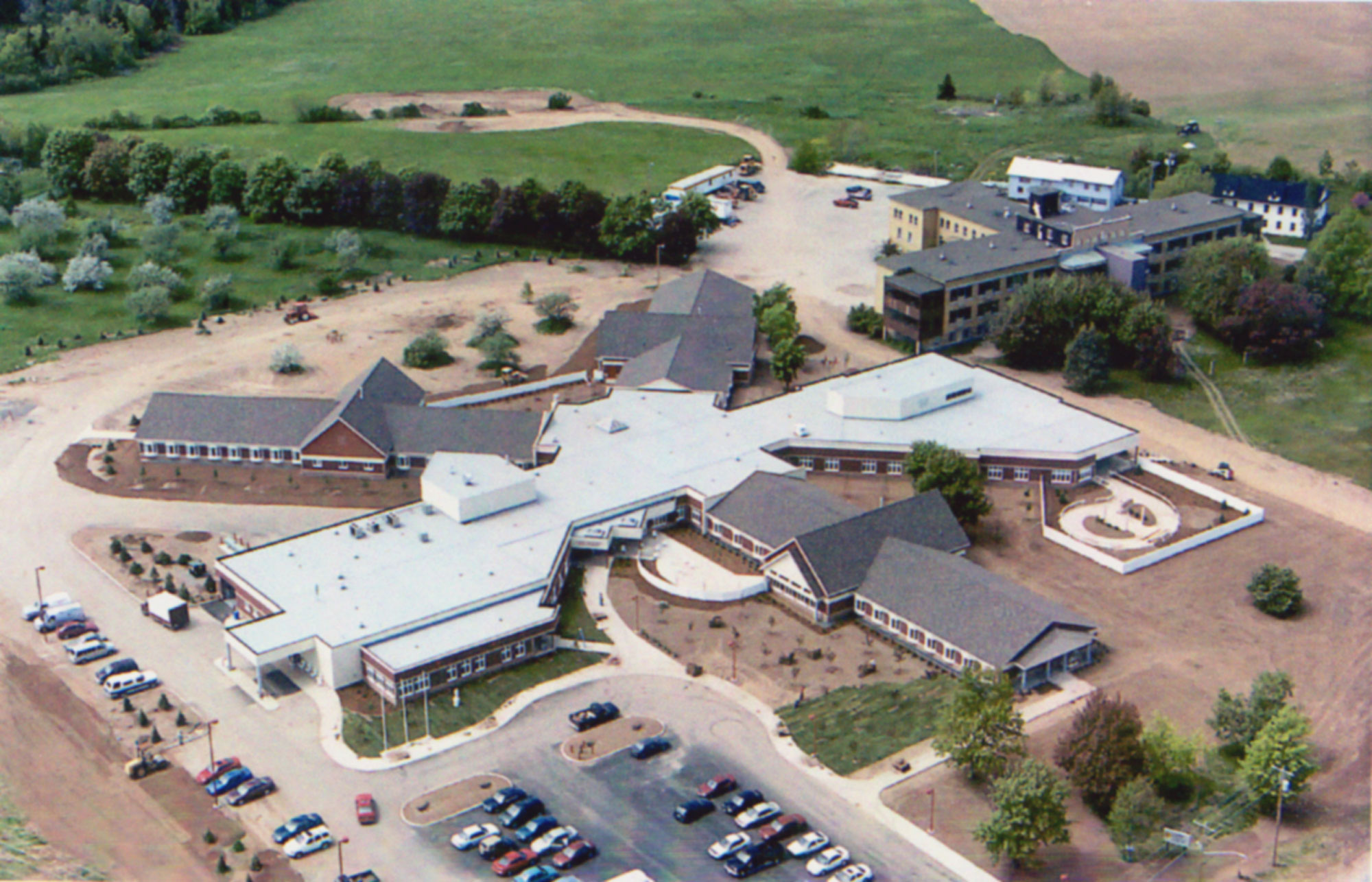
As of July 1, 1959, the new Hospital Insurance Plan for New Brunswick came into effect. Sister St. George (Alice Allain), Provincial Bursar of the Religious Hospitallers of St. Joseph, was part of the committee previously charged with studying the situation of New Brunswick hospitals. In the Chronicles of the Hôtel-Dieu Community, it is written: “All patients in the province registered under this plan do not have to pay their hospital bill.” Around 1970, health insurance also covered physician fees.

The Hôtel-Dieu Advisory Council was recognized as the Board of Directors in 1968. The sisters subsequently transferred the administration of the hospital, and then the property, on January 1, 1972. From the beginning, the sisters lived in a wing of the hospital and paid their own board. In 1969, those still at the Hôtel-Dieu moved into a private home on Laporte Street. They remained there until the closure of the community of the Religious Hospitallers of Edmundston on August 20, 1974.

Hôtel-Dieu St-Joseph in Edmundston, NB 1966. Source: Archives of the Religious Hospitallers of St. Joseph of New Brunswick.
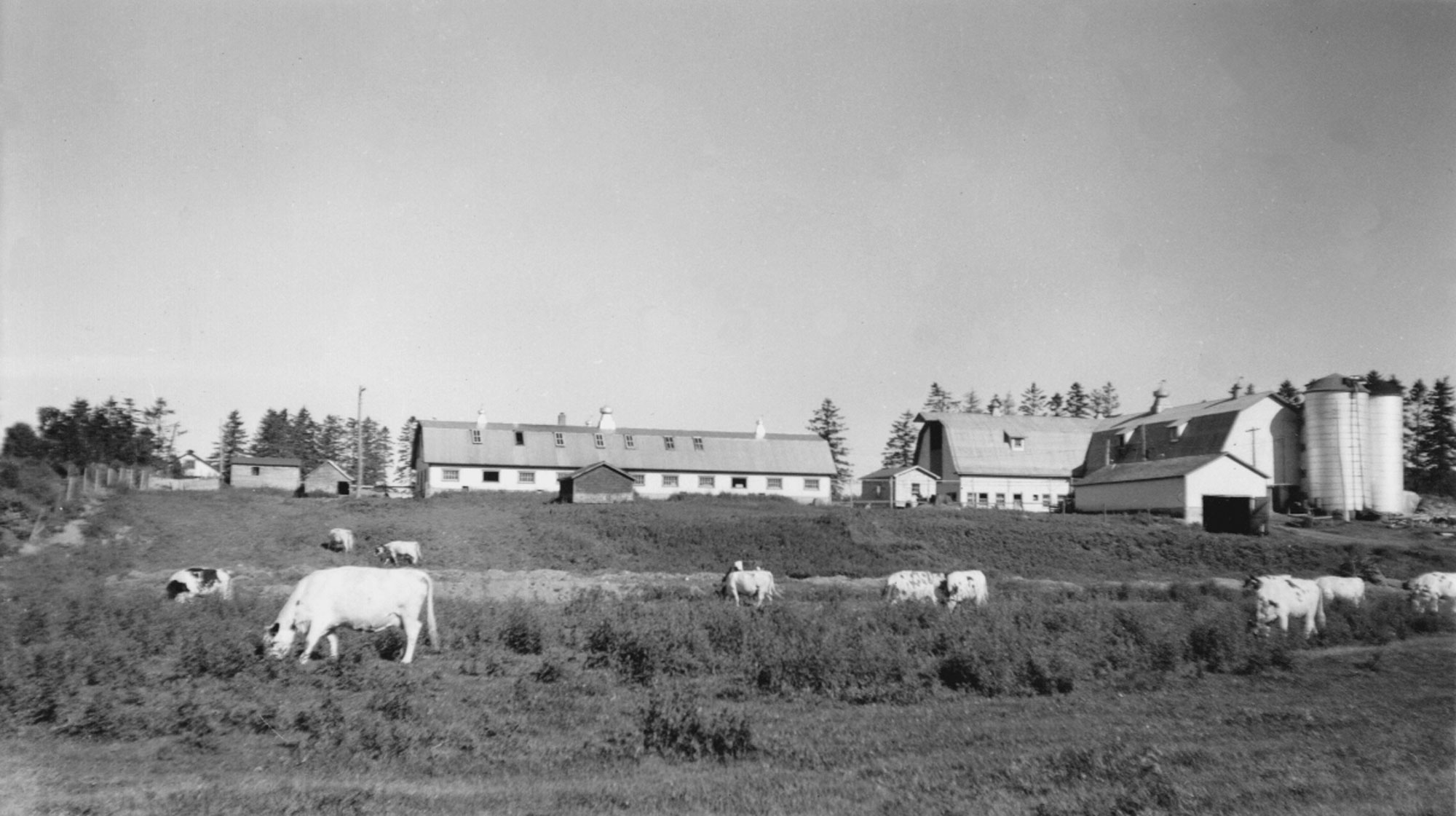
Hôtel-Dieu St-Joseph, first hospital in Madawaska, Saint-Basile, NB, 1881. Source: Archives of the Religious Hospitallers of St. Joseph of New Brunswick.
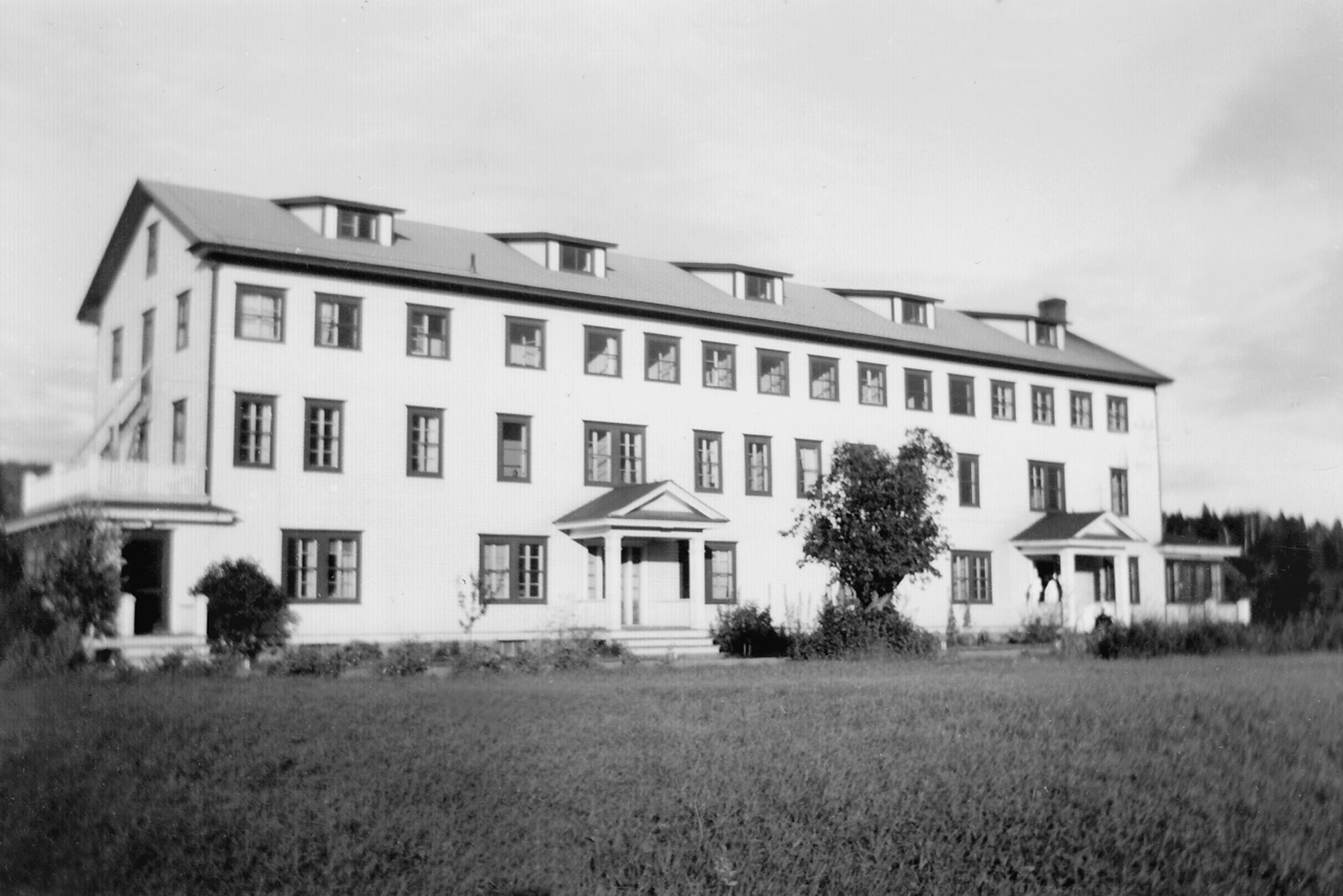
Hôtel-Dieu St-Joseph de Saint-Basile, west wing which served as a hospital from 1915 to 1946. Source: Archives of the Religious Hospitallers of St. Joseph of New Brunswick.
Hôtel-Dieu St-Joseph in Edmundston, NB 1966. Source: Archives of the Religious Hospitallers of St. Joseph of New Brunswick.

School of Nursing,1938‑1968

In 1938, Sister Carroll of Campbellton and Sister St-Charles (Joséphine Morneault) met to establish a nursing school for the sisters of the Hôtel-Dieu de Saint-Basile. Young women were admitted in 1943 and graduated in 1945 at Saint-Basile. In the fall of 1946, the school was transferred to the new Hôtel-Dieu St-Joseph in Edmundston. The school offered a three-year training program and was initially located at the hospital until its transfer to the Edmundston Educational Centre in 1968. It was subsequently relocated to the Larouche Pavilion on the Edmundston campus of the Université de Moncton (UMCE). Later, it became the UMCE School of Nursing and offered a baccalaureate degree.

CAMPBELLTON

Botsford House, Campbellton's first Hôtel-Dieu, in 1888. Source: Archives of the Religious Hospitallers of St. Joseph of New Brunswick.
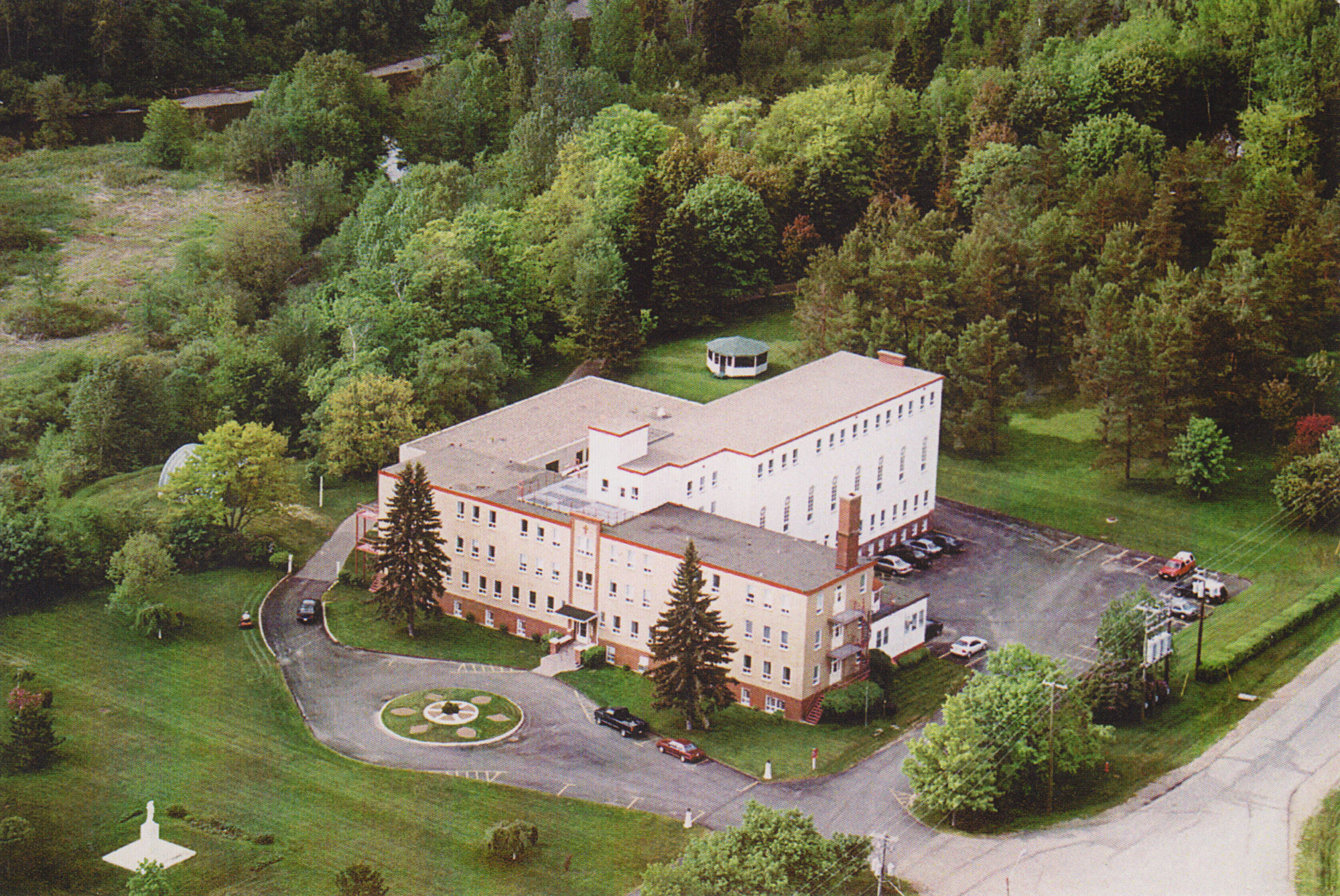
Campbellton: Teaching and Care of the Sick, 1888‑1918

At the request of Campbellton parish priest Father John L. McDonald and Bishop of Chatham, Msg. James Rogers, for the fourth time in twenty years the Religious Hospitallers of the Hôtel-Dieu de Montréal agreed to send sisters to New Brunswick. The need for bilingual, Catholic teachers was urgent in a small, predominantly Protestant and English-speaking town. The Superior of Montreal and her council agreed, with one caveat: “that teaching would continue as long as a teaching community was not called to replace us.” Mother Gendron, superior, and four companions arrived in Campbellton on September 21, 1888, ready to care for the sick and take charge of the education of children. Two sisters from Chatham would come to lend a hand with English teaching.
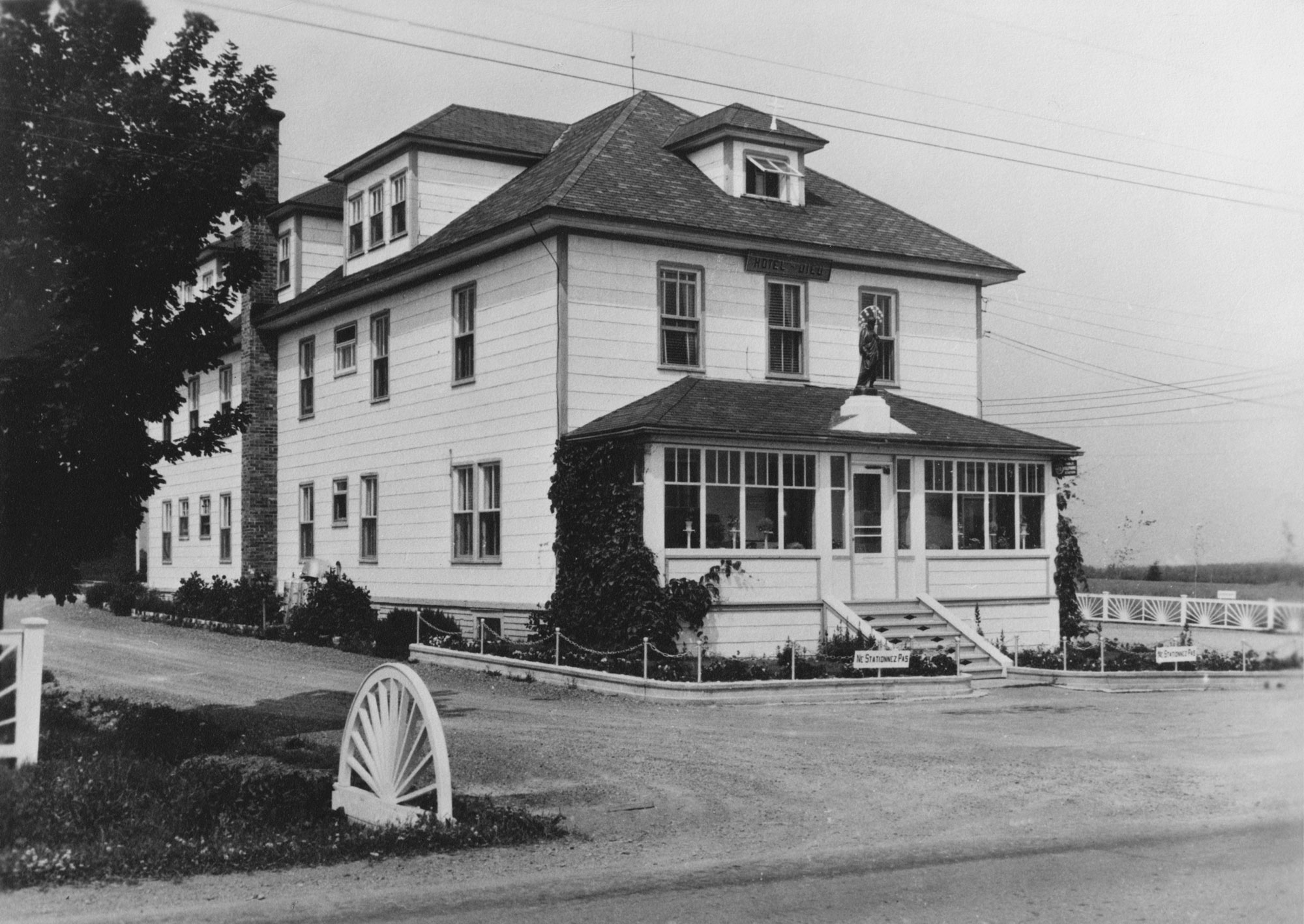
Botsford House, Campbellton's first Hôtel-Dieu, in 1888. Source: Archives of the Religious Hospitallers of St. Joseph of New Brunswick.
Second Hôtel-Dieu of Campbellton opened in 1890: school, convent and hospital. Burned down in 1910. Source: Archives of the Religious Hospitallers of St. Joseph of New Brunswick.

The sisters first settled in the Botsford house at the foot of Notre-Dame-des-Neiges hill. A shed converted into a temporary school welcomed 40 students, including boys and girls, on October 24, 1888. This was the beginning of a bilingual Catholic school in Campbellton that would provide great service to the population for about thirty years, under the direction of the Religious Hospitallers of St. Joseph. Faced with the urgency and the need to meet all the community’s needs, both educational and health-related, Father McDonald guaranteed a loan to the sisters of $20,000 for the construction of a large building at the top of the hill. In 1890, the sisters and their 90 students moved into the second Hôtel-Dieu, which included accommodations for the sisters, a boarding school, classrooms and five rooms for the sick.

Second Hôtel-Dieu of Campbellton opened in 1890: school, convent and hospital. Burned down in 1910. Source: Archives of the Religious Hospitallers of St. Joseph of New Brunswick.
Temporary hospital built in 1910. Burned down in 1918. Source: Archives of the Religious Hospitallers of St. Joseph of New Brunswick.

During the first twenty years after Campbellton’s founding, the number of students and patients increased, to the point that it became necessary to add another large building to serve as the hospital. Completed in 1909, the third Hôtel-Dieu could accommodate 40 to 50 patients and was equipped with operating rooms and other ancillary services. A few competent physicians took an interest in the Hôtel-Dieu, particularly Doctors Lunam and Pineault. But the beautiful hospital made of cement blocks was short-lived. Unfortunately, it was razed by the fire that ravaged the city of Campbellton in 1910.

After the city’s fire, the work of education continued in makeshift premises. In 1916, it became necessary to expand the classrooms and the school to accommodate more than 400 students, both day and boarders. In 1918, a fire broke out in the part of the school converted into rooms to treat victims of the Spanish flu. All of the sisters’ buildings burned down except for a small house. This marked the end of school education for the Religious Hospitallers of Campbellton. The Daughters of Mary of the Assumption, a teaching community founded by Father Arthur Melanson, took over in September 1922.

Temporary hospital built in 1910. Burned down in 1918. Source: Archives of the Religious Hospitallers of St. Joseph of New Brunswick.
Botsford House, Campbellton's first Hôtel-Dieu, in 1888. Source: Archives of the Religious Hospitallers of St. Joseph of New Brunswick.
Second Hôtel-Dieu of Campbellton opened in 1890: school, convent and hospital. Burned down in 1910. Source: Archives of the Religious Hospitallers of St. Joseph of New Brunswick.
Temporary hospital built in 1910. Burned down in 1918. Source: Archives of the Religious Hospitallers of St. Joseph of New Brunswick.

Hôtel-Dieu St-Joseph, 1888‑1991

With the abandonment of teaching in 1918, the care of the sick became the sole priority of the Religious Hospitallers. From the beginning, the founding of a hospital encountered major difficulties and faced a long series of trials: lack of space, two fires, caring for the sick in tents, the Spanish flu. The many difficulties did not, however, prevent the sisters from persevering until the opening, in 1920, of a Hôtel-Dieu that would grow and leave its mark on the Campbellton region and part of Quebec beyond the provincial border. The sisters also operated a large dairy farm in Oak Bay to provide for the needs of the community and the Hôtel-Dieu, for which they had full responsibility in the early days, until the New Brunswick government did its part.

In summary, the first major hospital was destroyed by the fire in the city of Campbellton in 1910. This was followed, for a time, by a tent hospital. A temporary 30-bed hospital was then built, which burned down in 1918. A hotel near the train station was then made available to the Religious Hospitallers and served as a 40-bed hospital starting in December 1918. Finally, a new fire-resistant, four-story building, solidly built of brick and rose on the hill of Notre-Dame-des-Neiges.

Hôtel-Dieu de Campbellton, built in 1920 and expanded on both sides. The sisters' monastery was added to the rear in 1939 and the annex to the left side in 1958. Source: Archives of the Religious Hospitallers of St. Joseph of New Brunswick.

The Hôtel-Dieu on Arran Street was inaugurated in 1920 and recognized two years later as meeting hospital standards by the American College of Surgeons. Subsequently, it was widened on each side with the addition of extensions of about twenty feet, so that, by 1927, the Hôtel-Dieu had a capacity of 75 beds. The statue of St. Joseph that was on the summit in 1920 was placed in a niche on the facade. In 1939, the sisters had a large wing built at the rear of the Hôtel-Dieu to serve as their monastery. The final stage of construction in 1958, the addition of a large modern annex on the left side of the hospital, immediately earned the Hôtel-Dieu the accreditation of the Canadian Council of Hospitals.

From the very beginning, the Religious Hospitallers were the owners and administrators of the Hôtel-Dieu and managed all its departments. At one point, approximately forty Hospitallers worked at the hospital. The doctors assisted the Religious Hospitallers in the management office and contributed to the hospital’s progress and modernization. The formation of a lay board of directors provided support and shared responsibilities with the sisters.

Administration of the Hôtel-Dieu was transferred to the New Brunswick Department of Health in 1973. The Religious Hospitallers of Campbellton lived in a wing of the Hôtel-Dieu until 1975, when they moved to a large prefabricated house at the end of Prince William Street. They remained there until their final departure in 2004. The Hôtel-Dieu and the Soldiers’ Memorial Hospital merged in 1991 to become the Campbellton Regional Hospital.

School of Nurses and Auxiliaries, 1916-1975

The School of Nursing at the Hôtel-Dieu St-Joseph in Campbellton was established by Sister Campion of Kingston in 1916. Eight Religious Hospitallers were enrolled and other young women were admitted the following year. Theoretical instruction was provided by doctors, and the first public graduation ceremony took place in 1922. The school’s motto was Pro Deo et Humanitas (For God and Humanity). The school would become renowned, among other things, for its teaching of nursing techniques. Sister Anastasia Harquail, known as Sister Carroll, who served as director of the School of Nursing from 1920 to 1927, was an excellent teacher. Her book, Techniques for the Care of the Sick, which was used at the Hôtel-Dieu in Montreal, earned her a decoration from the City of Paris at the first Congress of Catholic Nurses (CCIAMS) in 1933.

In 1934, the school was affiliated with Laval University in Quebec City for a time, but students were also required to pass the New Brunswick Registered Nurses Association exams. In 1939, the Alumnae Association was established. The school was run by the Religious Hospitallers, who received assistance from an advisory committee. The School of Nursing closed in the 1960s, while the Auxiliary School continued until August 1975. Between 1922 and 1975, 830 nurses and 200 auxiliaries graduated.

Dalhousie Hospital, 1946-1948

At the request of Father Aurèle Godbout, parish priest of Dalhousie, the Religious Hospitallers of Campbellton agreed to take charge of a hospital in Dalhousie. On May 18, 1946, Sister Albertine Richard and two sisters opened a temporary Hôtel-Dieu with 50 beds. Construction plans called for a 100-bed hospital, but in 1947, Rome refused permission to build. Since the Campbellton community was unable to finance the project, it was decided to withdraw and make way for the Daughters of Jesus. The three Campbellton sisters left Dalhousie on August 15, 1948.

BATHURST

Notre-Dame-de-Lourdes Sanatorium, 1931‑1972

In the 1930s, New Brunswick was marked by a tuberculosis pandemic. There was a sanatorium in River Glade and another in St. John in the south of the province, but there was nowhere to treat pulmonary tuberculosis in northern New Brunswick. Once again, the Religious Hospitallers of St. Joseph, who had experience in treating serious contagious diseases such as leprosy, stepped in, taking over the management of the Notre-Dame-de-Lourdes Sanatorium at the Lady Dunn Institution in Bathurst in 1931 and the St. Joseph Sanatorium in Saint-Basile de Madawaska in 1946. The government assumed the operating expenses of both sanatoriums, and by 1970, there were almost no more patients with pulmonary tuberculosis.

James Dunn House in Vallée-Lourdes, given to the Bishop of Bathurst, served as a sanatorium in 1931-1932. Source: Archives of the Religious Hospitallers of St. Joseph of New Brunswick.

Sanatorium in the Dunn House, 1931‑1932

At the request of Bishop Patrice-A. Chiasson of Bathurst, the Religious Hospitallers of St. Joseph of Tracadie, who were well aware of the existence of pulmonary tuberculosis in the northeastern region of New Brunswick, agreed in 1930 to take over the management of a sanatorium to be built in Vallée-Lourdes, near Bathurst. Sir James Dunn, a wealthy industrialist born in the region, donated the Somerset Vale Farm property located in West Bathurst to the Bishop of Bathurst. This immense property of 1,000 acres, partly cultivated, was ideal for a sanatorium and for a growing congregation in New Brunswick.

On May 4, 1931, Sisters LaDauversière (Isabelle Sormany), Éva Albert, Marie-de-l’Assomption (Yvonne Turcotte), and Léontine, all fromTracadie, took possession of James Dunn’s large summer home in Vallée-Lourdes. A few so-called tubercular patients were admitted and treated there while awaiting the opening of the sanatorium. The groundbreaking ceremony took place in September 1931 and construction work began immediately on a three-story brick building at the top of the valley on the other side of the rail line. With a capacity of 90 beds and subsidized by the New Brunswick government, the Notre-Dame-de-Lourdes Sanatorium of the Lady Dunn Institution opened its doors on August 5, 1932. The twenty patients from the Dunn House were transported there, thus freeing up the house which would subsequently welcome elderly people and serve as a common novitiate for the Religious Hospitallers of New Brunswick from 1936.

Notre-Dame-de-Lourdes Sanatorium, Vallée-Lourdes, NB, for treatment of tuberculosis (TB). 1932. Source: Archives of the Religious Hospitallers of St. Joseph of New Brunswick.

Notre-Dame-de-Lourdes Sanatorium of the Lady Dunn Institution, 1931‑1972

The Bishop of Bathurst eventually transferred ownership of the sanatorium to the Religious Hospitallers of St. Joseph, who assumed full responsibility for it. The sanatorium was a public institution and the community’s superior, who was also the administrator, reported to the New Brunswick Department of Health. Funding was provided with assistance from the government and municipalities of Gloucester, Restigouche, and Northumberland counties, where most of the patients came from.

Throughout its existence, 1932 and 1972, the Notre-Dame-de-Lourdes Sanatorium was run by a sister. All the sisters working at the sanatorium received the training required to assume responsibilities in their fields of expertise: administration, accounting, personnel management, laboratory, pediatrics, kitchen, laundry, pharmacy, sterilization, and medical records.

The sanatorium’s governing board included sisters and doctors who collaborated with management for the well-being of the patients. The sanatorium’s first medical superintendent, Dr. Gérald E. Gauvin, devoted himself to it for more than fifteen years, then transferred to the St. Joseph Sanatorium in Saint-Basile. The quality of the Notre-Dame-de-Lourdes Sanatorium’s operations was recognized in 1951 by the Council on Hospital Accreditation and later by the American College of Surgeons of the United States.

The services of a chaplain were also offered to the sick, who were mostly French-speaking Catholics, although English-speaking Protestants and Indigenous peoples, as well as any other sick person, were admitted without distinction of language or religion. The first chaplain was Father Damase Thibodeau. Beginning in 1941, adult classes, rehabilitation, and recreational activities were also offered. After 1946, sick children were treated at the St. Joseph Sanatorium in Saint-Basile. From the very beginning, a small Canadian National Railway station was inaugurated in Vallée-Lourdes and, in 1933, a post office opened in the Sanatorium. In 1940, the Lourdes grotto, erected in the valley on the property of the Religious Hospitallers, became a place of prayer that encouraged pilgrimages for the sick.

LaDauversière Pavilion, Vallée-Lourdes, NB, Sanatorium, Annex from 1950 to 1961. Source: Archives of the Religious Hospitallers of St. Joseph of New Brunswick.

LaDauversière Pavilion, annex of the Sanatorium, 1950‑1961

As the number of patients increased significantly, a lack of space was felt at the sanatorium. At the request of the New Brunswick Department of Health for a new building, on June 1, 1950, the LaDauversière Pavilion, which had been receiving elderly people since December 1948, was transformed into an annex of the Notre-Dame-de-Lourdes Sanatorium, thus providing 80 additional beds. In 1959, the sanatorium had a total of 172 beds and, since the foundation began, 3,740 patients had been treated. The treatments offered to tuberculosis patients were effective and, in 1961, the LaDauversière Pavilion, which had treated 1,218 patients, ceased to receive tuberculosis patients and became an annex of the overcrowded Hôtel-Dieu St-Joseph de Bathurst.

In 1972, as the number of patients at the Notre-Dame-de-Lourdes Sanatorium declined, the second floor was converted to accommodate the elderly. The Minister of Health announced the closure of the sanatorium and the few remaining tuberculosis patients were transferred to the hospital.

After renovations to the first floor were completed on October 26, 1974, the residents of the Foyer St-Camille-de-Lellis were transferred there, as the wooden building located on St-Pierre Avenue in Bathurst was permanently closing. The sanatorium building was henceforth named Foyer Notre-Dame-de-Lourdes.

Hôtel-Dieu Saint-Joseph, Bathurst, NB 1968. Source: Archives of the Religious Hospitallers of St. Joseph of New Brunswick.

Hôtel-Dieu Saint-Joseph, 1940‑2006

The project for a Catholic hospital in Bathurst was first initiated by Bishop Dosithée Robichaud, parish priest of Bathurst, who purchased the Pine Hill property and gave a portion to the Religious Hospitallers of Bathurst for the construction of a hospital to be run by the Religious Hospitallers of St. Joseph. They accepted on March 14, 1940 and Sister St. Albert (Éva Albert), who would become the hospital’s first director, actively collaborated with architect Louis N. Audet of Sherbrooke, who drew up plans for a five-story building. The community of Hôtel-Dieu sisters would be made up of six sisters from the Notre-Dame-de-Lourdes Sanatorium, four sisters from Tracadie, and one sister from Arthabaska. On August 5, 1942, the Religious Hospitallers took over management of the new 80-bed Hôtel-Dieu. Following a fire at the JH Dunn Hospital in Bathurst in 1950, 30 beds were added.

On September 9, 1942, Bishop Camille-André LeBlanc, the new Bishop of Bathurst, presided over the official opening ceremony of the Hôtel-Dieu, and Bishop Ildebrando Antoniutti, the apostolic delegate, performed the solemn blessing. Throughout the life of the Hôtel-Dieu, the eight successive directors and most of the department heads were Religious Hospitallers. Bishop A. Trudel, who was retired, was the first chaplain and Bishop Edgar Godin replaced him in 1948. In December 1942, the Ladies’ Auxiliary was organized under the presidency of Madame E.J. Léger. The first advisory board of the Hôtel-Dieu was activated in 1948 under the presidency of Bishop Dosithée Robichaud. A medical board formed in 1942 included seven physicians, with Dr. C.J. Veniot as president and Dr. Gérald Gauvin as secretary. By 1962, the medical office had thirteen doctors.

Between 1946 and 1953, Sister St. Albert, Superior and Hospital Director, reported on its management to the General Council of the Religious Hospitallers of St. Joseph of Vallée-Lourdes. Subsequently, the Notre-Dame-de-l’Assomption Provincial Council, which reported to the Generalate of North America with its headquarters in Montreal, acted as the Board of Governors of the institutions of the Religious Hospitallers of St. Joseph of New Brunswick.

In 1947, the Canadian Council on Accreditation recognized the excellence of care provided at Hôtel-Dieu. Then in 1951, the hospital received official accreditation from the American College of Surgeons.

Nurses' Residence at the Hôtel-Dieu de Bathurst, 1943. Source: Archives of the Religious Hospitallers of St. Joseph of New Brunswick.

Hôtel-Dieu de Bathurst Nursing School, 1943‑1962

As soon as the Hôtel-Dieu opened its doors, the project for a nursing school was put into action in February 1943. Sister Carroll of Campbellton was its organizer and director until 1945. Then Sisters Marthe LaPlante and Jeannette Thériault successively took over as directors. The nursing school was affiliated with the Université du Sacré-Cœur in Bathurst and nurses passed the New Brunswick Nurses Association exams to be recognized as registered nurses. From its beginnings until 1972, the year it closed, the Hôtel-Dieu de Bathurst Nursing School trained 567 qualified nurses.

Founded in 1953, a School of Auxiliary Nurses operated until 1962. Miss Yvonne LaPlante and Sister Lorraine Godin served as its directors. This school awarded diplomas to 144 graduates.

LaDauversière Pavilion: annex of the Hôtel-Dieu, 1961‑1970

At the turn of the 1960s, the ever-increasing number of patients at the Hôtel-Dieu made the situation difficult. To remedy this, the LaDauversière Pavilion, where there were almost no tuberculosis patients, was vacated in November 1961. It would serve as an annex to the Hôtel-Dieu de Bathurst, with a capacity of 80 beds in pediatrics, geriatrics, maternity, and nursery. Sister Estelle Martin was appointed superior of the LaDauversière Pavilion. In 1962, the Hôtel-Dieu St-Joseph de Bathurst had a staff of 200, including 30 registered nurses and 15 sisters. Between 1942 and 1967, there would be 96,332 admissions to the Hôtel-Dieu de Bathurst.

To ensure more space for hospital services, the sisters left their premises at the Hôtel-Dieu on August 4, 1967 and moved into the residence at 232 St. Andrew Street, not far from the hospital. In August 1974, the members of the Provincial Council moved into this large house until its closure in 2006.

LaDauversière Residence, 2094 Vallée-Lourdes Street, Bathurst. Source: Archives of the Religious Hospitallers of St. Joseph of New Brunswick.

Establishment of the Chaleur General Hospital in Bathurst, 1969

In preparation for the new Chaleur General Hospital in Bathurst, the New Brunswick government and the authorities of the Religious Hospitallers of St. Joseph reached an agreement. During the summer of 1968, at the request of the Department of Health, plans were drawn up for the merger of the three entities: the Hôtel-Dieu St-Joseph in Bathurst, its annex, the Pavillon LaDauversière in Vallée-Lourdes, and the tuberculosis care of the Notre-Dame-de-Lourdes Sanatorium. The merger was signed on January 19, 1969 and, in February 1969, the Hôtel-Dieu community moved to 2094 Vallée-Lourdes Street. Sister Thérèse Haché, who was then superior, was appointed executive director of the Chaleur General Hospital and put in charge of the transition and transfers.

After thirty years of dedicated service to the people of northeastern New Brunswick, the Hôtel-Dieu St-Joseph in Bathurst closed its doors for good. In January 1972, the patients were transferred to the Chaleur General Hospital and, on February 2, 1972, the Congregation of the Religious Hospitallers of St. Joseph transferred the LaDauversière Pavilion and ownership of a huge plot of land that would be used for the new hospital and its outbuildings to the New Brunswick government, for the symbolic sum of one dollar. The LaDauversière Pavilion would eventually be demolished, and the Hôtel-Dieu St-Joseph building on Pine Hill in Bathurst would be sold to the government on March 29, 1973. The former Notre-Dame-de-Lourdes Sanatorium would be transformed into a nursing home, still under the management of the Religious Hospitallers of St-Joseph, who owned it.

Blessing of the first Foyer St-Camille-de-Lellis, in the Rogers house, July 18, 1943. Source: Archives of the Religious Hospitallers of St. Joseph of New Brunswick.

Bathurst, Nursing homes, 1943‑2000

Foyer St-Camille-de-Lellis, Vallée-Lourdes and Belledune, 1943-1952
The Foyer St-Camille-de-Lellis changed location six times, and its name once, to become Foyer Notre-Dame-de-Lourdes. In 1943, the Religious Hospitallers of St-Joseph of the Sanatorium purchased the house and property of a Mr. Rogers in Vallée-Lourdes to build a nursing home. The home was named St-Camille-de-Lellis in honor of the new bishop, Mgr. Camille-A. LeBlanc. Three Religious Hospitallers from the Campbellton community served this home, which provided shelter to the region’s elderly.

Blessing of the first Foyer St-Camille-de-Lellis, in the Rogers house, July 18, 1943. Source: Archives of the Religious Hospitallers of St. Joseph of New Brunswick.
Belledune Rectory, used as a Home from 1950-1952. Source: Archives of the Religious Hospitallers of St. Joseph of New Brunswick.

The solemn blessing of the Foyer St-Camille-de-Lellis took place on July 18, 1943, and the elderly who had been housed at the sanatorium were admitted on August 25. This rather large house would serve as a Foyer until 1946, when it was transferred to the Capuchin Fathers. Consequently, the elderly and the sisters moved to the Dunn House in Vallée-Lourdes, which had been enlarged for the congregation’s novitiate. Two years later, on December 23, 1948, the LaDauversière Pavilion was sufficiently completed to accommodate as many elderly people from the diocese as possible. They would not be there long because, in 1950, at the request of the New Brunswick government, the LaDauversière Pavilion would become an annex of the Notre-Dame-de-Lourdes Sanatorium, whose number of patients was still increasing.

Some of the elderly were transferred to the care of the Religious Hospitallers of Chatham, Saint-Basile, and Saint-Quentin. A small group would move to the Belledune presbytery, which had been converted by Father Yvon Sirois, the parish priest, to accommodate twelve people. On January 11, 1951, five sisters were appointed to take charge of this small home, with Sister Mélanie Lavoie as Superior.

Belledune Rectory, used as a Home from 1950-1952. Source: Archives of the Religious Hospitallers of St. Joseph of New Brunswick.
Aerial view of the Foyer St-Camille-de-Lellis, avenue St-Pierre, Bathurst, 1972. Source: Archives of the Religious Hospitallers of St. Joseph of New Brunswick.

Foyer St-Camille-de-Lellis, St-Pierre Avenue,
1952‑1974

True to his promise, Bishop C.-A. LeBlanc had a large, three-story wooden building built on St. Pierre Avenue in Bathurst at the diocese’s expense. When the new Foyer St. Camille-de-Lellis opened on September 7, 1952, all 63 beds were occupied. Sister Mélanie Lavoie was the home’s first Superior and Director. Father Armand Martin served as chaplain for most of the home’s existence. With the help of social welfare and government grants, the home’s financial situation was satisfactory.

After 20 years of existence, the Foyer St-Camille-de-Lellis was deemed non-compliant with safety standards by the New Brunswick Department of Health, which recommended its closure. Departures were made in groups to the sanatorium, which was converted into a nursing home, between 1972 and 1974. The old wooden building, as well as the sisters’ residence built in 1968 near the home, were sold. The sisters left St-Pierre Avenue for good on August 31, 1976.

Aerial view of the Foyer St-Camille-de-Lellis, avenue St-Pierre, Bathurst, 1972. Source: Archives of the Religious Hospitallers of St. Joseph of New Brunswick.
Blessing of the first Foyer St-Camille-de-Lellis, in the Rogers house, July 18, 1943. Source: Archives of the Religious Hospitallers of St. Joseph of New Brunswick.
Belledune Rectory, used as a Home from 1950-1952. Source: Archives of the Religious Hospitallers of St. Joseph of New Brunswick.
Aerial view of the Foyer St-Camille-de-Lellis, avenue St-Pierre, Bathurst, 1972. Source: Archives of the Religious Hospitallers of St. Joseph of New Brunswick.

Foyer Notre-Dame-de-Lourdes, 1972‑2000

Meanwhile, the number of tuberculosis patients had decreased so much at the Notre-Dame-de-Lourdes Sanatorium that the second floor was practically empty. The vacant space would accommodate the first group of 35 elderly people from the Foyer St-Camille, who were transferred there on June 14, 1972. The renovation of the building to accommodate about 100 residents was approved by the New Brunswick Department of Health. Sister Thérèse Duplessis took charge of organizing the new Foyer and became its first Executive Director. In 1974, the last tuberculosis patients were transferred to the Chaleur General Hospital and, in September and October, the last residents of the Foyer St-Camille moved into their new home, which would henceforth be called the Foyer Notre-Dame-de-Lourdes.

In 1975, the sisters of the former sanatorium, which had become the Foyer Notre-Dame-de-Lourdes, gave up their premises in the west wing above the chapel to house the elderly. The sisters then moved into the Maison Sainte-Bernadette, the former residence for women employed at the sanatorium. Major renovations were required, and between 1974 and 1977, work was carried out to meet standards. The facility opened on October 1, 1977.

Aerial view of the old and new Foyer Notre-Dame-de-Lourdes, 2000. Source: Archives of the Religious Hospitallers of St. Joseph of New Brunswick.

On November 21, 1978, the Home was incorporated under the name Foyer Notre-Dame-de-Lourdes Inc. Since September 1983, a Board of Directors composed of lay people and sisters has ensured the smooth running of the institution. Mr. Claude Desrosiers was appointed Executive Director in September 1985. There are still six Religious Hospitallers working with the elderly, either as nurses or pastoral agents.

In February 1995, the Board of Directors of the Foyer Notre-Dame-de-Lourdes requested funding to expand the home. Two years later, the Board requested the construction of a new nursing home instead. The project cost approximately $10 million, but in 1997, the United Commercial Transfer (UCT) of Bathurst donated $1 million. The Government of New Brunswick provided a financial contribution and authorized a mortgage. The Religious Hospitallers donated eight acres of land between the old home and Chaleur Hospital. The groundbreaking ceremony took place on October 6, 1998. Construction of a single-story home with star-shaped units was completed in May 2000.

The transfer of the 100 residents to the new Foyer Notre-Dame-de-Lourdes was a major event: 200 people, employees and volunteers, contributed and it was completed in a record time of 2 hours and 15 minutes. The official opening took place on October 1st and employees celebrated the occasion by planting about 20 trees on the site. The old building, which had served as a sanatorium and then a nursing home, would be demolished.

In January 2002, the Religious Hospitallers of St. Joseph and the Board of Directors of the Foyer Notre-Dame-de-Lourdes transferred responsibility for the Foyer to the Catholic Health Partners Inc.

The Foyer has 130 beds and, in addition to long-term care, offers other services for people with disabilities and impairments. This state-of-the-art facility is in keeping with the compassionate values and mission that the Religious Hospitallers have championed since their founding in France in 1636.

VALLÉE LOURDES, BATHURST

Government of the RHSJ in New Brunswick

A significant change in administrative structure took shape among the Religious Hospitaller of St. Joseph of New Brunswick in the first half of the 20th century. The houses, which had been autonomous from the beginning, united in 1946 to form the Acadian Generalate. Then, in 1953, with the creation of a North American Generalate, the houses of New Brunswick formed the Province of Notre-Dame-de-l’Assomption with its headquarters in Bathurst. The provinces were abolished in 2000 and the remaining sisters and communities were attached to the General Council, which resided at the Maison des Hospitalières in Montreal.

Overview of the herd of cows and buildings at the Ferme de Lourdes, 1944. Source: Archives of the Religious Hospitallers of St. Joseph of New Brunswick.

Acadian Generalate, 1946‑1953

Before the establishment of a general structure uniting the houses of the Congregation, all RHSJ houses were autonomous. This meant that each house had full financial responsibility for the community’s assets and for the management of its healthcare (sick, disabled, and elderly) and educational (orphanages, boarding schools, and public schools for girls and boys) works. Almost all foundations housed their staff and operated a farm that provided subsistence and sometimes economic income for its institutions.

The project to unite the Religious Hospitallers houses in New Brunswick into a generalate dates back to the 1930s and began with the Religious Hospitallers community in Campbellton. The institutions of Saint-Basile, Tracadie, and Bathurst soon pledged their support. In 1933, an initial request to Rome to form a generalate was refused. The Chatham house had been consulted but they preferred to wait to join the English-speaking sisters in Ontario. However, the request for a common novitiate for the houses in New Brunswick was approved in 1935 and Dunn House in Vallée-Lourdes proved to be the best location for its establishment.

Overview of the herd of cows and buildings at the Ferme de Lourdes, 1944. Source: Archives of the Religious Hospitallers of St. Joseph of New Brunswick.
Dunn House expanded to house the Mother House and the Vallée-Lourdes novitiate, 1950. Source: Archives of the Religious Hospitallers of St. Joseph of New Brunswick.

New Constitutions would be proposed to Rome for the formation and operation of a generalate. After much consultation and intervention by Bishop Camille-André LeBlanc of Bathurst and Bishop Ildebrando Antoniutti, Apostolic Delegate, the union of the four monasteries of Tracadie, Saint-Basile, Campbellton and Vallée-Lourdes into a generalate was finally approved on November 13, 1946. The Dunn House in Vallée-Lourdes, enlarged to serve as a novitiate, became the Mother House of the houses in New Brunswick. Sister LaDauversière (Isabelle Sormany) was Superior General from 1946 to 1949 and Mother Savoie (Georgina Robichaud) succeeded her until the advent of the North American Generalate in 1953. There were assistants from almost all the houses. Sister Éva Albert was appointed General Treasurer and assumed responsibility for the Ferme de Lourdes.

A fire on Christmas Eve in 1951 destroyed the Mother House and the novitiate in Vallée-Lourdes. The General Council found refuge at the Hôtel-Dieu in Bathurst, while the novitiate continued for the twenty novices and postulants in the St. Joseph retreat house in the Diocese of Bathurst until the opening of the Provincial House in Vallée-Lourdes in 1953.

Dunn House expanded to house the Mother House and the Vallée-Lourdes novitiate, 1950. Source: Archives of the Religious Hospitallers of St. Joseph of New Brunswick.
Overview of the herd of cows and buildings at the Ferme de Lourdes, 1944. Source: Archives of the Religious Hospitallers of St. Joseph of New Brunswick.
Dunn House expanded to house the Mother House and the Vallée-Lourdes novitiate, 1950. Source: Archives of the Religious Hospitallers of St. Joseph of New Brunswick.
Aerial view of the NDA Provincial House, Vallée-Lourdes, NB, 2000. Source: Archives of the Religious Hospitallers of St. Joseph of New Brunswick.

Notre-Dame-de-l’Assomption Province, 1953‑2000

Around 1950-1951, the foundations of a second Mother House, which would become the Provincial House in 1953, were dug near the old Mother House, which burned down in 1951. People began to live in the new Provincial House in 1953, the year in which the Generalate of America, with its headquarters and Mother House in Montreal, was approved by Rome. The RHSJ houses of New Brunswick formed the religious province of Notre-Dame-de-l’Assomption (NDA), with a provincial council in Vallée-Lourdes, which included the provincial superior, Sister Marthe Laplante, and three assistants. Sister St-Georges (Alice Allain), provincial treasurer, would play an important role in the reform of health insurance in New Brunswick.

The mid-20th century witnessed a significant expansion of the work of the Religious Hospitallers of St. Joseph within New Brunswick: the opening of two sanatoriums (in Vallée-Lourdes and Saint-Basile); small hospitals in St-Quentin, Perth-Andover, Lamèque, Caraquet and Grand-Sault; as well as two large nursing homes in Bathurst and Saint-Basile.

Outside the province, the Religious Hospitallers established new foundations in Van Buren, Maine; Sorel, Quebec; Yarmouth, Nova Scotia; as well as important works in Peru, especially in San Pablo and Lima. The religious staff, quite numerous in the postwar years until the 1960s, provided most of the leadership positions and essential services to the institutions. Many young women, most of them former students or employees of the sisters, then entered the community, thus ensuring the continuity and expansion of the works of the Religious Hospitallers of Saint. Joseph.

The NDA Province had some fairly successful works in the early days, but it would undergo many changes, both civil and religious, over the course of its fifty-year existence. In the 1960s and 1970s, the health and education works of the Religious Hospitallers were taken over by the New Brunswick government, and the number of sisters declined rapidly.

This phenomenon is partly explained by the sharp decline in the number of entries, but also by the deaths and departures of sisters in perpetual vows. According to the statistics of the NDA Province, in December 1953, there were 22 novices, 22 postulants and 342 temporary and perpetual professed sisters, distributed in 18 houses, including the houses of Peru. In 1967, there were 368 professed sisters in the NDA Province; in 1987, there were 237; in 2007, 116.

The NDA Provincial Council was dissolved in 2000. In 2025, there remained only a General Council for the entire congregation, which consisted of six community groups, including the two in New Brunswick – Bathurst and Saint-Basile – which had around forty sisters.

SAINT-QUENTIN
Hôtel-Dieu St-Joseph, 1947‑2010

In 1946, the people of Saint-Quentin took the initiative to establish a hospital in their community. A committee of the Chamber of Commerce purchased lots 4 and 5 of range 11, which included 200 acres of land, a large house, which would serve as a hospital, and farm buildings. The organizing committee also purchased the equipment and materials for the recently closed Sanita Hospital in Edmundston. In January 1947, Miss Zita Rioux, a registered nurse, was hired as Superintendent of a small 11-bed hospital that admitted its first patients on April 7, 1947.

Hôtel-Dieu St-Joseph, Saint-Quentin, NB, 1950. Source: Archives of the Religious Hospitallers of St. Joseph of New Brunswick.

However, to ensure the success and stability of the nascent hospital, the contribution of a religious community proved indispensable. The parish priest, Mgr. Eudore Martin, addressed the Religious Hospitallers of New Brunswick. On April 14, 1947, the small hospital welcomed Sisters Séguin, Superior, Célestine Allard, and Ste-Elisabeth (Elisabeth Thériault). Brigitte LeCouteur de Lamèque, considered the community’s “jack of all trades,” accompanied them. On May 11, 1947, an expansion project was already under consideration and construction of an extension began immediately, doubling the space to create a 30-bed hospital. The official blessing of the Hôtel-Dieu de St-Joseph de Saint-Quentin took place on December 8 of the same year.

The Hôtel-Dieu quickly encountered financial problems that jeopardized its existence. Sister Anne-Marie Dionne, who was appointed Superior in 1953, put her administrative skills to good use. A Board of Directors established in 1946 was replaced by an Advisory Council.

By 1955, everyone was convinced that a modern building was needed to meet the healthcare needs of the greater Restigouche-Ouest region. The Religious Hospitallers approved the project and, after much negotiation, the Council received a promise of a significant financial contribution from Premier Louis J. Robichaud, who approved the plans and the construction grants for a 40-bed hospital. Brunswick Construction of Edmundston broke ground in August 1962 and the new, modern and spacious hospital officially opened in November 1963.

Hôtel-Dieu St-Joseph, Saint-Quentin, NB, 1950. Source: Archives of the Religious Hospitallers of St. Joseph of New Brunswick.
Hôtel-Dieu St-Joseph, Saint-Quentin, NB, 1963. Source: Archives of the Religious Hospitallers of St. Joseph of New Brunswick.

From the hospital’s inception until 1981, the Religious Hospitallers managed the Hôtel-Dieu. A few physicians also left their mark, including Dr. Bernard Savoie and Dr. Jean-Claude Terras. Until 1992, the Hôtel-Dieu Board of Directors reported to the Board of Governors of the Religious Hospitallers of St. Joseph in Bathurst. Then, New Brunswick passed a law transferring ownership of Catholic hospitals from the RHSJ to government corporations.

In 2001, the Hôtel-Dieu de Saint-Quentin became part of the Region 4 Hospital Corporation. In 2004, a new provincial reform plan declared the hospital’s closure, although it remained open with only six beds and all outpatient and outpatient services. In 2008, the Hôtel-Dieu became part of the Vitalité organization.

To protect the Catholic values inherited from the Religious Hospitallers, the Hôtel-Dieu de Saint-Quentin is a member of Catholic Health International Inc. The Religious Hospitallers’ dedication has been publicly recognized on numerous occasions. In 2003, the Saint-Quentin Heritage Society named them Citizens of the Year. In addition, a monument honoring the Religious Hospitallers of St. Joseph was unveiled on October 14, 2012, on the hospital grounds.

Hôtel-Dieu St-Joseph, Saint-Quentin, NB, 1963. Source: Archives of the Religious Hospitallers of St. Joseph of New Brunswick.
Hôtel-Dieu St-Joseph, Saint-Quentin, NB, 1950. Source: Archives of the Religious Hospitallers of St. Joseph of New Brunswick.
Hôtel-Dieu St-Joseph, Saint-Quentin, NB, 1963. Source: Archives of the Religious Hospitallers of St. Joseph of New Brunswick.

PERTH-ANDOVER
Hôtel-Dieu St-Joseph, 1947‑2010

At the request of Father Grégoire Léger, OFM, then parish priest of Aroostook, and with the authorization of Bishop Marie-Antoine Roy of Edmundston, the Religious Hospitallers of St. Joseph agreed to open a small hospital in Perth, a predominantly Protestant English-speaking community. The need was evident and the population was willing to cooperate. Charles Armstrong, a Protestant who was in favor of the sisters’ arrival, made a former restaurant available to them to receive the sick. The first Hôtel-Dieu in Perth opened in 1947, in a house with eleven beds for the sick. In early 1948, to make more space for health care, a residence was built for the sisters and employees.

Hôtel-Dieu St-Joseph de Perth, 1950. Source: Archives of the Religious Hospitallers of St. Joseph of New Brunswick.

The first director was Sister Corinne Kerr, a bilingual English speaker from Campbellton, who served until 1952. She reportedly told an influential person in the region who refused their presence: “We didn’t come for you. We came for the sick.” Four doctors from the Perth-Andover area were already interested in the hospital and came to treat the sick. Six exceptional sisters subsequently served as executive directors, including Sisters Brigitte Légère (1952-1958), Imelda Lizotte (1969-1980), and Bernadette Lévesque (1980-1993).

Gradually, the number of beds increased, and construction work began in 1953 on a new 45-bed hospital. In July 1954, Bishop Joseph-Roméo Gagnon of Edmundston blessed the new Hôtel-Dieu St-Joseph de Perth. The hospital progressed and, in October 1956, a certified surgeon joined the medical staff. After the construction of a new hospital and the transfer of patients to the new premises, the sisters moved into the upper floor of what had been the temporary hospital. That same year, a group of Ladies’ Auxiliaries, mostly Protestant, dedicated themselves to the advancement of the work.

Hôtel-Dieu St-Joseph de Perth, 1950. Source: Archives of the Religious Hospitallers of St. Joseph of New Brunswick.
Hôtel-Dieu St-Joseph de Perth, 1954. Source: Archives of the Religious Hospitallers of St. Joseph of New Brunswick.

In 1958, the Hôtel-Dieu received its first official accreditation from the Hospital Accreditation Commission. Over the next two decades, transformations were carried out to improve the services offered to the population. Thus, in 1959, a fireproof building was completed and, in 1968, a hospital expansion project was undertaken which included the addition of a wing with a surgery department, two patient rooms, and various services, such as radiology, a laboratory, and others.

In October 1978, the hospital opened a new emergency and an outpatient department, a physiotherapy department, and a pediatrics department. In 1981, the hospital’s Advisory Council was replaced by a Board of Directors composed of members of various religious denominations active in the Perth-Andover region. In true ecumenical spirit, all worked for the well-being of patients, in accordance with the charism of tenderness and compassion bequeathed by the Religious Hospitallers of St. Joseph. The Perth-Andover community of sisters closed in 2010, after more than 60 years of service in health care and hospital pastoral care.

Hôtel-Dieu Saint-Joseph in Perth-Andover is currently a 42-bed acute care hospital operated by the Valley Health Authority. Hôtel-Dieu is part of Catholic Health International, Inc., which owns and sponsors this small hospital, one of 19 facilities in the region.

Hôtel-Dieu St-Joseph de Perth, 1954. Source: Archives of the Religious Hospitallers of St. Joseph of New Brunswick.
Hôtel-Dieu St-Joseph de Perth, 1950. Source: Archives of the Religious Hospitallers of St. Joseph of New Brunswick.
Hôtel-Dieu St-Joseph de Perth, 1954. Source: Archives of the Religious Hospitallers of St. Joseph of New Brunswick.

LAMÈQUE
Hôtel-Dieu St-Joseph, 1949‑1972

The Hôtel-Dieu St-Joseph de Lamèque was founded in 1949, thanks in large part to the parish priest, Father Louis Morin, who approached the Religious Hospitallers of St. Joseph and offered his presbytery to serve as a hospital. Mother LaDauversière (Isabelle Sormany), Superior General at the time, was pleased to open a hospital in her native community. Father Morin died suddenly in 1950 and his successor, Father Lucien Saindon, took the health needs of the inhabitants of Lamèque Island to heart. His collaboration in the construction of a new hospital in 1960 was remarkable.

Lamèque presbytery, first hospital, 1949. Source: Archives of the Religious Hospitallers of St. Joseph of New Brunswick.

The first three sisters appointed to organize and serve the small hospital in Lamèque were Sisters Ste-Thérèse-de-Lisieux (née Alfréda Haché), Superior, Madeleine Roy, and Marie-de-Jésus (Bernadette Haché). They arrived in Lamèque on February 2, 1949, shortly after the first physician, Dr. Eugène Cormier. The hospital departments were organized and directed by sisters in close collaboration with the director, Sister Alfréda Haché, a native of Lamèque, who devoted herself for four years to establishing a small Hôtel-Dieu.

Several doctors worked at the Hôtel-Dieu de Lamèque. Without the help and collaboration of the Auxiliary Ladies, a group founded in 1949 by the hospital director, it would have been difficult to successfully organize a hospital in the middle of an isolated countryside, in a presbytery that didn’t even have a heating system. It’s not easy to organize a hospital on an island in the middle of winter. Sister Alfréda Haché risked her life more than once by helping seriously ill people cross the uncertain and fragile ice around an island where there was still no bridge.

The Hôtel-Dieu Saint-Joseph de Lamèque was incorporated in 1956. The medical and hospital staff, the advisory board, the Ladies’ Auxiliary, and the entire population of Lamèque always offered excellent cooperation to the Religious Hospitallers who were responsible for the administration of the Hôtel-Dieu. In 1960, Sister Albertine Allain took over, with the additional responsibility of overseeing the construction of a hospital.

Lamèque presbytery, first hospital, 1949. Source: Archives of the Religious Hospitallers of St. Joseph of New Brunswick.
Hôtel-Dieu St-Joseph de Lamèque, NB, 1963. Source: Archives of the Religious Hospitallers of St. Joseph of New Brunswick.

The Hôtel-Dieu St-Joseph Advisory Board was established in March 1953. It was reorganized on April 19, 1959. The elected members were residents of Lamèque: Bertin Jean, President, Alexis Duguay, and Martin Paulin. All three remained in office during the construction of a small, modern hospital, a joint effort of the people of Lamèque, the Religious Hospitallers of St. Joseph, and the New Brunswick Department of Health.

Bishop Camille-A. LeBlanc blessed the site on September 25, 1961, and Dr. Georges Dumont broke ground. The new 42-bed Hôtel-Dieu St-Joseph officially opened its doors on August 4, 1963, with Mr. Chaiker Abbis, former president of the Maritime Hospital Association, as the guest speaker. The approximate cost of construction was $620,000.

Unfortunately, the Congregation of the Religious Hospitallers of St. Joseph had to leave the Hôtel-Dieu St. Joseph in Lamèque in June 1972. Sister Thérèse Duplessis was the last sister to run the hospital, which was taken over by the New Brunswick government.

Hôtel-Dieu St-Joseph de Lamèque, NB, 1963. Source: Archives of the Religious Hospitallers of St. Joseph of New Brunswick.
Lamèque presbytery, first hospital, 1949. Source: Archives of the Religious Hospitallers of St. Joseph of New Brunswick.
Hôtel-Dieu St-Joseph de Lamèque, NB, 1963. Source: Archives of the Religious Hospitallers of St. Joseph of New Brunswick.

CARAQUET
Enfant-Jésus Hospital, 1963‑1985

The idea of a hospital in Caraquet was first launched in mid-February 1958 by Doctor Joseph Ryan and Fernand Lanteigne. The realization of this large-scale project was due to close collaboration between the City of Caraquet, the Religious Hospitallers of St. Joseph, and the government of New Brunswick. The Religious Hospitallers of the Notre-Dame-de-l’Assomption Province agreed to take charge of the construction and administration of the Hôpital de l’Enfant-Jésus. The total cost estimate was $800,000 and the government of New Brunswick promised a contribution of $307,000. Part of the land purchased by the parish was transferred to the Religious Hospitallers for the construction of a 55-bed hospital with premises for the sisters.

Enfant-Jésus Hospital, Caraquet, NB, 1975. Source: Archives of the Religious Hospitallers of St. Joseph of New Brunswick.

On May 19, 1963, seven Religious Hospitallers arrived in Caraquet to take over the organization and administration of the Hôpital de l’Enfant-Jésus. Sister Bernadette Lévesque was both Superior and Executive Director. On August 15, 1963, Bishop Camille-A. LeBlanc presided over the official blessing of the hospital, in the presence of Hédard Robichaud, Minister of Fisheries, Dr. Georges L. Dumont, Minister of Health, as well as many local citizens. The hospital had a capacity of 56 beds, 18 places in the nursery and 14 beds in the maternity ward. The main departments and services were headed by sisters: pediatrics, surgery, medicine, obstetrics, modern kitchen, laundry, dispensary service, and others. The first medical office was composed of doctors Raymond Savoie, Isabelle Bourgeois-Savoie, Perly LeBouthillier, and C.A. Blanchard.

In February 1971, a mental hygiene clinic opened at the Hôpital de l’Enfant-Jésus, with the aim of serving the entire population from Grande-Anse to Néguac. In December 1972, the Board of Directors granted premises to the public health nurses. Home care services began in March 1973. The administration of the Hôpital de l’Enfant-Jésus came under the Board of Governors of the Religious Hospitallers of St. Joseph, which appointed Fernand Rioux, the first lay executive director, on January 12, 1986. The growth of services at the Hôpital de l’Enfant-Jésus was accentuated with the following additions: gynecology, physiotherapy, occupational therapy, ultrasound, mammography, respiratory therapy and speech therapy.

After the closure of the community of sisters on March 5, 1985, a few hospital workers continued to work in Caraquet for a while. During the same period, the Fondation de l’Hôpital de l’Enfant-Jésus was created in 1987. However, the reforms of 1992 and 2002 resulted in a loss of autonomy and governance. With the dissolution of the boards of directors, services gradually declined. The development of the Hôpital de l’Enfant-Jésus was blocked but the population demonstrated for the preservation of their hospital. From 1991 to 1994, the hospital was partially renovated and work carried out to expand it. From 2004 to 2008, the hospital became a community health center but regained its status as a hospital in 2008. The hospital is part of the Santé Vitalité network and is a member of Catholic Health International, Inc.

GRAND-SAULT
General Hospital, 1964‑1985

The establishment of a hospital in Grand Sault/Grand Falls was the result of the efforts of the General Hospital Company, composed of influential and interested citizens who began negotiations with the Religious Hospitallers of St. Joseph, towards the end of the 1950s. In 1962, representatives Wilmot Vasseur and Roger Cloutier signed an agreement with the Provincial Council of the Religious Hospitallers, whose head office was in Bathurst, NB. The sisters did not wish to assume the responsibility for building or acquiring another hospital. The Grand Falls General Hospital Company therefore had full responsibility and ownership of the new hospital that would serve Grand Falls and the surrounding area. As was the custom at the time, the blessing of the land took place in September 1962, before the start of construction, which was supervised by the General Hospital Company.

Grand Falls General Hospital, NB, 1964 Source: Archives of the Religious Hospitallers of St. Joseph of New Brunswick.

On January 2, 1964, five Religious Hospitallers arrived in Grand Falls, where a small residence near the hospital was made available to them. Initially, the sisters occupied most of the management positions, both in administration and in certain departments. The General Hospital, which officially opened its doors on June 7, 1964, had 62 beds, including 17 in medicine, 17 in surgery, 12 in maternity, 16 in pediatrics, and 13 bassinets in the nursery.

The Board of Directors managed the General Hospital, and the Religious Hospitallers were responsible for its operation. The last two sisters to hold the position of Executive Director were Sisters Jeannette Thériault and Adrienne Desjardins. In 1980, Madame Marcelle Fafard took over at a time when the hospital was growing. A new wing, opened in April 1979, added a waiting room, emergency examination rooms, physiotherapy and electrocardiography services, a laboratory, and radiology.

In 1985, the Religious Hospitallers permanently left the Grand Falls General Hospital. The Board of Directors presented them with tributes and thanks for the twenty years of excellent service they provided to the city of Grand Falls and the surrounding area. The hospital continues to serve the population and is part of the Santé Vitalité network.

BRANTVILLE
Maison des Sœurs Hospitalières, 1974‑2005

By founding a small community in Brantville, the Provincial Council of the Religious Hospitallers of St. Joseph aimed to provide a helping presence in a disadvantaged area far from major centres. The first sisters designated for this new apostolate arrived in Brantville on August 24, 1974. They lived in a small house across from the Community Center and provided multiple services: teaching catechism, baptismal pastoral care, home visits to the elderly and the sick, liturgical activities, organizing a community kindergarten, prenatal classes, individual instruction for the disabled and adults, organizing workshops, and leading Al-Anon and the Scout, Guide, and Brownie movements.

The Brantville and Rivière-du-Portage kindergartens, established and subsidized by the Religious Hospitallers of St. Joseph between 1974 and 1990, were undoubtedly very successful educational initiatives. The kindergartens were later integrated into the New Brunswick public school system.

RHSJ House in Brantville, NB, 1986. Source: Archives of the Religious Hospitallers of St. Joseph of New Brunswick.

Between 1979 and 1987, the Religious Hospitallers sponsored a Social Justice Project, whose main objectives were to inform people about existing government programs and help them take charge of their own lives. A social worker was hired as coordinator of the project, which proved successful. During these years, families received assistance in building a suitable home or renovating their existing ones. Others received help filling out forms for loans, taxes, and old-age security pensions, among other things. The project ended in December 1987. The Brantville Religious Hospitallers’ House closed on April 29, 2005.

NOVA SCOTIA

YARMOUTH

Villa St-Joseph-du-Lac, 1958‑2014

At the request of Bishop Albert Leménager of the Diocese of Yarmouth, on July 16, 1958, the NDA Provincial Council of the Religious Hospitallers of St. Joseph agreed to establish a home for the elderly in Nova Scotia. On October 9, three Religious Hospitallers from New Brunswick arrived at the former Hôtel Évangéline, which the diocese had purchased to serve as a temporary nursing home. The new Foyer St-Joseph would operate for two years.

Founding Sisters in front of Foyer St-Joseph, formerly the Evangeline Hotel, Yarmouth, NS, 1958. Source: Archives of the Religious Hospitallers of St. Joseph of New Brunswick.

On April 1, 1960, the Canadian Pacific Railway Company put the Lakeside Inn, a luxury hotel in Dayton, near Yarmouth, up for sale. The sisters purchased the hotel, its furnishings, and the grounds for a paltry $70,000, on the condition that the property be “used exclusively for a hospital, a home for the aged, or a combination of both.” On May 16, 1960, the 18 residents of the Foyer St-Joseph were transferred, and on August 15, Bishop Albert Leménager officially blessed the Villa St-Joseph-du-Lac.

Demand for admission increased and, by 1964, the space reserved for the elderly had become too limited. The rooms occupied by the sisters on the third floor of the north wing were then given over to residents, also known as guests. The Congregation agreed to add a floor above this wing for the sisters of the local community.

Villa St-Joseph-du-Lac was incorporated by an act of the Halifax Legislative Assembly on March 13, 1961. In August 1965, a twelve-person advisory board was appointed to support the sisters in administration. In January 1966, the Villa was recognized as a nursing home by the Nova Scotia Department of Health.

Founding Sisters in front of Foyer St-Joseph, formerly the Evangeline Hotel, Yarmouth, NS, 1958. Source: Archives of the Religious Hospitallers of St. Joseph of New Brunswick.
Villa St-Joseph-du-Lac, former Lakeside Inn, Yarmouth, NS, 1960. Source: Archives of the Religious Hospitallers of St. Joseph of New Brunswick.

Several Religious Hospitallers assumed the role of general director of the Villa since 1958, beginning with Sister Mélanie Lavoie, from 1958 to 1964, and ending with Sister Estelle Arseneault from 1979 to 1995. Roy Smith, the first lay director, then took over at the Villa St-Joseph-du-Lac.

From the outset, the Villa benefited from the services of a resident chaplain. Since 1971 religious services from other denominations were also offered. By 1986, ten sisters were employed at the Villa. After fifty-six years of dedicated service, the Religious Hospitallers of St. Joseph community left Yarmouth in 2014.

Villa St-Joseph-du-Lac, former Lakeside Inn, Yarmouth, NS, 1960. Source: Archives of the Religious Hospitallers of St. Joseph of New Brunswick.
Founding Sisters in front of Foyer St-Joseph, formerly the Evangeline Hotel, Yarmouth, NS, 1958. Source: Archives of the Religious Hospitallers of St. Joseph of New Brunswick.
Villa St-Joseph-du-Lac, former Lakeside Inn, Yarmouth, NS, 1960. Source: Archives of the Religious Hospitallers of St. Joseph of New Brunswick.

ALBERTA

St. Joseph Hospital, Barrhead, Alberta. Archives Department of the Religious Hospitallers of St. Joseph, St. Joseph Region, Kingston, Ontario

BARRHEAD

St. Joseph Hospital, 1940‑1947

In 1940, with the permission of the Archbishop of Edmonton, three Religious Hospitallers of St. Joseph from Chatham, New Brunswick, Sisters Gertrude Delaney (Borden), Caroline Kenny, and Mary Veronica Doran, arrived in Barrhead, Alberta, some 150 kilometers northwest of Edmonton, to open the small, 30-bed St. Joseph Hospital. The sisters served for seven years and were then recalled to Chatham where their services were needed. The Sisters of St. Joseph of Pembroke, Ontario, took over the administration of the hospital.

First glimpse of Whitelaw, Sisters Marie Roy, Laura Leboeuf (nickname Marie-de-la-Ferre), and Blanche Garceau. Photographer unknown 1949/09/26 – Archives Department of the General Administration of the Religious Hospitallers of Saint Joseph.

WHITELAW

Hôtel-Dieu of St. Joseph, 1950‑1979

At the request of the people of Whitelaw, Alberta, who wanted a Catholic hospital, the religious authorities of the Diocese of Grouard began negotiations with religious communities. The Religious Hospitallers of St. Joseph of the Hôtel-Dieu de Windsor agreed to their request, and three sisters arrived in Whitelaw on March 15, 1950.

Hotel-Dieu of St. Joseph, Whitelaw, Alberta (Windsor Postcard Coll.) - Service des archives des Religieuses Hospitalières de Saint-Joseph, région St. Joseph, Kingston, Ontario

However, the Minister of Health, who had not been consulted, saw no need for a new hospital. The sisters nevertheless obtained permission to build a 40-bed hospice for the elderly and chronically ill. Twenty-seven sisters worked at this mission until it closed in 1978 due to a lack of replacements.

On a beautiful summer day, photo of the McLennan Nursing Home. - Archives Department of the General Administration of the Religious Hospitallers of Saint Joseph

MCLENNAN

Our Lady of the Lake Home, 1967‑1982

At the request of Bishop Henri Routhier of the Diocese of Grouard, four RHSJs arrived in McLennan on November 22, 1967, to take charge of the Our Lady of the Lake Nursing Home, owned by the diocese. Twelve sisters worked at this nursing home until its closure in March 1982.